









After the setback at the beginning of the year, the Mexican economy has regained its momentum. Mexico’s Gross Domestic Product (GDP) in the second quarter of the year grew by 1.5%, according to data published this Thursday by the National Institute of Statistics and Geography (Inegi). The recovery of the agricultural sector, the progress of services, and the boost from consumption and tourism, due to the celebration of the World Cup in the country, drove economic activity during the second quarter. The GDP result from April to June represents a significant recovery after the 0.6% contraction recorded in the first three months of 2026.
Read more Sunsets, music, and experiences: this is how the most sensory Ibiza is lived this summer
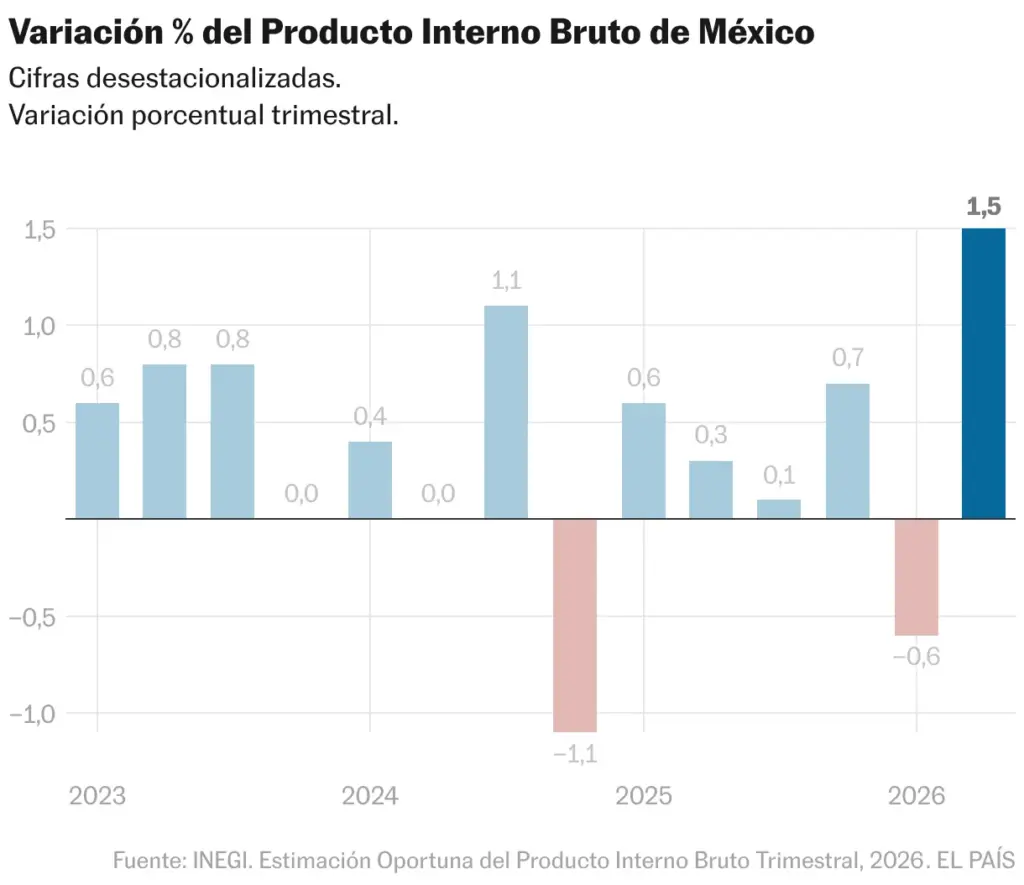
In the breakdown of the quarterly figures, all were positive: primary activities grew by 3.3%; the secondary sector, which includes industry and manufacturing, increased by 1.6%, while tertiary activities (services) rose by 1.5%. On an annual basis, the Mexican GDP reported an increase of 2.1%, according to the Timely Indicator of Economic Activity from Inegi.
Alfredo Coutiño, director for Latin America at Moody’s Analytics, explains that after a disappointing start to the year, Mexico’s economy surprisingly rebounded in the second quarter, entering positive territory and laying the groundwork for better performance for the rest of the year. However, the expert warns that since growth is mainly driven by consumption, economic progress will be limited unless the engine shifts towards investment. “On the demand side, consumption was the main driver, while investment continued to contract in annual terms,” he adds.
The specialist notes that the Mexican economy operated with excess demand, driven by liquidity from government transfers to families, increased spending on social programs, and double-digit increases in the minimum wage. On the investment side, Coutiño points out that Claudia Sheinbaum’s government has been forced to accelerate infrastructure projects and associated contracts. In the country, public investment represents barely around 3% of GDP, while private investment accounts for more than 18%.
The Mexican economy has been on edge this year due to external and internal dark clouds. Mexico still suffers from U.S. sectoral tariffs on cars, steel, and other raw materials, while negotiating with the U.S. government the future of the USMCA, which has added more uncertainty to the environment. Domestically, the Latin American country also faces a slowdown in consumption, public and private investment, and the labor market.
To overcome this uphill battle and with little room in public finances, Sheinbaum’s government has implemented various plans to support investments in line with its government strategy, Plan Mexico. The set of measures ranges from tax incentives to reducing administrative processing times. On the ground, one of the sectors that has reactivated these mixed plans has been the energy sector, specifically with Petróleos Mexicanos (Pemex) and the Federal Electricity Commission (CFE) to complete about twenty energy projects.
After this positive result, it remains to be seen whether the growth forecasts from the Bank of Mexico and multilateral organizations will be revised upward for the rest of 2026. Last July, the International Monetary Fund (IMF) lowered its growth forecast for the Mexican economy this year to 1.2%, down from the previously estimated 1.6%, while the Bank of Mexico places its forecast at 1.1%. On the government side, the Ministry of Finance estimates that Mexico’s GDP will grow between 1.8 and 2.8% this year.
Read more Arrested the alleged arsonist who caused the fire that confined 33,000 neighbors in Anoia