





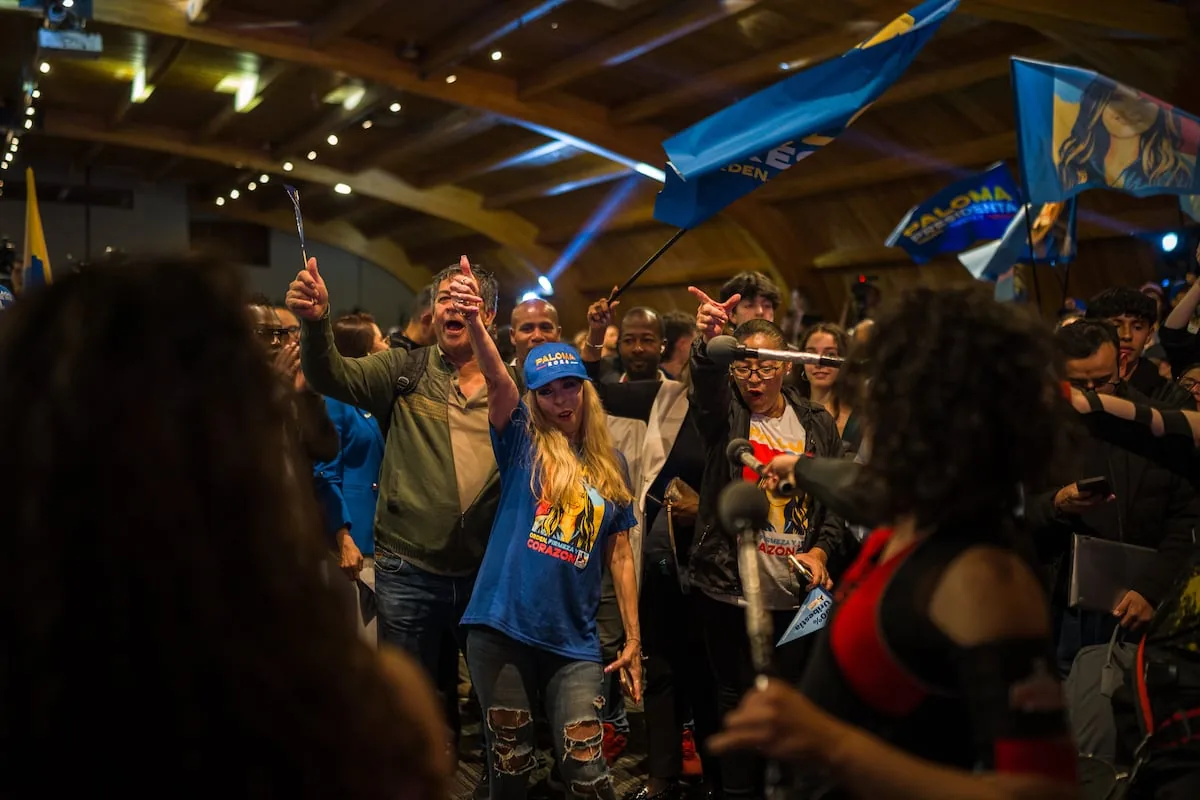
The 2026 presidential campaign could be remembered as one of the most boring in recent decades. After an explosion of pre-candidates with zero chances, most of whom have resigned and whose names no one remembers, and several consultations that put Paloma Valencia, Claudia López, and Roy Barreras on the first-round ballot, the electoral dispute seems to follow a languid path, with no presidential debates, zero groundbreaking proposals, and media campaigns that shake the voters. It has been a campaign subordinated to the confrontation between Álvaro Uribe, the head of the far right, and Gustavo Petro, the leftist president, who feels represented by the leadership of Senator Iván Cepeda Castro.
Read more The Mexico City Prosecutor’s Office arrests a probable suspect in the femicide of Edith Guadalupe
The most extraordinary have been the occasional death threats to the right-wing candidates, Valencia and Abelardo de la Espriella, who received intimidating messages that the Petro Government has taken seriously and have also provoked the angry reaction of the United States Government. In a debate in that country’s Congress, Michael Kozak, from the State Department for Latin America, warned of the “terrible consequences” for those who dare to touch the presidential candidates.
The most serious threat report, however, was made by President Petro himself, through a tweet on X, where he pointed out that the CIA, the United States intelligence agency, already had concrete information about a plan to assassinate candidate Cepeda, who leads the polls for the first round.
This security situation would not be so serious if it were not for the precedent of the assassination of presidential candidate Miguel Uribe, from the Democratic Center, apparently ordered by the Second Marquetalia, a dissident group of the disappeared FARC. Most of the material perpetrators are already in jail, but the intellectual authors remain free.
Colombia has been fertile ground for political assassinations. At the end of the 1980s, it saw four of its national leaders disappear by gunfire: Luis Carlos Galán, Jaime Pardo Leal, Carlos Pizarro Leon-Gómez, and Bernardo Jaramillo. The first of them, a potential president on behalf of the Liberal Party, who confronted Pablo Escobar and was gunned down in Soacha in August 1989, at the request of the mafias by his fellow party member, the liberal Alberto Santofimio Botero. All of them were eliminated by hitmen with the help of corrupt sectors of the State.
What is happening now is a warning bell that the country hears, immersed in the memory of that lost decade in which Colombia saw many of its best leaders die, in a human hunt that included more than five thousand militants of the Patriotic Union, UP, at the hands of the far right and paramilitarism, including Manuel Cepeda, the father of the candidate now leading the polls and also a victim of violence.
These dark clouds of violence over democracy once again reveal the thin line that separates Colombia from barbarism. And it overshadows the fact that presidential debates remain absent from the presidential campaign today. It must be remembered that these media scenarios help define the course of democracy, clarify the outlook, and influence the decision of large segments of voters. Especially the undecided.
This was understood by Petro in the 2022 elections when he went to the media to confront the theses of his then opponents: Federico Gutiérrez, Sergio Fajardo, and Rodolfo Hernández, who, in his role as a millionaire outsider, eventually made it to the second round and lost by nearly a million votes. The debates were then decisive in showing a much more brilliant Petro in his responses, capable of breaking the myths the right had built against him, and connecting with more than eleven million Colombians who made him president.
In 2026, the confrontations of the most favored candidates have not taken place in front of television cameras, with agreed rules and chosen mediators, but in the Senate of the Republic, where Iván Cepeda and Paloma Valencia serve as senators. They have not been in-depth debates that allow glimpsing their programmatic platform, but on current issues. Which, of course, have served for the media to record two opposing models of seeing and understanding the country, on issues such as corruption. One of the latest triggers of that confrontation was the presence in the chamber of Senator Ciro Ramírez from the Democratic Center, Álvaro Uribe’s party, who was sentenced in the first instance to 23 years in prison by the Supreme Court of Justice and insists on attending the Senate as if he were a spotless man.
It was not an anecdote but a transcendental fact because it reflects the enormous sensitivity and hypocrisy regarding corruption, a central theme of the political debate that has marked the left’s struggle for power. “You are an affront, Mr. Ramírez, to this country. You are a disgrace to this country. You are a disgrace to this Congress,” Cepeda told Ramírez, who was defended by Paloma Valencia.
The issue of corruption has been exploited this time by the right due to scandals involving corrupt actors in the Petro Government, especially the UNGRD case, which the president himself denounced and has several of his initial allies in jail.
The question is, when will the televised and radio debates of the most favored candidates take place? The political country misses the confrontation of ideas. There is a widespread perception that the campaign is moving in slow motion, stripped of passion, as if the protagonists were reserving all their artillery and resources for the second round. Debates are a huge opportunity being wasted, also violating the voters’ right to know what the candidates think.
De la Espriella has stated that he will only attend debates if Cepeda is present; Paloma needs them to position herself beyond the shadow of her ideological “father.” But Cepeda has focused on public square calls, leaving aside, for now, confrontation with his contenders. His political advisors seem entrenched in the idea that in the public square they would have more electoral returns and greater chances of winning in the first round. However, the polls do not show that possibility today.
If Cepeda does not open the door to debates now, perhaps in 45 days the scenario will be different. In politics, every day is different. Cepeda has nothing to lose and much to gain. He leads the opinion polls, has ideological solidity, parliamentary experience, cold blood to withstand attacks, and passion to defend his proposals. Going to the front of the media battle means opening the gates for millions of voters who have only heard about him but perhaps have not listened to or observed him in such a setting. It is also an opportunity to amplify his ideas, increase his electorate, and consolidate his narrative that he has the authenticity necessary to seduce those who remain undecided today. And above all, that he is not only Petro’s candidate but capable of maintaining his legacy.
The country needs to hear from the candidates, beyond petrism or anti-petrism, their proposals on the new world order, deepening social reforms, consolidating democracy, overcoming the armed conflict, and fighting corruption, among many topics.
Debates are urgent, with clear rules of the game, without insults or offenses, limited to the strongest names, which would bring life to the campaign, add excitement, and show the country the real capacities of the contenders. And, of course, it would also take the campaign out of the lagoon of the therian, the tigers and the doves, the hippos and the pink dolphins, putting things in their place so that millions of voters take sides and Colombia chooses in peace.
Read more Personalized piggy banks: the communion gift that never fails