







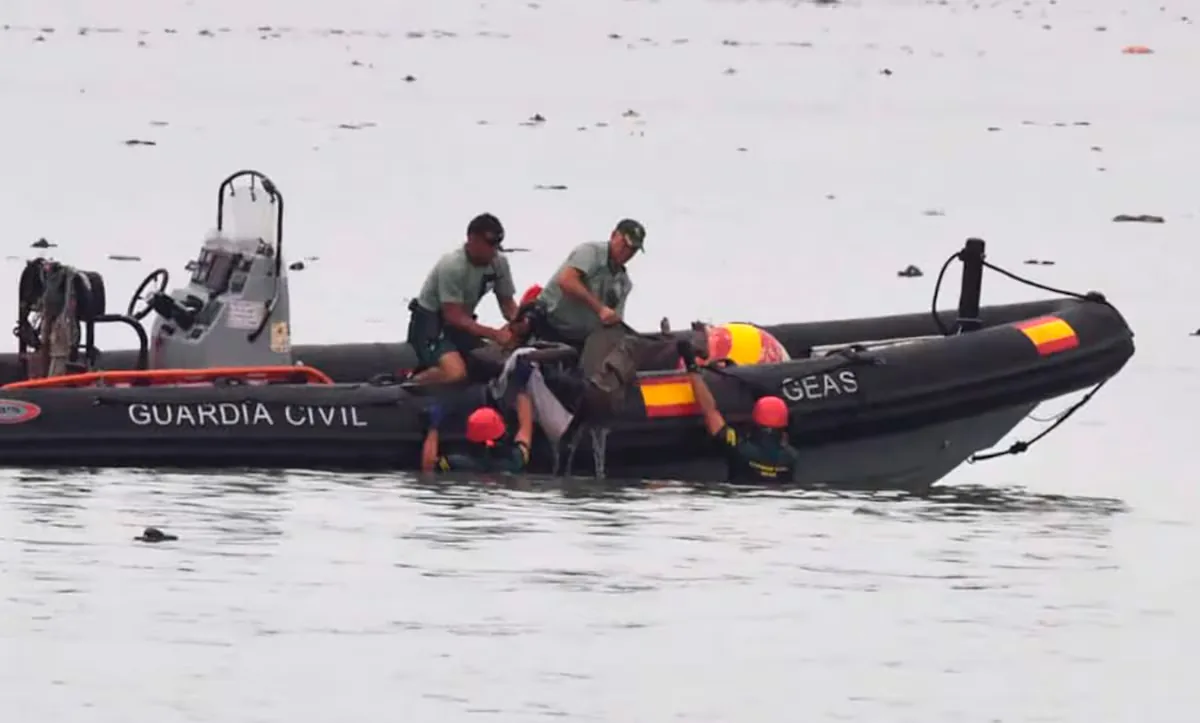
Shortly before eight in the evening last Thursday, security forces had already found the bodies of nine migrants who had drowned near the coast while trying to reach Ceuta by swimming around the border breakwater of El Tarajal. A dramatic count began that added new deaths in the following hours until reaching 18 just minutes before midnight. Throughout this Friday, the number has continuously grown over the hours, reaching, shortly after 4:30 p.m., 57 dead, a number that makes what happened this week in the autonomous city one of the deadliest incidents at a Spanish border in recent history.
Read more Boca eliminated O’Higgins, who had their dreams limited
Behind is the event of February 6, 2014, at this same point in Ceuta, in which 14 people died who were also trying to enter by swimming. More recently, on June 24, 2022, there was the jump over the fence in Melilla of around 2,000 migrants that ended in tragedy after Moroccan police forces tried to disperse them brutally to prevent them from crossing the border into Spain. Moroccan authorities then officially acknowledged the death of 23 people. Amnesty International raised this figure to 37 dead and added 77 missing. An investigation by EL PAÍS with other European media also pointed out that the real number of deaths could have been much higher than admitted by Rabat.
The circumstances in which the tragedy in Ceuta has now occurred are very different from those two events. First, because of the origin of the victims. Both in 2014 and 2022, most of those who tried to enter Spain illegally were sub-Saharan Africans. Now the protagonists have been practically entirely Moroccans ―mostly young men, although there were also women, children, and families― from towns near the Spanish city, many from the bordering Fnideq (the former Castillejos). Also, the number has now been much higher. From around 250 in 2014 and just over two thousand in 2022 to the tens of thousands this Thursday, of which 50,000 reached their goal, according to the estimate given this Friday by the Ministry of the Interior.
The attitude of Moroccan security forces in each case has also been very different. In 2014 in Ceuta, the official version stated that migrants allegedly attacked Moroccan soldiers trying to prevent them from reaching the border with Spain with sticks and stones and that when they entered the water to swim around the breakwater, Civil Guard agents fired rubber bullets to prevent them from reaching the coast. In Melilla, Moroccan agents charged against the migrants and used tear gas, which caused the victims to crowd into a dead-end area such as the Barrio Chino border post, and the victims died from crushing in the stampede. Those who managed to cross the fence were detained by the Civil Guard, which used riot control equipment for this purpose.
On this occasion, however, the police sources consulted highlight that Moroccan security forces have had a passive attitude that allowed thousands and thousands of people to approach the beach without opposition up to the breakwater that marks the boundary between the two countries to try to go around it. The response of the Spanish police was also passive, but in that case due to the change in the legal framework. In 2014, the 23 migrants who reached the coast were immediately taken to the Moroccan side of the border on the grounds that the forces of that country were claiming them.
In Melilla, Spanish security forces carried out 470 border rejections, colloquially known as hot returns, supported by the citizen security law or gag law approved by the PP precisely one year after the El Tarajal events. Now, however, the National Police and Civil Guard have not been able to apply this measure because three weeks ago the Supreme Court interpreted that law and determined that the provision allowing border returns in Ceuta and Melilla was not applicable to those intercepted at sea trying to enter by swimming.
What has been consistent in the three events is that political representatives have had or will have to give explanations of what happened. Thus, regarding what happened in 2014 at El Tarajal, the then Minister of the Interior, Jorge Fernández Díaz, currently awaiting sentencing for the Kitchen case, appeared before Congress to defend the actions of the Spanish agents. Despite this, 16 Civil Guards were charged for firing rubber bullets and smoke grenades, although the case was ultimately dismissed.
In 2022, it was Fernando Grande-Marlaska’s turn to give explanations. In this case, the Prosecutor’s Office also opened an investigation but closed it six months later after finding no evidence of wrongdoing by the Spanish security forces on that day. The Moroccan prosecutor’s office did the same regarding what happened on its territory, finding “no evidence of crime.” Now the PP has already requested the urgent appearance in Congress of President Pedro Sánchez to give explanations for what they call a “late” and “insufficient” response to an “unprecedented avalanche.”
Read more ONCE Big Coupon: check the draw for Friday, July 31