








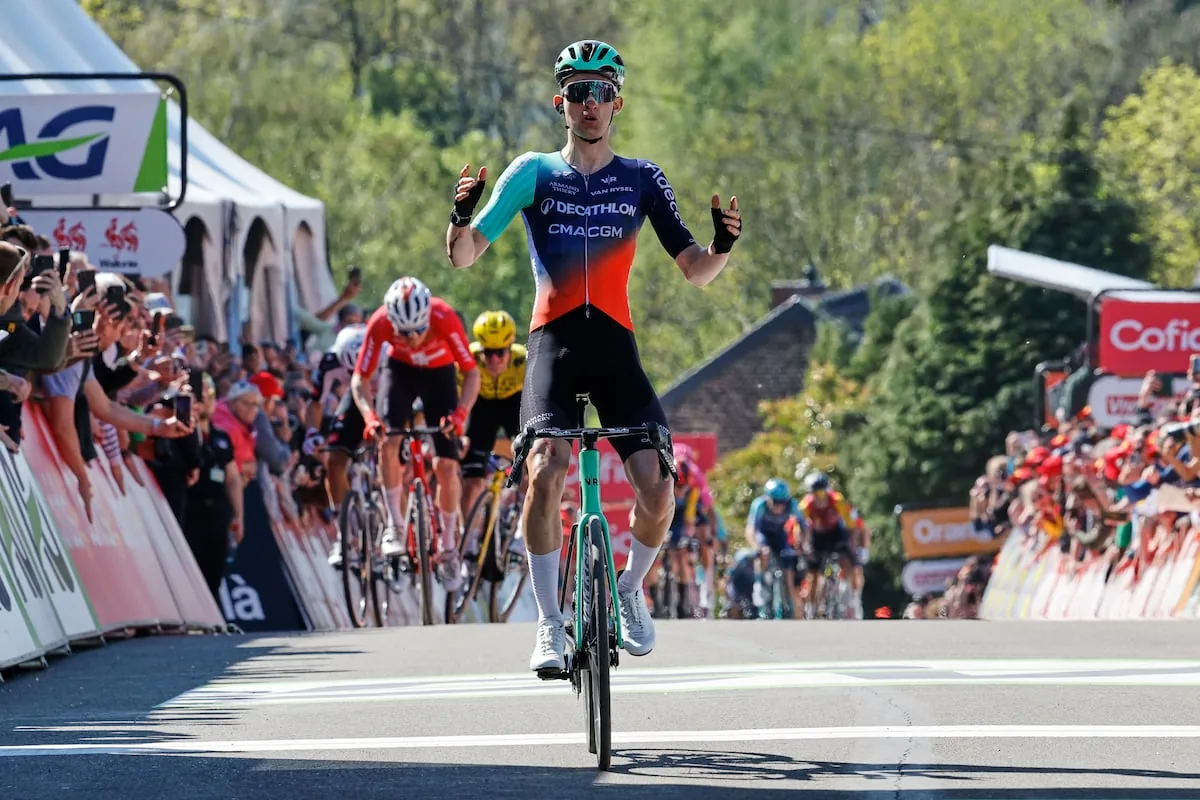
In the process of purification, of reducing a race to an instant, the San Remo boasts its final five kilometers, up and down the Poggio, straight and curved on the flat, Via Roma, but the Flèche Wallonne, beats the Italian Monument by a landslide: it’s 200 kilometers of course and 400 meters of race, the last two bends of the Mur de Huy, left, right, and the flight of Paul Seixas, his spring in a state of grace.
Read more Zelensky awards Margarita Robles “for the support and commitment” of the Government with Ukraine
Watching Seixas win the Flèche Wallonne, in the lead from before the Criquielion bend, 27% on the inside, 23% on the outside, Tadej Pogacar in front of the TV could have started singing My generation and no one would have been surprised. His generation is the same as Seixas’. Childlike curls, adolescent complexion. Child’s laugh. Killer’s gaze, and his precision. He is the youngest winner in history, just as two weeks ago he was the youngest winner of the Itzulia. He is 19 years old, has a younger brother nine years his junior, but marked by the same spirit as the Slovenian, the “I hope to die before I get old,” the impatience to succeed, which distinguishes all the champions of the decade, his generation. Seixas, a Portuguese surname from the Raia, returns to Portugal to compete in the Algarve with others of the Pogacar generation – Ayuso, Almeida, the same ambition – and says he doesn’t even remember that his great-grandparents left Guarda, nor does he care. He lives in the future. The present flies. Like the inhabitants of the Greek villages that the writer Pierre Bayard visits following in Oedipus’ footsteps, today’s cyclists “are not aware of the legacy they hold, as if it had been lost over the generations, and the most important names of legend, even those that mean something, no longer evoke any tangible reality for them.”
Neither does the style, the habits. Seixas is not a Valverde, he doesn’t have the dynamite and the change of pace on short climbs, of three minutes, with percentages above 10%, that made the Murcian seem invincible if he hadn’t been dropped before the last 200 meters of the Camino de las Capillas, the straight section of the Mur de Huy. Valverde won five times, four times consecutively, and imposed the speed of a short-distance sprinter, colossal watts as a physical axiom. The Valverde method. When Pogacar arrived, winner in Huy in 2023 and 2025, the dogma cracked. A super-class, too, with resistant strength and speed, like 800-meter athletes, could look back in the last meters of the Flèche and see only emptiness and, blurred by the distance, the agonizing faces of those dying on the climb chasing him. The Slovenian never waited for the last 200 meters to change abruptly and pull away. That effort is not within his reach, but imposing a very high speed earlier and maintaining it is, while everyone else gives in, as those who tried to follow Seixas did this 2026, the only one who can race à la Pogacar and not make a fool of himself. “I knew I had to set the pace at the front, but then, honestly, I let myself be carried away by my feelings, by instinct,” Seixas explains at the finish line. “I tried to manage my effort. I looked at the signs a bit to see how many hundreds of meters I was from the finish and I saw that everyone was a bit blocked, so I made the maximum effort. I assessed my rivals a bit. And when I saw that they were falling back a bit, at 300 meters, I told myself I had to go all out to the top.”
Read more Germany avoids speculating about the merger between Deutsche Telekom and T-Mobile
“It’s incredible. It’s a huge victory. I tell myself that, just a year ago, I was watching it on TV. And this year, I come and, in my first participation, I win,” says Seixas, feigning surprise, as if he hadn’t spent the whole winter preparing for that climb with specific training or repeating very intense three-minute efforts on climbs in the Itzulia. And perhaps he doesn’t want to deceive anyone, because as they say in his team, Decathlon, which will soon win the Tour with him. “We’ve known him since he was a child, we know his characteristics perfectly, but seeing how he evolves week after week it’s difficult to draw conclusions,” in the words to L’Équipe of the French team’s performance manager, Jean Baptiste Quiclet.
Seixas races à la Pogacar and in last October’s European Championships and in the Strade Bianche, a month and a half ago, he raced alongside Pogacar, close to him, against him. Third in the Europeans, second in the Strade. Cycling fans, those to whom the legends of the past still whisper in their ears, and always tell them something, are already salivating at the thought of what’s coming on Sunday, the Liège that Remco Evenepoel was waiting for to measure himself against Pogacar, and that now awaits Seixas to stage the great generational battle in a trio. “It’s going to be another story, as they say, but what is certain is that I’m going to fight to give my best and today it was clear that I’m in good shape,” promises Seixas, who will not grow old. “I don’t want to wait for Pogacar to drop his level to defeat him. My goal is to beat him when he’s still at his peak.”