






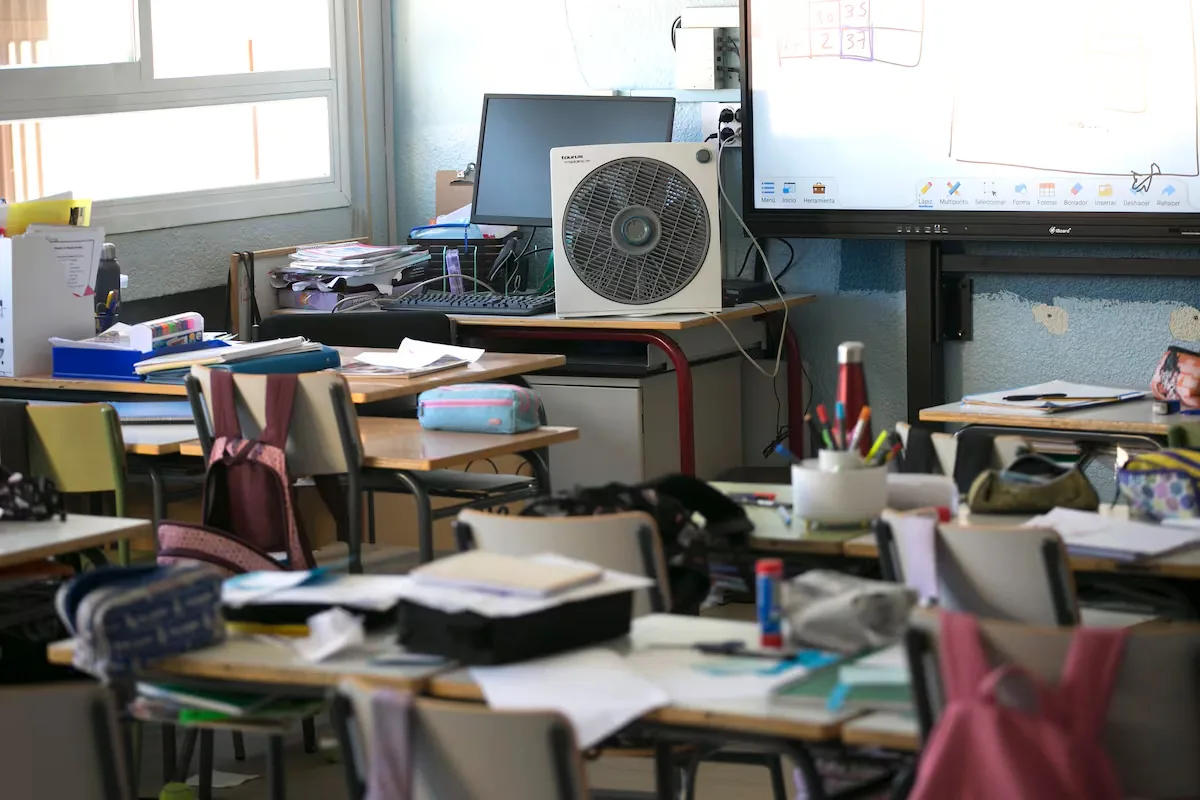
In the educational sphere, no one has found it amusing. The words of Mariano de Paco, Minister of Culture of the Community of Madrid, defining this Thursday as a “source of inspiration” enduring the heat experienced these days in Madrid classrooms, have generated a flood of responses from parents, teachers, and students who are struggling to get through the last days of the school year. The day before, the Minister of Health, Mercedes Zarzalejo, had already warned. “When it’s hot, it’s hot,” Zarzalejo merely said in response to complaints from the school community about the lack of air conditioning in the centers. Now, everyone in class has gone from stupor to indignation, and from there to pure and simple anger over words that De Paco uttered, dressed in a suit and tie, from the air-conditioned building of the Madrid Assembly.
It’s no longer just, teachers and parents explain, that schools and institutes don’t have air conditioning: the buildings also lack thermal insulation. In many cases, they don’t even have fans. “Those statements are outrageous. With this heat, students lose concentration. They are constantly thinking about going to the bathroom to cool down. Even if you let them have a bottle of water, it either gets warm or runs out, and they ask for more. It’s no way to teach,” says professor José Rodríguez, who has been teaching for 40 years at a private school in Madrid.
Given the attitude of the politicians of Isabel Díaz Ayuso’s regional government, the Federation of Student Parents’ Associations, the Association of Directors of Public Institutes of Madrid, and Madrid teachers denounce the attitude of the Minister of Culture and demand that measures be taken. “The law states that you cannot work above 27 degrees,” explains Sandra Valiente, director of CEIP Nuestra Señora de la Paloma.
To demonstrate that students are studying in conditions that are endangering their health, the Francisco Giner de los Ríos Federation of Student Parents’ Associations (FAPA) has launched, once again, a campaign for the air conditioning of educational centers with the slogan #HowHotIsYourCenter #BecauseTheyDoNothing. “We are distributing weather stations to parent associations to record temperatures, upload them to the federation’s website, and file a complaint with the Ombudsman.”
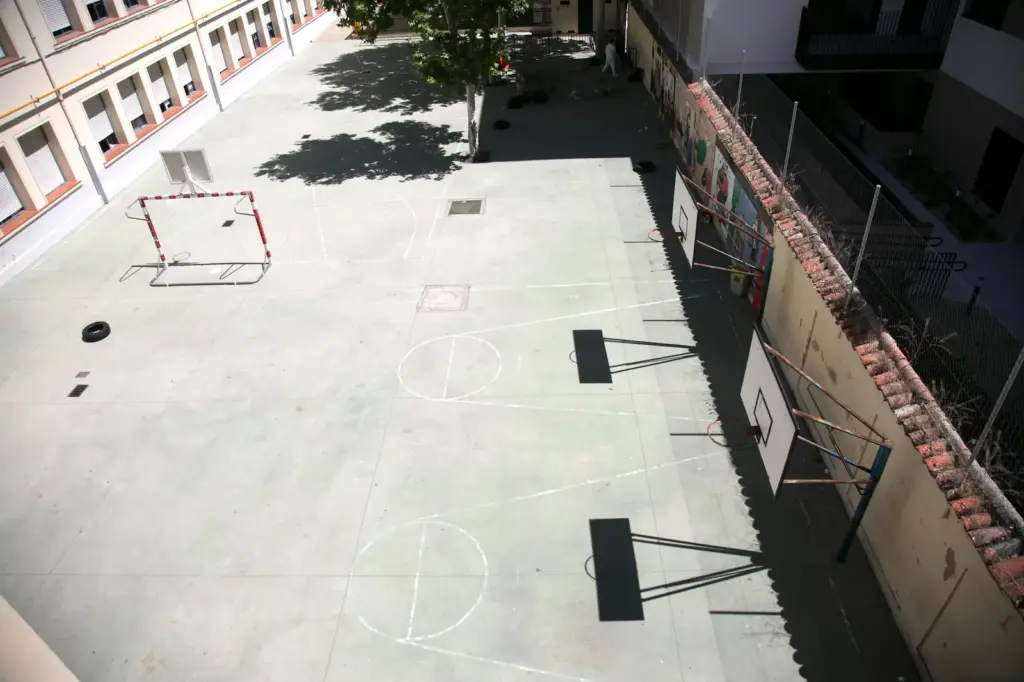
Last year, the Popular Party and Vox voted against the popular legislative initiative brought to the Madrid Assembly to air-condition classrooms. Driven by FAPA, the trade unions Comisiones Obreras and UGT, in addition to the Regional Federation of Neighborhood Associations of Madrid, had collected 72,000 signatures, exceeding the 50,000 required. It didn’t matter. “Given the statements of the Minister of Culture claiming that heat is inspiring, we can only respond that you can’t get blood from a stone. These are deeply unfortunate statements at a time when the high temperatures recorded in numerous educational centers in Madrid are putting the health of children and young people at risk,” denounces María Carmen Morillas, president of the association.
Valiente denounces that the measures against high temperatures in Madrid’s public schools are being applied “at zero cost” and without real solutions for students and workers. In her school, a building over 100 years old, she assures that the problem affects both cold and heat due to the lack of insulation, the age of the windows, and the absence of thermal conditioning. “We are the only public buildings that still lack conditioning,” she laments. The director also judges De Paco’s words, who reduced the solution to a matter of students wearing short sleeves to school: “It’s an insult. We are on the verge of fainting and collapsing.” As she explains, one of the most extreme situations occurs in the school cafeteria, where more than 400 students eat in two shifts between 1:00 PM and 3:00 PM. “With the kitchen running, we are at 42 degrees. It doesn’t matter if you wear shorts.” Given the lack of resources, the center improvises with water sprayers, watering patios, fans, and constant breaks to hydrate the children and force them to stay in shaded areas. “After ten minutes, they are soaked with heat again,” she summarizes.
Read more The massacre of eight young people devastates an entire city in Ecuador
The president of the Association of Directors of Public Institutes of Madrid (Adimad), Rosa Rocha, is utterly tired of the use of sarcasm to downplay the heat in classrooms. The minister’s words in the Assembly “are out of place,” she believes. “It’s outrageous, but it’s the Community’s line. They talk about things they don’t know and express opinions lightly. Since they don’t suffer from it, they must find it very amusing that we complain. They want to pull our leg or laugh at us,” she comments by phone a few hours after the controversial phrase. Rocha is a director at a center with 1,000 students and has seen how heat has gone from being a concern for a couple of weeks in June to “a structural problem” that, for some years now, starts in May and surprises them upon returning from summer. Most schools and institutes have aged and have not adapted, beyond specific improvements. “They are patches. If we talk about air conditioning, that’s a big deal. The comments are already annoying to me. I don’t understand it, I don’t know if they don’t see it as a problem or what’s happening,” she adds.
Teachers share the same opinion as the directors. Secondary school teacher Silvia Casado Arenas denounces that the lack of measures against heat in classrooms, in her opinion, evidences a policy that does not address the real needs of Madrid residents: “They do not govern for the people of Madrid, they govern for an elite,” she states. She criticizes that, despite repeated requests from unions, no specific plan against high temperatures —with measures such as awnings, trees, or fans— has been implemented, and warns that in many classes, temperatures have exceeded 30 degrees during exam season, which prevents normal educational activity. “The students’ right to receive an education is being violated,” she asserts, after recounting situations of dizziness and difficulties during tests like the PAU. She also recalls that the Labor Inspectorate already required a plan from the Administration last academic year and regrets that the Community of Madrid, in her opinion, remains behind other regions. “No one imagines teaching in January without heating; this is exactly the same,” she concludes, demanding institutional empathy and warning of the risk to students and teachers if action is not taken.
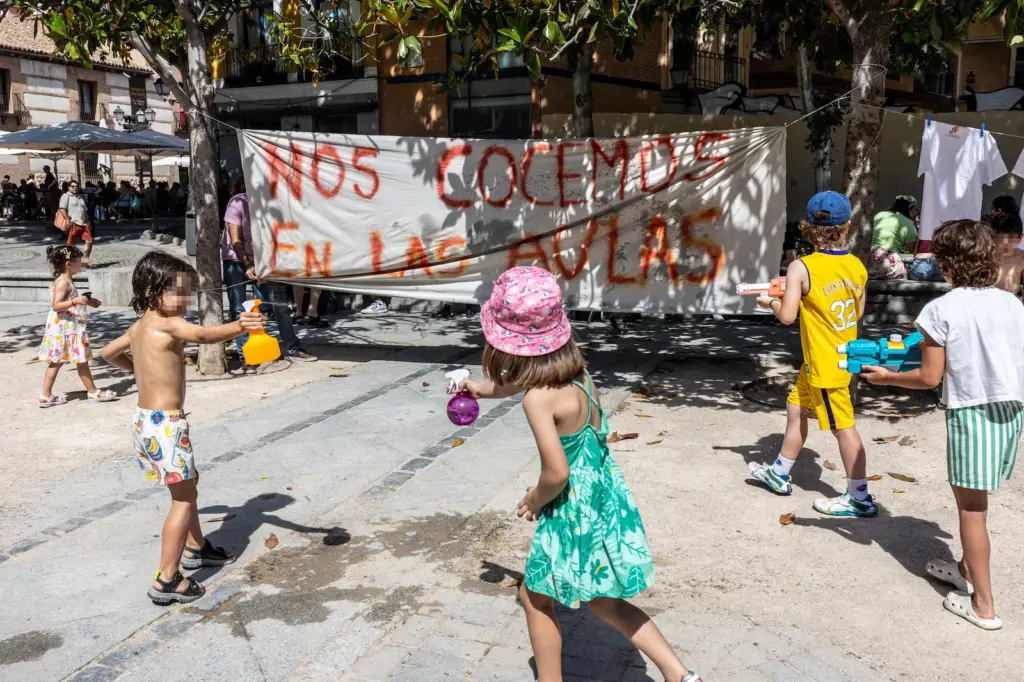
For Isabel Galvín, a professor at the Complutense University, the Ayuso government “has started to lose this issue and knows it,” and criticizes its reliance on arguments that, in her opinion, demonstrate a lack of response to a real problem. She states that high temperatures in classrooms are not an anecdotal or “inspiring” matter, but a public health problem, as temperatures have exceeded 30 degrees in most centers, with peaks of up to 34 and 35 degrees, causing dizziness, headaches, fainting, and attention difficulties. “At that temperature, the body suffers, the mind suffers, and mental health suffers,” she warns, emphasizing that minors are especially vulnerable. Galvín also denounces that, while educational centers lack air conditioning, the institutions and offices of the government itself are conditioned, and recalls that since 2017 there have been resolutions from the Labor Inspectorate urging action. “It is not a matter for whims or partisan struggle; it is about guaranteeing the right to education,” she concludes, noting that the problem worsens every year due to the advance of climate change.
Given all this, the only response from the Ministry of Education of the Community of Madrid is to refer to the Action Plan for High Temperature Episodes 2026, which includes recommendations for educational centers such as adapting the school schedule to meteorological conditions, reorganizing physical activities to avoid intense exercise during the central hours of the day, and taking extreme precautions during breaks in the playground. The regional government assures that it has allocated a total of 17.8 million euros for the 2025-2026 academic year to improve air conditioning and reduce the effects of high temperatures in public centers in the region, representing a 33% increase compared to the previous academic year.
Read more The ghost of U.S. intervention haunts Mexico, Brazil, and Colombia