





Costa Rica is a country of peace. This is stated in its national anthem, taught in its classrooms, and projected in all international forums. The Central American nation—which abolished its armed forces in 1948—elevated this ideal to a state principle in 1983 with the proclamation of “Perpetual, Active, and Non-Armed Neutrality.” However, in recent months the country has taken an unprecedented diplomatic turn that calls this foundation into question.
The National Security Council of the Costa Rican Government declared several actors involved in the current conflict in the Middle East as terrorist groups on April 6, including Hamas, Hezbollah, the Houthis, and the Islamic Revolutionary Guard Corps of Iran. According to the official statement, the decision was made “in accordance with the country’s international principles in the fight against terrorism,” a move that closely aligns the Central Americans with the United States’ security strategy.
This decision by the outgoing government of Rodrigo Chaves is not an isolated event. For Carlos Torres, an international politics analyst and professor at the National University of Costa Rica (UNA), the “myth” of perpetual neutrality “died” in 2022, when Costa Rica showed its explicit support for Ukraine in the face of the Russian invasion.
For the expert, there is a clear contrast when comparing that stance with the caution Costa Rica maintained for more than two years regarding Israel’s invasion of Gaza. “While the country advocates for a conflict resolved peacefully, it never declares Israel as an aggressor country, but rather subtly hides it under the discourse of the free determination of peoples,” he explains.
After Israel’s response to Hamas attacks on October 7, 2023, Costa Rica and Israel suspended negotiations on a Free Trade Agreement through which the Central Americans sought to attract investment in technology. However, in December 2025, both countries signed the treaty, which now only needs to be ratified by the Legislative Assembly, which from May 1 will have a pro-government majority.
This strengthened commercial relationship with Israel and the fact that the United States is Costa Rica’s main trading partner (50% of Costa Rican exports go to the North American country) are, for Torres, the explanation for the shift “from international idealism to commercial pragmatism” and why Costa Rica condemns terrorist groups but “says nothing about the attacks by the United States and Israel against Iran.”
The office of the Costa Rican Foreign Minister, Arnoldo André—who is not part of the National Security Council, although he is responsible for communicating its decisions diplomatically—denied through a letter sent to EL PAÍS that the designation of terrorist groups puts the nation’s neutrality at risk. The Foreign Ministry explained that the decision fits within a “modern conception of neutrality” and clarified that the designation does not constitute “taking a position in an armed conflict nor a form of intervention in hostilities.” It is, they said, a legitimate exercise to “prevent the financing of terrorism and protect public order.”
For the government, Costa Rican neutrality should not imply “inaction in the face of phenomena that compromise international peace and security.” The letter emphasizes that the decision is consistent with the country’s pacifist tradition and argues that protecting citizens from “asymmetric threats” is an “obligation that the state must actively address within the framework of international law.”
Support for operations in America
Alongside its stance on conflicts in other continents, the government has also shown sympathy for the agenda that the United States has advanced in the American continent. The clearest nod to Washington was the closure of the Costa Rican embassy in Cuba on March 18, amid the humanitarian crisis the island is experiencing.
Carlos Murillo, professor of International Relations at the National University of Costa Rica (UNA), states that the executive closed that embassy to “curry favor” with the United States without “any evidence that Washington asked Costa Rica to break diplomatic relations with Cuba.” “Doing this is to disregard the management of foreign policy because questioning the Castro regime does not mean abandoning the Cuban people,” says the analyst.
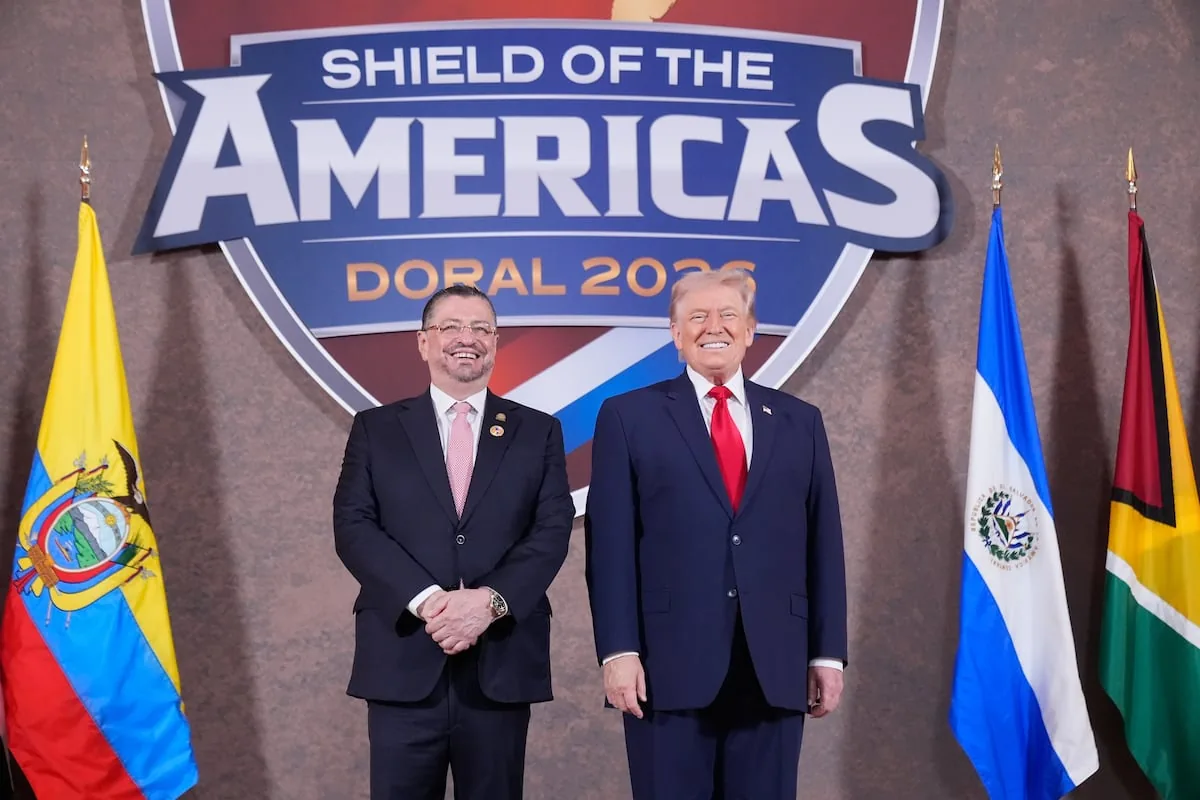
The decision by Costa Rica also came just days after the government of Daniel Noboa in Ecuador, another ally of President Donald Trump in the region, expelled the Cuban ambassador from Quito. All this happened in March, coinciding with the declaration of Donald Trump’s Shield of the Americas, the anti-narcotics alliance for which the U.S. president called on his regional allies, including, besides Chaves and Noboa, other Latin American leaders such as Nayib Bukele and Javier Milei.
Costa Rica subscribed to the Shield of the Americas with the particularity that it is the only country in the alliance without an army. Although the Minister of Public Security, Mario Zamora, has defended in various media statements that it is not a military agreement, the Constitutional Chamber is already processing amparo appeals filed by citizens questioning the legality of this adhesion.
“Call it an alliance or whatever you want, the truth is that it is a manifestation of the Costa Rican government in favor of the militarization of the fight against organized crime and represents a narrative that is clearly militaristic and has never been part of the language of Costa Rican presidents,” explains analyst Murillo.
At the end of last year, with opposition votes, Congress approved the entry of 195 vessels of the U.S. Coast Guard to carry out operations against drug trafficking. In March, U.S. forces attacked an alleged drug-running boat in Costa Rican waters—as has also happened in Colombia—that resulted in the death of two of its crew members, both Ecuadorians, and the handing over of a third Colombian crew member to Costa Rican authorities.
According to Carlos Murillo, Costa Rica established neutrality as a “state policy and not as a decision of governments in office” and this remained firm except when President Abel Pacheco decided to support the U.S. invasion of Iraq in 2003, but he ultimately had to retract by order of the Constitutional Chamber.
“It is a state decision that has been reaffirmed government after government until 2022, with the arrival of Rodrigo Chaves, who begins to distance himself from those principles,” comments Murillo.
Hugo Vargas, historian at the University of Costa Rica specializing in Central America, considers that beyond recent events, the concept of neutrality must be “put into perspective.” “In contemporary history, Costa Rica has not been neutral but has always had a stance very identified with the interests of the United States and there has never been a questioning of U.S. foreign policy,” the academic maintains.
The historian points out that in the 1980s, with almost all of Central America immersed in conflicts, the United States pressured Costa Rica because it wanted military bases to be able to “contain” Nicaragua, which led the government at the time to declare itself neutral. “President Luis Alberto Monge did this mainly as a response to the bellicose policies of that time, but not as a hostile attitude towards the United States,” adds the historian.
“Uncritical” follower of Washington
Vargas opines that Costa Rica has become an “uncritical follower” of all U.S. policy, even overlooking “aspects that violate human rights such as bringing migrants into the country against their will,” says the historian referring to the memorandum signed by both countries, in which Costa Rica committed to continue receiving migrants from third countries deported from U.S. territory.
Torres, for his part, believes that Costa Rican authorities act guided by “pragmatism” in order not to jeopardize strategic sectors of Costa Rica’s economy, such as the development of medical devices.
The analyst thus explains the “strategic silences” on issues that could strain the relationship with Washington, such as the case of Randall Gamboa, a Costa Rican deported in a vegetative state from a migrant detention center in Texas who died a few weeks after his return to Costa Rica.
Read more Looking for good delicatessens and cheese shops? These six places are a must-visit