









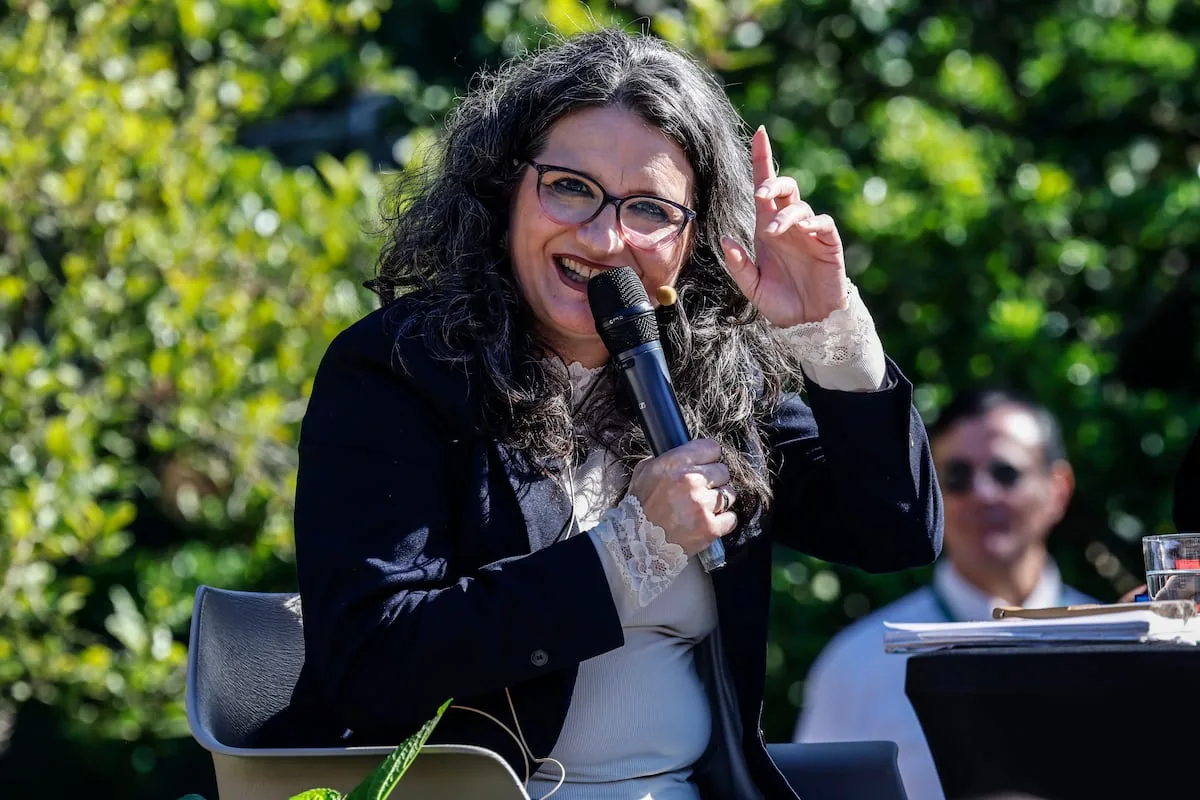
“Composed,” “balanced,” without the anxiety attacks she used to have before accepting “the challenge” of leading her party, Compromís, in the mayoral race of Valencia. This is how Mónica Oltra says she feels in an interview this Saturday, three weeks after announcing her return to active politics, despite the Valencia Court ordering the opening of a trial for the alleged cover-up of sexual abuse by her ex-husband of a minor, committed between 2016 and 2017 (for which he is serving a five-year prison sentence), when she was the Minister of Social Inclusion. The former Valencian vice president and 12 of her collaborators at the Generalitat at that time will face trial.
Read more French actress Nathalie Baye dies at 77 years old
“Do you believe you are a victim of lawfare [judicial persecution]?” I asked her, journalist Julia Otero from Onda Cero, in the first interview Oltra has given since resigning from all her political positions four years ago. “Not only do I believe it, all of Spain believes it, even those who practice it against me,” she replied. “But not the court,” the journalist countered, referring to the order given by the fourth section of this body to the investigating court to open a trial, despite the judge having dismissed the case three times for lack of evidence, with the support of the prosecutor. “The Court knows it too. That’s why they say, well, regardless of what happens in the trial, these people have the right to accuse. This is a contradiction. There is not a single piece of evidence. The evidence they present is defensive. It’s nonsense that will be studied in law schools.”
The journalist referred to voices linking the judicial persecution with the reversal of the privatization of public healthcare [initiated by the former socialist Minister of Health, before being appointed minister of the department, Carmen Montón]. And Oltra recalls that there were many economic interests, also in the social services under her responsibility, whose public management she defended. She mentioned the “famous photo” she showed in Les Corts where the CEO of Ribera Salud, Alberto de Rosa, the “lady who filed a complaint” against her, Cristina Seguí (who was a founder of Vox in Valencia), and the former president of the Generalitat, Francisco Camps (the main target of Oltra’s criticism in the opposition), were seen talking at a station. “Obviously, they were not talking about the weather,” commented the 56-year-old Valencian politician.
Oltra indicated that her departure from the Consell was “a forced resignation,” because otherwise, the so-called left-wing “Botànic government” would have “broken.” In this regard, she recalled that the socialist president Ximo Puig had publicly suggested her resignation or dismissal. “I make the decision out of responsibility. In sin lies penance,” she added. And about the attitude of some party colleagues who did not support her, she said: “They didn’t know how to hold on at a time when you had to tough it out.”
Now, the trial (for which no date has yet been set) could coincide with the electoral campaign or even put her on the bench “while being mayor,” if she wins. “It’s taking a long time. The goal was to put me on the bench,” she stated. But the right and far-right could not get their way, she argues. “They are bothered by emancipatory policies and if I gave in, they would have won. That was the driving force,” she added in the interview. She expressed support for the left-wing convergence project of the PSOE, although her focus is Valencia, the local politics she knows. She already rejected a proposal to run for the European Parliament, she added.
The interview given to Julia Otero this Saturday is part of Oltra’s process of returning to political activity while keeping her law office open, which provides for her and her family (she has two children). Sources close to her emphasize that the return will be gradual, precisely because she needs to keep working and, in addition, she continues studying and preparing mediation topics.
Oltra announced her return on March 28, at the congress of her party, Iniciativa del Poble Valencià (IPC), which is part of the Compromís coalition. The announcement generated numerous reactions. It was very well received especially by parties to the left of the PSOE, who immediately showed willingness to join her candidacy. The socialists also welcomed her return. The PP and Vox, on the contrary, attacked the leader who has shown she still has political capital on the Valencian left.
After the announcement, Oltra did not participate in any public event until last Thursday, when the former Valencian vice president took part in a meeting with the Minister of Youth and Childhood, Sira Rego, the Podemos leader and MEP, Irene Montero, and the First Lady of Brazil, Janja Lula da Silva. The event sought to mark a firm position rejecting wars and political violence suffered by women and, in this sense, she also denounced judicial persecution.
Read more Sánchez advocates for progressive unity against Trump: “Democracy must not be taken for granted”