









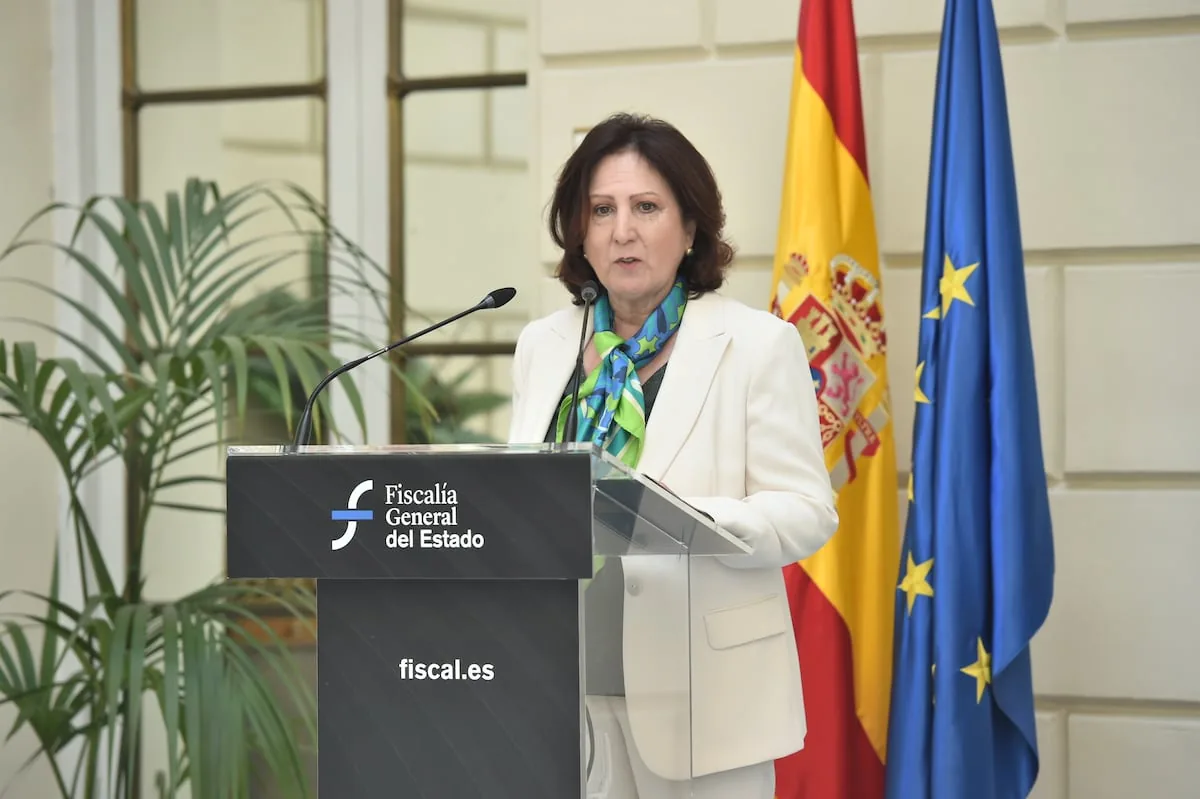
The new Attorney General of the State, Teresa Peramato, completed last Thursday an internal renewal process that has provoked harsh criticism from those who believe that with this round of discretionary appointments she has purged the detractors of her immediate predecessor, Álvaro García Ortiz. The Progressive Union of Prosecutors (UPF) has reacted by denouncing a campaign of “systematic delegitimization,” far from what they believe should be criticisms formulated “with rigor, respect, and institutional loyalty.”
Read more Minor arrested for the violent death of a man in downtown Barcelona
It was on February 27 when Peramato made her first discretionary appointments at the top of the Prosecutor’s Office. At that time, she chose to promote former members of García Ortiz’s team, such as Ana García León or Diego Villafañe, to the detriment, for example, of the procés prosecutors Consuelo Madrigal and Jaime Moreno. In this way, a process of renewal of the Technical Secretariat began, the engine room of the Attorney General’s Office where people of the utmost trust of the institution’s leader usually end up. The change culminated last Thursday, with a new batch of appointments that positioned Isabel Martín, coming from the Technical Secretariat, as head of the Madrid Superior Prosecutor’s Office, a position held for five years by Almudena Lastra, who was seeking renewal. At the same time, Peramato rejected consolidating Julián Salto as a prosecutor of the National Court; promoted Pilar Rodríguez, head of the Madrid Provincial Prosecutor’s Office, to the Supreme Court; and placed Pilar Fernández, García Ortiz’s wife, as lieutenant of the Superior Prosecutor’s Office of Galicia.
The Prosecutors’ Association (AF) ―the majority in the prosecutorial career― interpreted these moves by Peramato as an “evacuation plan” to “orderly and quickly remove people from a risky place to a safe point” in order to favor “those who were part of García Ortiz’s closest circle of trust.” The AF focused on Lastra, whose professional performance they say “could not be subject to any reproach.” “But she had the audacity to contradict the official doctrine (…), her testimony being one of the evidentiary elements” against García Ortiz. Of Rodríguez, who was charged along with the then Attorney General but was exonerated at the doorstep of the trial by the Supreme Court itself, the AF pointed out that her great merit is being in “absolute harmony” with her former boss because she lacks “previous experience” to land in the social section of the Supreme Prosecutor’s Office. From the PP, they spoke directly of “internal purges after the conviction” of García Ortiz.
UPF responds that, although “criticism is inherent to any democratic institution,” “it must be formulated with rigor, respect, and institutional loyalty.” “Systematic delegitimization, interested simplification, or projection of suspicions on decisions made in accordance with the law do not strengthen the independence of the Public Prosecutor’s Office, but rather compromise it,” it warned in a statement.
For the progressive association, the “assessments” heard, “beyond legitimate disagreement, project a distorted image of the appointment processes in the Public Prosecutor’s Office,” which it assures “are governed by the principles of merit and ability and are carried out in full compliance with the law.” Therefore, it maintains that “their overall disqualification, through terms such as ‘purges’ or arbitrary decisions, not only lacks foundation but directly affects the prestige of the institution and the professional consideration of those who make it up.”
Read more Rosalía: “In life, you have to have wit and a sense of humor”
“All candidates have sufficient merits”
The UPF regrets that, to begin with, critics usually omit an essential premise: that “all candidates who participate in these processes have sufficient merits.” “Precisely for that reason,” it explains, “the decision is not about identifying who has them — because they have them — but about determining which profile is most suitable for performing specific functions.” The association concedes that “seniority in the rank is, without a doubt, an element to consider,” but warns that “making it the only determining criterion actually means displacing the very meaning of the principles of merit and ability.” “It is not about denying its value, but rejecting its absolutization,” it clarifies, stating that, “when accessing positions of responsibility, what is at stake is not only the accumulation of years of service, but the capacity for leadership, technical competence, experience in team management, institutional knowledge, specialization, or the suitability of the project to the position.”
The UPF also finds it “particularly striking that the value of careers developed in central bodies of the Prosecutor’s Office,” such as the Technical Secretariat, is questioned. It recalls that, “historically, that performance has been considered an element of special relevance, precisely because of the global vision of the institution it provides and the technical and organizational demands it entails,” so it considers that “denying that value now not only represents a partial and interested reading of reality but would hardly withstand comparison with the career’s own evolution at different times and under attorneys general of diverse sensibilities.”
All in all, it indicates that, “beyond specific cases, what truly worries is the consolidation of an interpretative framework in which any decision that does not fit a certain expectation is presented as illegitimate,” thus configuring “a prior, closed narrative that makes any resolution that does not coincide with it suspicious.” For the UPF, “this approach not only distorts the analysis but projects to the public a reductionist and distorted image of the Prosecutor’s Office, alien to its plural reality and the professionalism of those who make it up.” Moreover, it “finds it especially worrying that this type of stance is sometimes reinforced by voices from within the career itself, even being aware that it does not correspond to the facts nor to the way these decisions have traditionally been made.” “That dynamic does not contribute to the debate but unnecessarily weakens the institutional position of the Prosecutor’s Office and erodes its credibility,” UPF warns.
Read more Stuck