




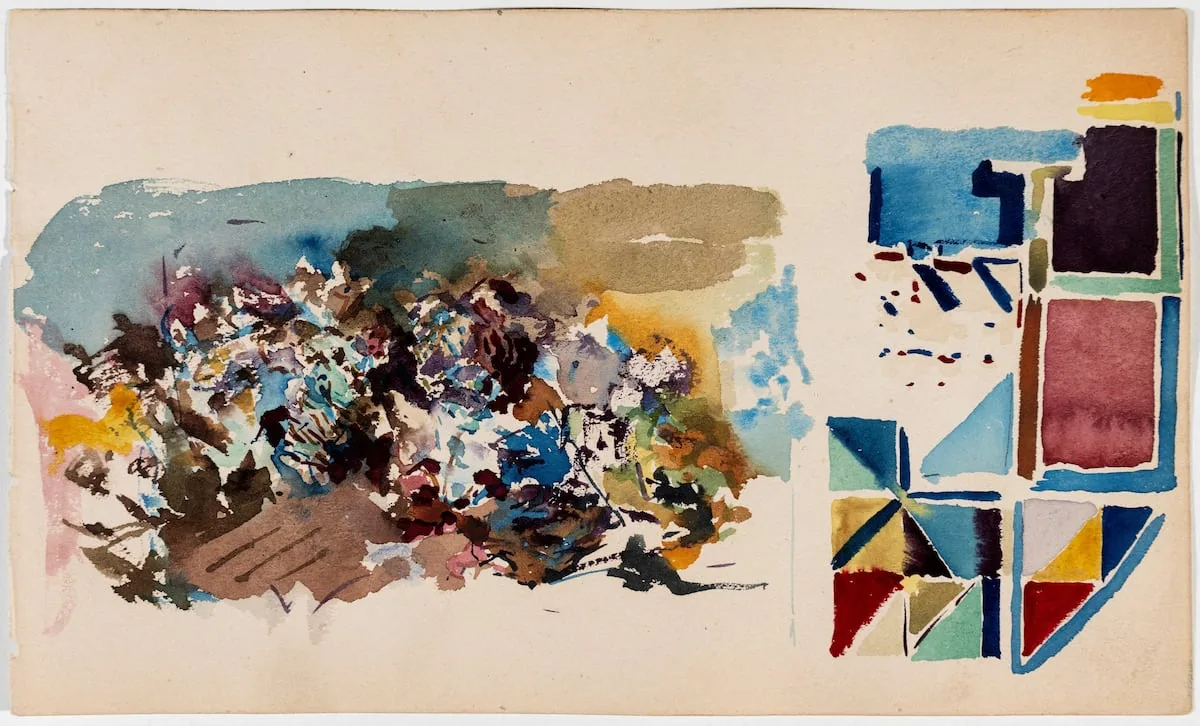
Seen without context and ignoring the authorship, the 26 unpublished watercolors by Marià Fortuny, discovered a few months ago in a private home in Madrid, may seem like an abstract art work, with an intense play of colors that blend and overlap creating “rich, lively and splendid” atmospheres, in the words of Fortuny expert Francesc Quílez. But they are sketches that are part of an incomplete album, which the Delamano Old Masters gallery found by chance at the home of a deceased collector in Madrid. The family consulted him about the value of an old work, and by chance, they showed him this album to which they had not given much importance. The gallery owner, José de la Mano, explains that these are relevant sketches that “change the image of Marià Fortuny.”
The authorship of the mentioned watercolors, which will be seen together for the first time at the Lab Art gallery in Barcelona from May 11 to 16, is confirmed by the printed seal of the Fortuny estate. In addition, they have been studied by Quílez, who was commissioner of the Fortuny Year in 2024. These are sketches that “even prefigure Impressionism,” which, given the year of his death, 1874, he could not even know, argues this expert, who qualifies Fortuny as “the best Spanish painter of the 19th century,” considering Goya (1746-1828) an 18th-century artist.
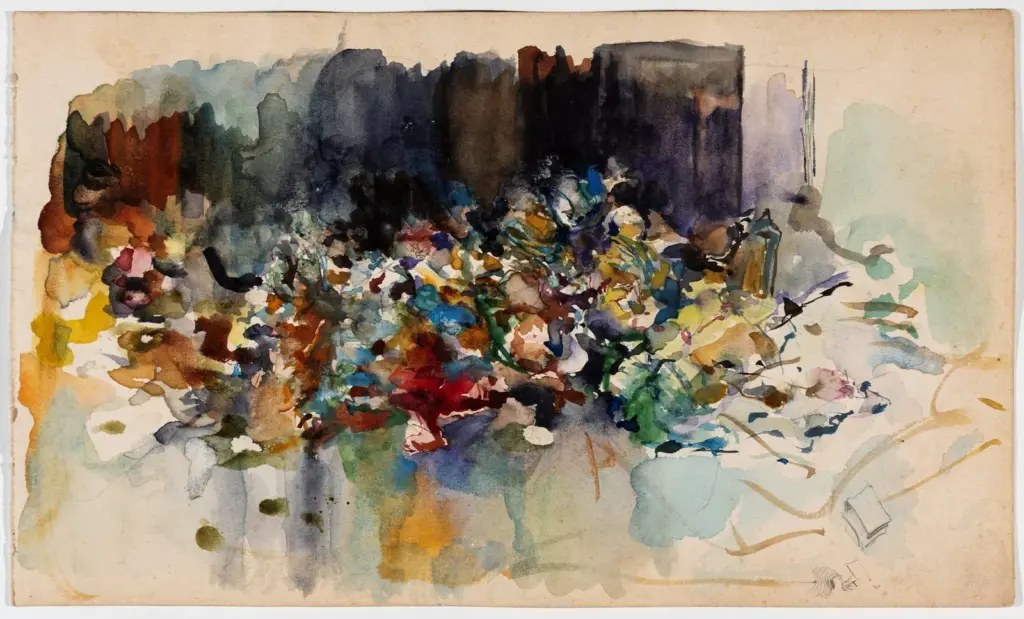
He estimates that these watercolors were painted between 1870 and 1874, during his Granada or Italian period. “It is a very important discovery due to its singular and unique characteristics, which prefigure his modernity,” points out Quílez, adding that other works already foreshadowed this more experimental side of the artist, very modern for the time. “The most special watercolors are those of creative nature, works of imagination and fantasy that bring us closer to an unknown Fortuny, who broke stereotypes,” he adds to reinforce this idea.
Fortuny’s work is vast, and can reach between 3,000 and 4,000 productions, assures Quílez, which is a surprising amount considering he only lived 36 years. It responds to “his gift for painting and an early start, at 14 or 15 years old,” he estimates. Of all of them, the National Art Museum of Catalonia (MNAC) holds 2,000 and the Reus Museum collects about 300. But there are many more that testify to his “two souls,” according to Quílez. One more commercial, painting intended for the European and American market; and another more experimental and spontaneous, where he cultivates his own interests. The found sketches are part of this freer side, which he probably reinforced when he lived in Granada, on the periphery of the cultural system.
From the Delamano Old Masters gallery, representing the property for sale, José de la Mano, who is an art historian, also gives strength to this less canonical side of Fortuny, who did not limit himself only to the classical art that surrounded him. The artist married Cecília de Madrazo, thus becoming the son-in-law of Federico de Madrazo, artist and director of the Prado Museum for a few years, who introduced him to the art elite, where the key figures of the Baroque were Velázquez, Ribera, and Goya. La Vicaria, The Battle of Tetuan, The Print Collector, Granada Landscape or Carmen Bastián are just some of his works preserved at the MNAC.
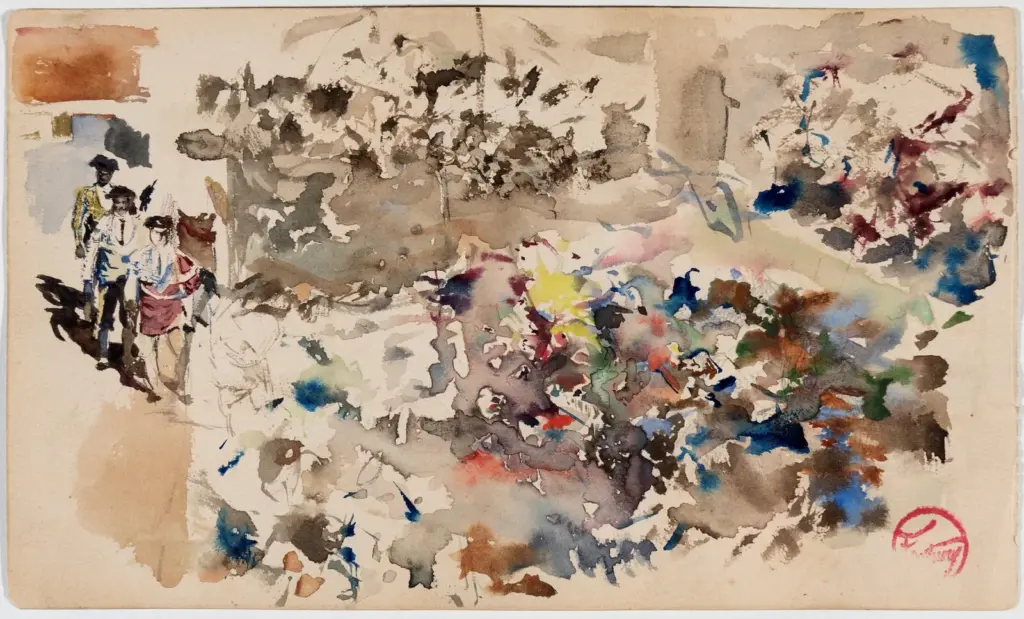
“It looks like abstract art, but he is trying compositions,” comments José de la Mano, who points out that in one of the watercolors the influence of Orientalism is sensed, even by a perspective that recalls a floating house, adds Quílez; while in another it is seen that he prepares a bullfighting scene, as shown by the presence of bullfighters who seem to enter the ring; and in another studies on tiles can be observed, which could well be from his Granada period, where he stayed for two years that transformed him radically.
These drawings reveal an innovative Marià Fortuny who, beyond his academic success, anticipated modernity and sought a free and personal artistic expression. Quílez, seeing these watercolors, of a fascinating interaction between light and color, considers that they “prefigure Sorolla or Rusiñol,” later artists, and even Pollock, a first half of the 20th-century artist, for his exercise of “pure abstraction.”
At the TEFAF Maastricht 2026 fair this winter, five sheets could be seen, but in Barcelona the entire album, found almost by chance, will be exhibited for a week. Used to searching in the most unusual places for artistic works, especially old Spanish painting, his specialty, José de la Mano explains that he went to a private home in Madrid where he was asked for an opinion on an 18th-century painting of a collector who had just died. But this work turned out to be less interesting than the album of Marià Fortuny watercolors he discovered, which the heirs had not considered relevant because they were not even framed.
Read more 10 movies from our childhood to watch with the kids