





The cycle scheduled by the PP with four consecutive regional elections in a drip-feed leaves a worrying outlook for the Spanish left. Although all the communities involved were already PP territories, and therefore right-leaning —“you wouldn’t be making these analyses if there had been elections in Catalonia in between, these were four that we didn’t have and still don’t have,” a minister says privately—, the truth is that the results have consolidated a very evident rightward shift in at least a significant part of the country, including two historic left-wing vote strongholds like Andalusia and Extremadura.
Read more Guardiola finalizes his departure from Manchester City this summer after a decade at the club
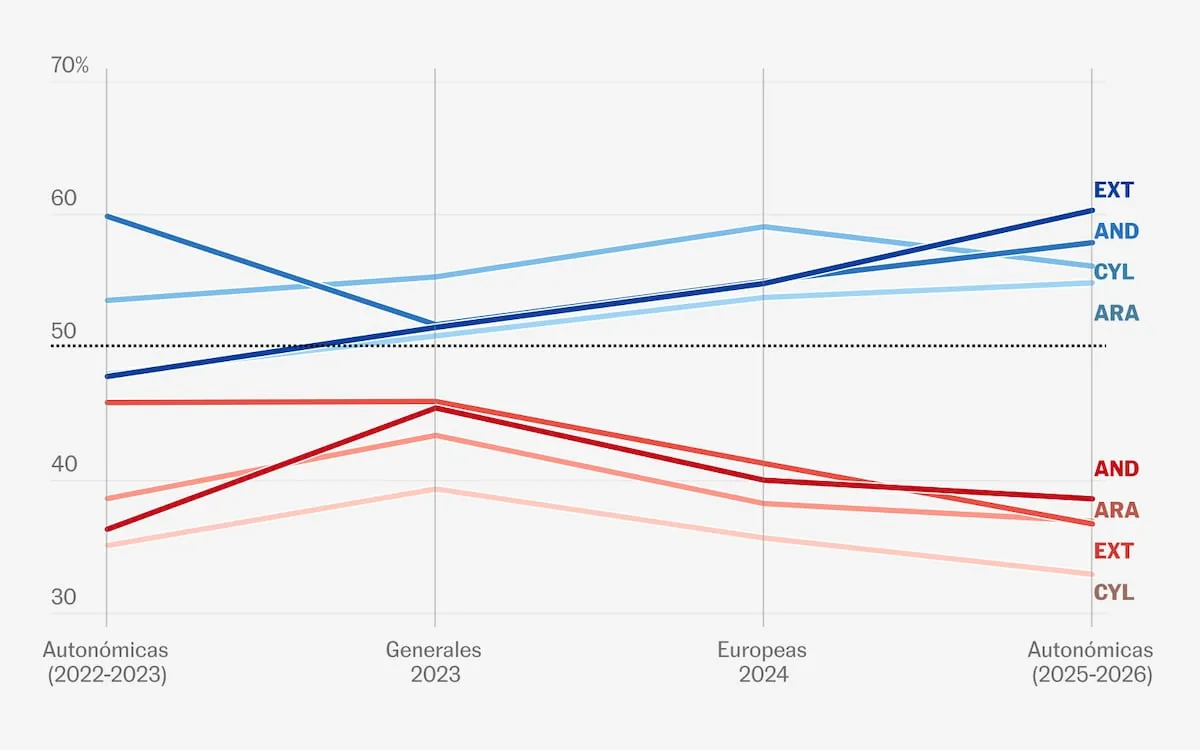
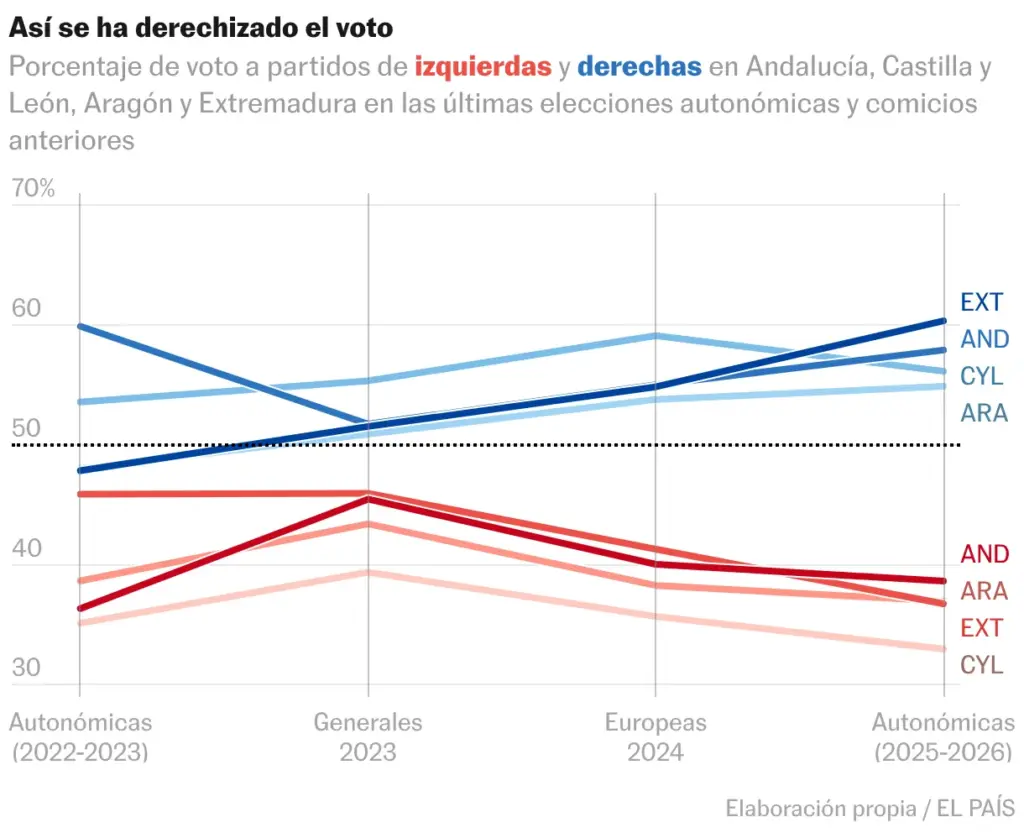
Each of the four autonomous communities —Extremadura, Aragón, Castilla y León, and now Andalusia— has nuances, but together they send a message: all territories have voted more right-wing. The sum of the right improved its results in three elections: Castilla y León (+2.5 points), Aragón (+7), and Extremadura (+12). The only exception was Andalusia, where the right dropped two points from its 2022 peak, and even so achieved 58% of the votes, which remains its second-best historical result. In Andalusia, the right-wing wave slowed slightly in percentage terms, although it had a strong effect on seats —the bloc lost four, the PP five— and that served to somewhat encourage progressive leaders, who still privately, and even some publicly, show concern about the evident rightward shift.
The PP is convinced that, with these numbers, Sánchez will not be able to repeat the 2023 miracle and the right will return to power in 2027. In fact, at Alberto Núñez Feijóo’s leadership, they believe these figures indicate that the left will lose two strongholds it defends by just one seat in the next regional elections: Asturias and Castilla-La Mancha. It is no coincidence that their two presidents sounded worried. The Asturian Barbón, a Sánchez supporter but increasingly distant from the president’s figure to try to avoid being swept away by the wave, believes the PSOE should conduct a “critical internal analysis” to “reconnect with the citizens.” And Page, always the most critical of Sánchez, was very harsh and concluded that on this path, if the president does not listen to the message and change, this punishment towards him will take down the little territorial power the PSOE has left. “The recipient to whom the clear message from the citizens is addressed does not want to understand it or looks the other way,” he said about Sánchez. Also, the leader of Castilla y León, Carlos Martínez, called for “a self-critical reflection.” “The problem is the disconnection we have with society,” he concluded.
In Sánchez’s circle, on the contrary, they believe everything remains very open for the general elections, and that if in 2023 the PSOE gained 600,000 more votes in the general elections in Andalusia than in the regional ones with an absolute majority for the PP, now that it has lost it and will have to negotiate with Vox, mobilization could be even greater. “The general elections are another world. There, the rightward shift is yet to be proven. In the general election polls, the PP is at the same numbers as 2023 or below. The novelty is Vox, which is gaining a lot. But that can change in a year. Many things will happen. We must not be carried away by what happens in the regional elections. It is much harder to remove someone from power than to defend the castle. And Sánchez is in La Moncloa,” another minister concludes.
No electoral result is written in advance. Anything can happen. But the data from what has happened in these months is eloquent. The rightward shift is even clearer when comparing the evolution with the 2023 general elections. The right has risen everywhere: in Castilla y León (1 point), in Aragón (4), in Andalusia (6), and in Extremadura (9). And the left has declined in mirror or even more: in Castilla y León (6 points), in Aragón (6), in Andalusia (7), and in Extremadura (9).
The Government insists that the problem is that, although in these last elections there was more mobilization than expected, people and especially the left vote very little in regional elections, as if they did not take it entirely seriously. “It is a failure of everyone, but it is like that. Forty-five years later, many people still think that regional elections do not concern them, even though health, education, and housing are decided there. That is why the battle of the general elections is the real one, it is much more ideological, and the left works much better there, especially Sánchez. No one believed that the PSOE could win in Castilla y León, Aragón, Extremadura, or Andalusia. And that penalizes you. But Sánchez can win, he has done it several times, and that mobilizes a lot,” summarizes another leader.
Read more Neymar will play in the World Cup
The PP sees it completely differently: “The PSOE is a devastated brand until they purge the leader. All territorial leaders will fall. We have turned left-wing strongholds into right-wing bastions and the father of that movement is Pedro Sánchez,” summarizes a member of the leadership.
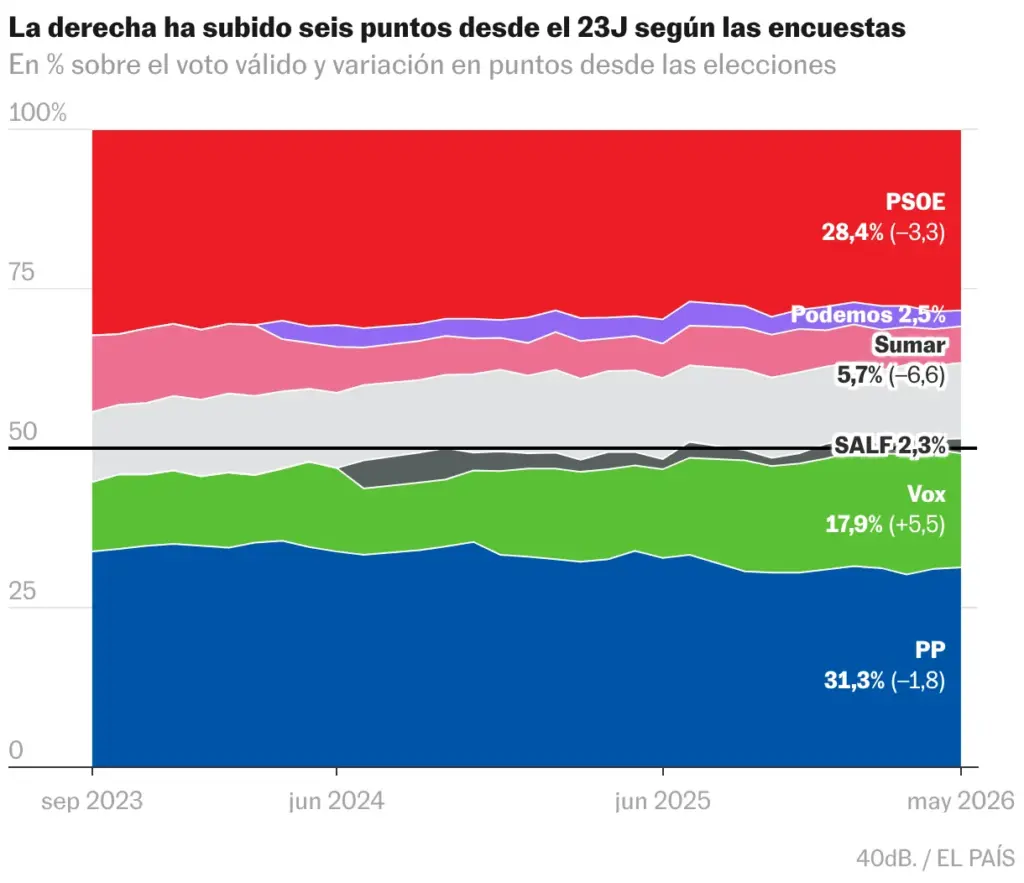
Bad news for the PP is that the advance of the right is not led by them. Where it is clearest is in polls for hypothetical general elections: the estimated vote for the PP is a couple of points lower than what it achieved in 2023, but the bloc rises due to the appearance of SALF and especially the growth of Vox, which would go from 12% to around 18%. At the PP leadership, they insist that this is not their main priority now, but to ensure that the right sums an absolute majority to govern, and they see that as practically guaranteed.
Polls for the general elections
What the data says is that the thermometer of the regional electoral cycle coincides with what the general-level polls indicate. What estimates do they handle? They describe an electorate leaning to the right. In the 2023 general elections, the sum of PP and Vox beat the left by 1.6 points (45.6% to 44%) —a margin insufficient to reach a majority of seats—. But now polls like those from 40 dB. have widened their lead: the sum of the right (PP, Vox, and SALF, which could be a problem for the right due to vote splitting) leads the sum of the left (PSOE, Sumar, and Podemos) by 14 points, winning 51% to 37%. It is a tremendous shift. In seats, these vote figures place PP and Vox above 190 seats, comfortably above the 176 deputies that give a majority. It is true that a left mobilization like that of 2023 or higher could greatly alter these figures, but also that now the miracle Sánchez and Yolanda Díaz achieved that year is more difficult not only because of wear but because they start from lower.
Other signs
Another sign of the shift is the rightward shift of Spaniards and especially young people, who have traditionally been the group most sensitive to the climate of the moment. As Borja Andrino and Pablo Ordaz have reported, today young people position themselves more to the right than ever in the history of democracy. In 2025, 51% of voters aged 18 to 29 chose a right-wing force; in 2014 it was barely 17%. The change has been profound in a decade: in 2015 Podemos had 40% of the youth vote; the PSOE left now does not exceed 13% and the leading force among young people is Vox, with one in four young votes.
Can it change in the general elections?
Of course, all this can change: nothing is written. The elections have measured the current moment in specific provinces. Communities with more nationalist presence have not voted in this cycle, especially places where the PSOE is stronger like Catalonia. Polls are volatile and almost always move when elections arrive —this happened in 2023, when the left regained ground and left the sum of PP and Vox below the absolute—. At La Moncloa, they insist that many things will happen in a year —some with international impact, like the midterm elections in the US where Trump could suffer a severe punishment— so no one should take anything for granted in Spanish politics that always surprises. But repeating the 2023 comeback now seems more difficult. The problem for Pedro Sánchez is that he starts from farther away, much farther away.
Read more Five dead, including the two attackers, in a shooting at a San Diego mosque