









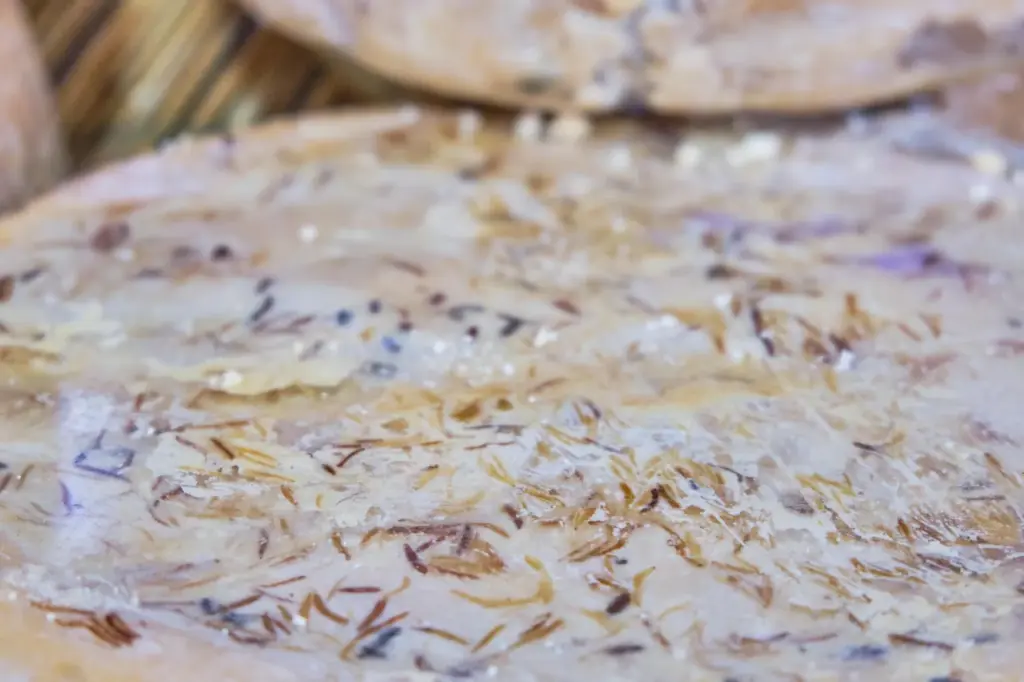
In Sardinia, they make a cheese with a strong, pungent flavor and an even stronger smell. It is called casu marzu (in neighboring Corsica it is known as casgiu merzu). Casu/casgiu is easy to translate, cheese. Marzu/merzu not so much. In Sardinian and Corsican it means rotten. Both are made with goat or sheep cheese. In the case of the former, it starts with pecorino. To rot it, they open it when it is not yet fully cured and introduce larvae of Piophila casei, a fly; they call it the cheese fly. It is one of the few exceptions to the aversion Europeans have to eating insects. Now, a study of dental calculus from sapiens, Neanderthals, and great apes suggests that the former do not eat them in Europe because they never did. The authors of the work, published in Science Advances, suggest that this repulsion is not cultural, but biological.
Read more 11 series to have on the radar this summer
“Dental calculus can not only tell us about the infections a person had,” says Pablo Librado, leader of the ancient population genomics research group at the Institute of Evolutionary Biology (IBE), a joint center of the Spanish National Research Council and Pompeu Fabra University. “It is also a molecular archive of the diet, of the most consumed foods. It is, shall we say, a window into the modus vivendi of people in other times,” adds Librado, co-author of this research.
Using advanced screening techniques, researchers compared the genetic profile of dental calculus from 745 modern humans (modern refers to sapiens), the oldest from 33,000 years ago, with those of about twenty Neanderthals and some Denisovans. Also, with a hundred samples from gorillas and chimpanzees. What follows already seems like science fiction: thanks to techniques that didn’t exist until recently, they were able to trace the presence of genetic material from 10,761 insect species in the teeth. “This way we can calculate the proportion of DNA belonging to species A or species B, functioning as an indicator for the abundance of consumption of that species,” Librado points out.
Where they found the most traces of insects was in the dental calculus of gorillas. These great apes are herbivores; they do not have them in their diet. Everything suggests that they ingest them accidentally while gorging on tender shoots. And indeed, the genera and species of these identified arthropods are caterpillars and leaf-eating adults. They are followed by Neanderthals and chimpanzees, but not all of them. Of the three subspecies, only the western ones, with a more savanna-like environment, eat them, especially termites, in times of scarcity. They are followed by eastern and central African chimpanzees, who have plant resources and fruits all year round. Only 4% of their nutritional needs are covered by bugs.
But the trace is even weaker in modern humans from northern Eurasia. Everything indicates that they did not habitually practice entomophagy. Furthermore, the insect species identified in the dental calculus of Homo sapiens indicate accidental ingestion, through the consumption of water or contaminated food.
2 billion people eat them
Neither in prehistory nor today, Europeans, nor northern Asians (most Chinese, Japanese, Koreans…) had or have insects in their diet. And yet, there are about 2 billion people who do eat worms, grasshoppers, crickets, locusts… And almost all of them are found in tropical regions, from Central America to Southeast Asia, passing through Central Africa. Why? Thanks to a novel approach, this study suggests that they can digest them, but those in the north do not tolerate them as well.
“It is the first time it has been described, and the idea was basically to see which genes in the human genome are capable of digesting chitin,” says Manuel Piñero, also an IBE researcher and co-author of the study. Chitin is, after cellulose, the most abundant polymer in nature. The problem is that if ruminants need a stomach with four compartments and an army of bacteria to make use of cellulose, chitin is just as indigestible. “In the stomach there is an enzyme [acidic chitinase] that is encoded by a gene that allows it to break down. There is another, chitobiase, which is also expressed in the stomach,” adds Piñero. They then looked for genetic variations based on latitude.
What they have found is that, as one moves away from the equator, the alleles (genetic variations) that facilitate the breakdown of chitin are less abundant. The logic would be ecological. Although insects are very rich in protein, they are small. So, many must be eaten. And in the tropics, the abundance and variety is much greater: “By not having a positive balance in more northern latitudes, the selection towards entomophagy would have relaxed, losing certain mutations that allowed and still allow tropical populations to digest chitin,” Librado believes. The inverse of what happened with Europeans and lactose would have occurred: unable to digest it for millennia, most eventually assimilated it.
But researchers from other fields still believe that the aversion has a more cultural than biological basis. Marianna Olivadese, a researcher in agri-food technology at the University of Bologna, recalls the case of ancient Rome: “Insect consumption was culturally more visible than in later Western societies”. It was not a staple food like wheat, but it appears in various contexts. “They could be emergency food in times of scarcity, but also delicacies or luxury curiosities among the elite”. In fact, several authors, such as Pliny the Elder, Horace, or Petronius, include them in their stories.
With the fall of Rome, these gastronomic traditions also fell. “In medieval and later European societies, insects became increasingly associated with dirt, decomposition, infestation, poverty, hunger, and disorder, rather than with a legitimate food,” the researcher recounts. And she concludes: “In this sense, the Roman case is interesting because it reminds us that the Western rejection of insect consumption is not timeless, but has historical roots”.
The entomologist from Wageningen University (Netherlands), Arnold Van Huis, is one of those who has done the most to include insects in the Western diet. Some of his works have served as a basis for FAO guidelines in this field. “They are safe for consumption, nutritious, beneficial for health, and have a lower environmental impact than animal products,” he says in an email. In fact, he considers them a better alternative to soy and fishmeal, both with a high environmental impact, for sustaining livestock. Regarding their direct consumption, “the basis of our aversion is disgust” and, he concludes, “disgust is not based on reason, but on emotion, therefore, it is very difficult to reverse”.