







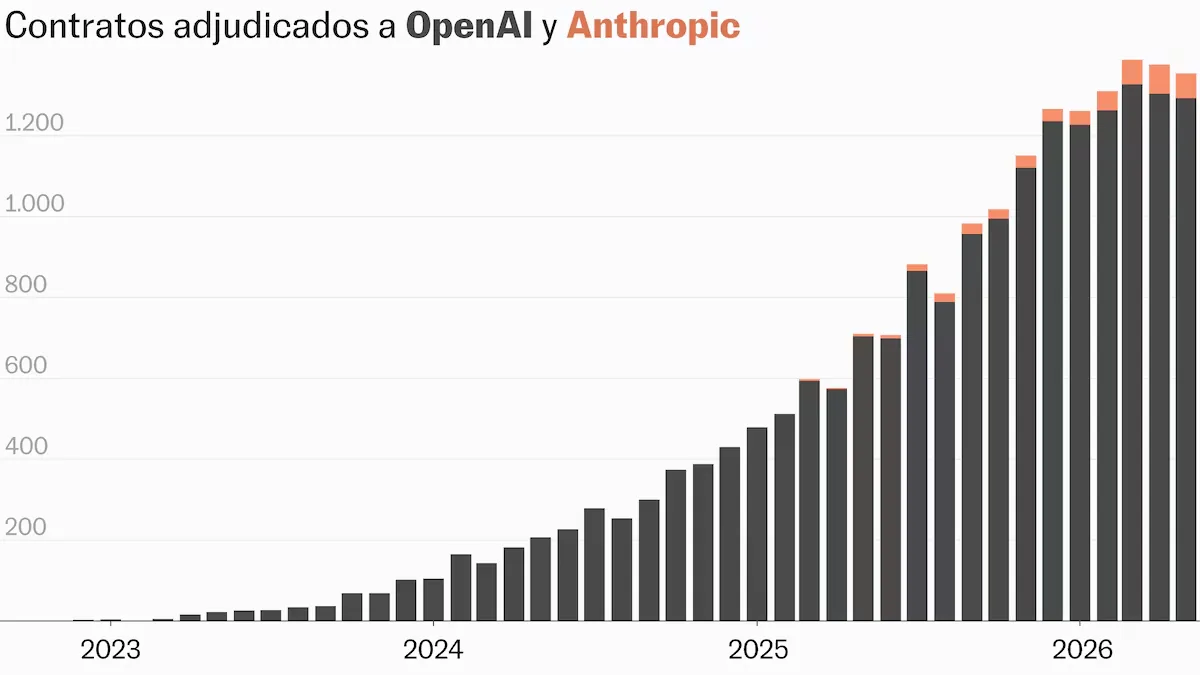
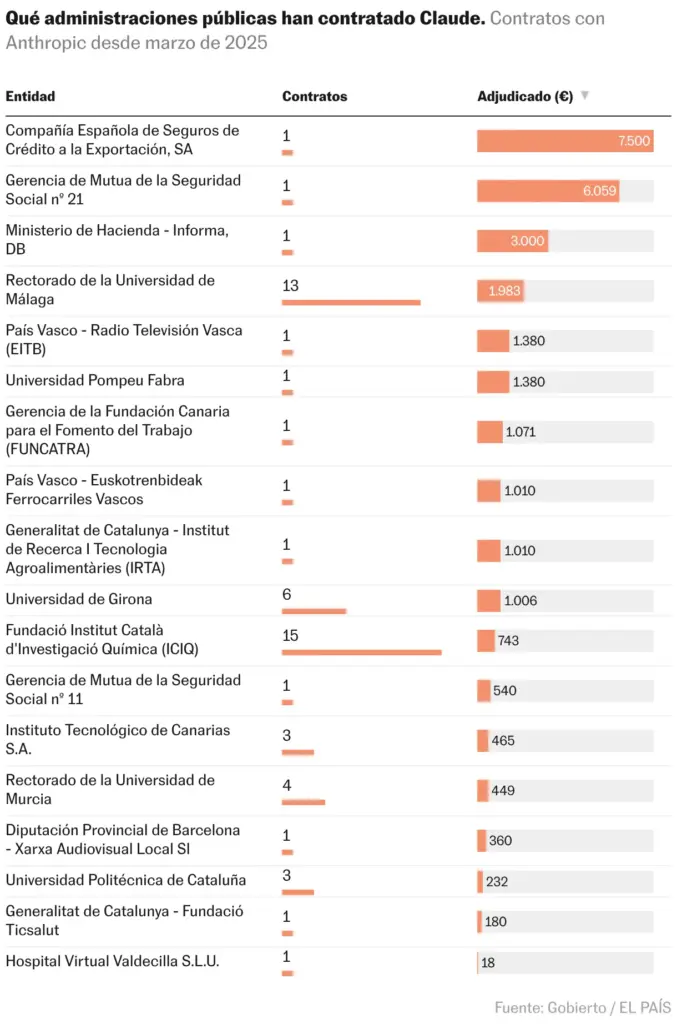
Spanish public organizations are rapidly adding a new item to their ordinary expenses. Payments for artificial intelligence chatbot services, especially ChatGPT but also Claude, have gone from one contract in November 2022, when ChatGPT was launched, to more than 1,350 just three years later. Public administrations today spend more than 394,000 euros on this type of service, almost all of it on OpenAI, creators of ChatGPT and pioneers in the sector. Only a handful of institutions have so far subscribed to Claude, Anthropic’s AI launched in 2023, for a total of 28,000 euros spread across 56 contracts.
Read more The Europeans’ disgust at including insects in their diet comes from afar and is biological
These are still minimal figures, but their evolution gives an idea of how the use of these tools is permeating the Administration. The contracts analyzed include only the direct contracting of these companies. The sum may be higher, considering those that come in packages of Google or Microsoft tools (which may include their generative AI services Gemini and Copilot) but whose purpose does not detail whether they have AI services. The contracts that explicitly mention these two chatbots are only four: Copilot, with Microsoft as the awardee, has only three in 2024 totaling 1,348 euros, and Gemini only one in 2026, for 4,000 euros (ten licenses for the Technological and Renewable Energies Institute).
There are also many contracts prior to the explosion of chatbots that include “artificial intelligence” in their purpose. Their figures are much higher: they total more than 2,500 contracts, between 2018 and 2026, for a value of 172 million euros, but their purpose seems different. The beneficiary companies are mainly NTT Data Spain, Telefónica or Indra. Although some of their contracts include “software licenses,” most are for the creation of platforms or infrastructure, not to allow civil servants to use chatbots.
Cemeteries, bikes and zoo
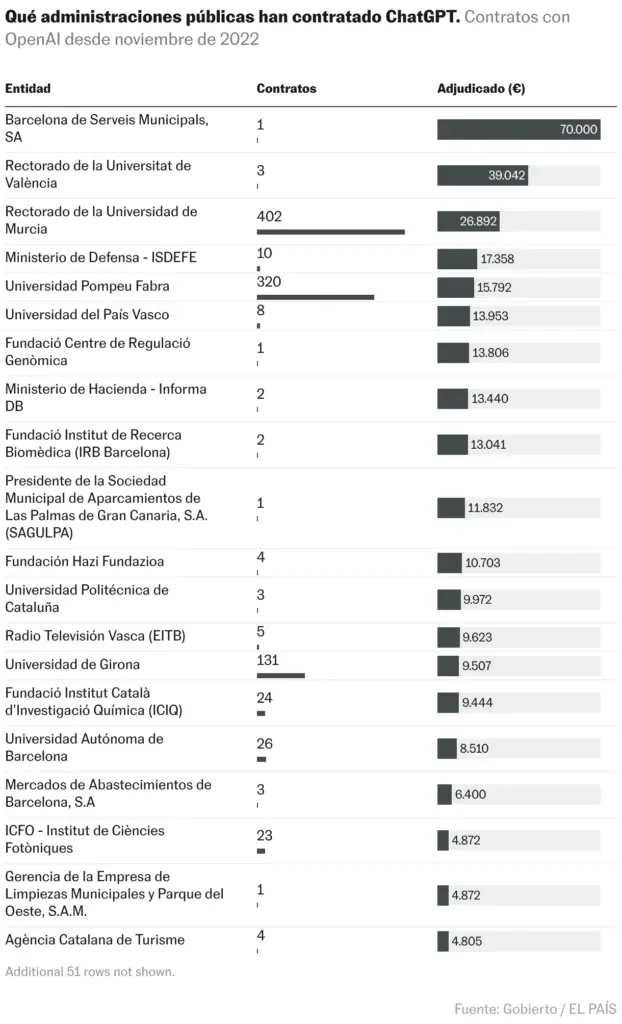
The vast majority of contracts with OpenAI and Anthropic, published on the State Contracting Portal, are for individual subscriptions by university professors or employees who ask their organization to pay for their use of AI. But there are some organizations that have launched very specific tenders to contract OpenAI services: the largest is for 70,000 euros from the Barcelona City Council for the “supply of ChatGPT Enterprise licenses for Barcelona Serveis Municipals,” which is the municipal entity that manages services such as cemeteries, the bicing shared bicycle service, or the zoo. “It’s for subscriptions to these services that allow us to improve our internal processes,” say sources from this organization, which gives no further details. An OpenAI sheet linked to the contract mentions that there are 52 user accounts.
The largest contract of an administration with Anthropic barely totals 7,000 euros. It is from a public company dependent on the Ministry of Finance, the Compañía de Seguros y Reaseguros, Sociedad Mercantil Estatal (CESCE), a public-private group that manages commercial credit and surety insurance. They contracted Claude, according to the purpose of the contract, for “Matlab maintenance,” a calculation software used to analyze data or create algorithms. Claude became popular among programmers for the quality of its version for writing code, Claude Code.
No organization seems to have deployed AI chatbots on a large scale in its services, according to the responses offered to this newspaper. The universities of Murcia, Valencia, and Pompeu Fabra in Barcelona are the ones that have directly invested the most money in subscriptions. The University of Murcia, for example, spends almost 27,000 euros on 402 contracts with AI companies. “We do not have any corporate license with OpenAI; the subscriptions are individual, from faculty and management staff,” says a spokesperson for the entity.
Read more 11 series to have on the radar this summer
The Universitat de València has only three contracts of 13,000 euros each: 39,000 euros in total between 2024 and 2026. “The subscription is for a chatbot system, for one year, to reinforce the training of administrative staff with managerial profiles and middle managers of the University,” says a spokesperson for this university. There are also ministries among the main public users of AI. Defense, through its entity ISDEFE (Systems Engineering for the Defense of Spain), has spent 17,300 euros on AI. For what? ISDEFE gives a very vague answer: “The licenses allow progress in areas such as training, controlled experimentation of use cases, and the evaluation of technologies capable of providing value.”
An example of how these subscriptions are just an extra part of the administrations’ use of AI is given by the Universitat Pompeu Fabra in Barcelona. The center is the second entity that has signed the most contracts with OpenAI: 320 totaling 15,700 euros, which are, according to university sources, “initiatives by professors and researchers who may require specific AI tools” and are managed “decentrally from the research groups themselves.” In addition to these specific purchases, which are not few, the University offers Google services to its employees. “The University uses the AI included in the Google Workspace for Education Plus license, which includes the use of Gemini and NotebookLM,” they explain.
Pompeu Fabra is not an isolated case in Catalonia. Entities in this community have been the first to contract AI services, or at least to publish the contract details on the state platform. In ChatGPT’s first year of life, only Catalan institutions contracted its services: from Mobile World Capital to the Fundació Institut Català d’Investigació Química (ICIQ), to the Autonomous University of Barcelona or the Rovira i Virgili University of Tarragona, in addition to the Barcelona City Council.

Not all organizations are ministries or universities; there are also small town councils like Dosrius (Barcelona) and Elgoibar (Gipuzkoa), which have not responded to calls from this newspaper to clarify their use. Data from the contracting portal also shows that OpenAI’s first public contract was five days before ChatGPT’s launch in 2022: Mobile World Capital spent 80 euros on a tool from the company (which had already launched Dall-E) for image generation: “We used it for the graphic image of an event called Jump2Digital and created some little animals with glasses,” says an MWC employee.
In December 2022, a group from Universitat Rovira i Virgili made the first ChatGPT subscription in Spain. “It was something revolutionary, we had to explore it well, and the free version was very limited at first,” says Clara Granell, a Complex Systems researcher and the name under which that first subscription was made.