




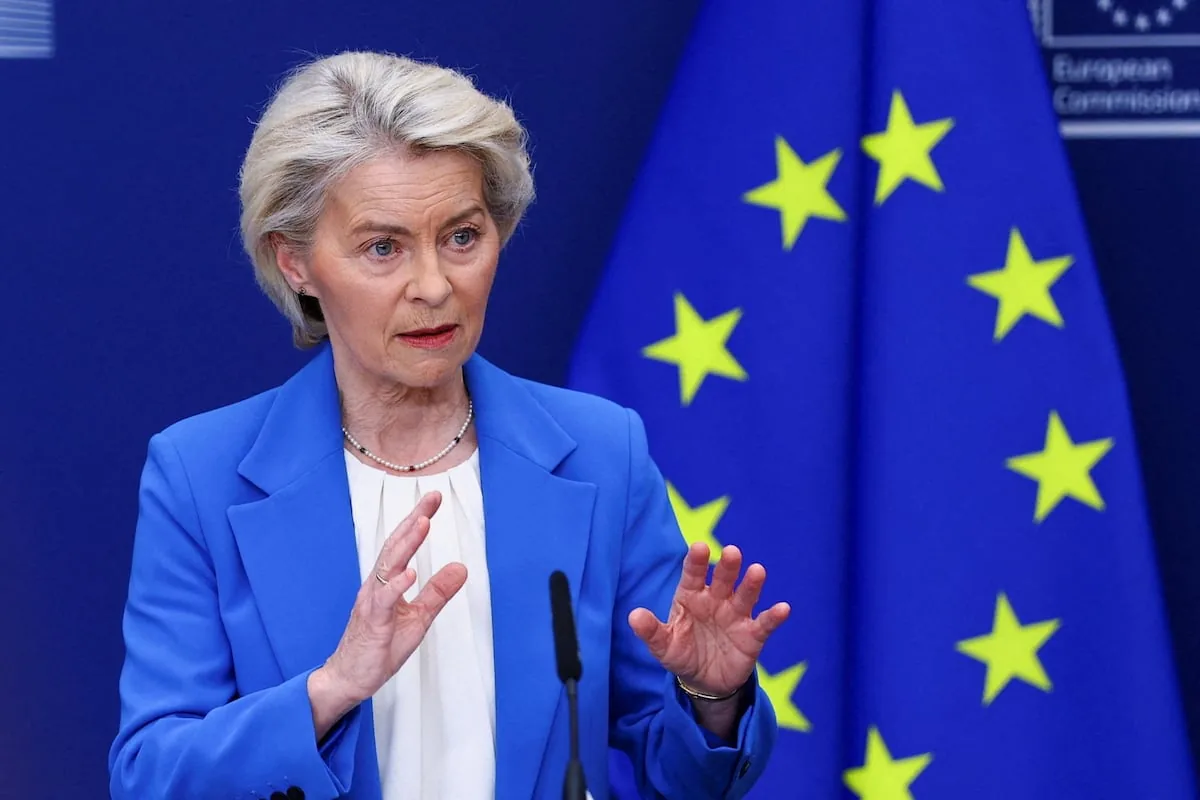
The European Commission avoids taking sides regarding the extraordinary profits (the so-called windfall profits) that energy companies are accumulating as a result of the war between the United States and Israel against Iran. Brussels resists promoting a European mechanism to tax the extraordinary profits of these companies derived from the Middle East conflict and the closure of the Strait of Hormuz, through which 20% of the world’s liquefied natural gas and oil for global consumption passed before the crisis. Spain, Germany, Italy, Austria, and Portugal demanded a solid legal framework from Ursula von der Leyen’s Community Executive to tax these unexpected revenues in the sector, with the aim of preventing the cost of the energy crisis, which is already being felt in citizens’ pockets, from falling exclusively on consumers and the public purse. The Commission, however, is reluctant to do so at a European level. Instead, the new European plan against the new energy crisis leaves the implementation of such measures in the hands of the countries.
Read more The shooting at the archaeological jewel of Teotihuacan strikes Mexico’s image again
The five Member States that requested the measure by letter a few days ago continue to push for a formula that allows it to be applied en masse: a new coordinated tax. Something that, moreover, would send a powerful and symbolic signal and help mitigate the economic impact derived from the rise in oil prices after the military escalation in the Middle East and the conflict with Iran, as detailed by the Economy Ministers of those countries in a letter to the European Commission. However, in the various drafts of the package of measures being finalized by the Community Executive, to which EL PAÍS has had access, this mechanism is not included.
In the new strategy that Von der Leyen plans to present on Wednesday and then take to Cyprus, to the European summit where the leaders of the 27 Member States will meet, Brussels plans to settle the request from Spain, Italy, Germany, Austria, and Portugal with a mention that states can already do so at a national level. In this energy crisis response plan, Brussels includes measures such as promoting mandatory teleworking once a week, to save on transport and energy; closing official buildings as much as possible; requiring companies to avoid air travel; or maximizing funding for public transport, according to the drafts advanced by this newspaper.
In addition, the Commission plans to include an electrification target and underpin a mechanism to make State aid more flexible for the transport or agricultural sectors, which are more affected by rising energy prices.
Madrid, Berlin, Rome, Vienna, and Lisbon had demanded more ambition from Von der Leyen. They argue that current market volatility, driven by geopolitical tensions, has generated distortions that require immediate Community intervention. And they base their proposal on the precedent of 2022, when the European Union introduced a temporary solidarity contribution to address the price crisis after Russia’s invasion of Ukraine. The ministers argue that the current situation presents technical and fiscal parallels that justify a similar tool, without prejudice to the measures that each Member State adopts individually.
But returning to the 2022 recipe in this specific aspect is not popular in Brussels. Even then, the European Commission was very reluctant to seek ways to implement an extraordinary tax on the profits of energy companies. It finally took the step. In September of that year, it put forward “a temporary solidarity contribution applicable to the profits of companies in the oil, gas, coal, and refinery sectors” for 2023 and 2024, which the EU Council approved a month later, a record time in European terms.
Read more The pitfalls of a debate amidst distrust
Now, however, there will only be that mention that states that wish to can implement this tax; something that is actually nothing more than an obvious point due to the distribution of competences in the EU, which reserves the tax section for countries. The Commissioner for Economy, Valdis Dombrovskis, referred to this less than two weeks ago when he stated in the European Parliament that “nothing prevents” governments that want to adopt this measure from doing so. Beyond that, even the Climate Commissioner, Wopke Hoekstra, has pointed out, despite the precedent: “Initial analyses show that it is legally complicated.”
There is another argument heard in Brussels that also points to a lack of enthusiasm for promoting a mechanism like the one four years ago. “We are not in the same situation as in 2022. It is important to take into account the lessons learned then, including the temporary solidarity contribution,” reads the official response when asked about this matter.
This response, comparing the speed of the multiple responses four years ago with the current one, suggests that the Commission has not wanted to move at the same pace as then. And not so much because of the extraordinary tax on energy companies, but because of the delay in presenting its announced range of recommendations for the States in response to the current crisis. In the conclusions of the European Council of March 19, this response was demanded, which has now taken more than a month. It is true that, unlike 2022, there is no imminent supply shortage problem now as there was then with natural gas, and prices have not yet spiraled out of control as they did then. Furthermore, the fiscal margin that governments have, as Dombrovskis also emphasized to MEPs, is not large.
Despite this, precisely in the European Parliament, MEPs are starting to get impatient and demand more ambition from the EU Executive. One of them is the Socialist Nicolás González Casares, who has decided to defend this measure, placing great emphasis on the design so that it falls on fossil fuels.
Read more The López Aliaga phenomenon: blind faith in times of evidence