









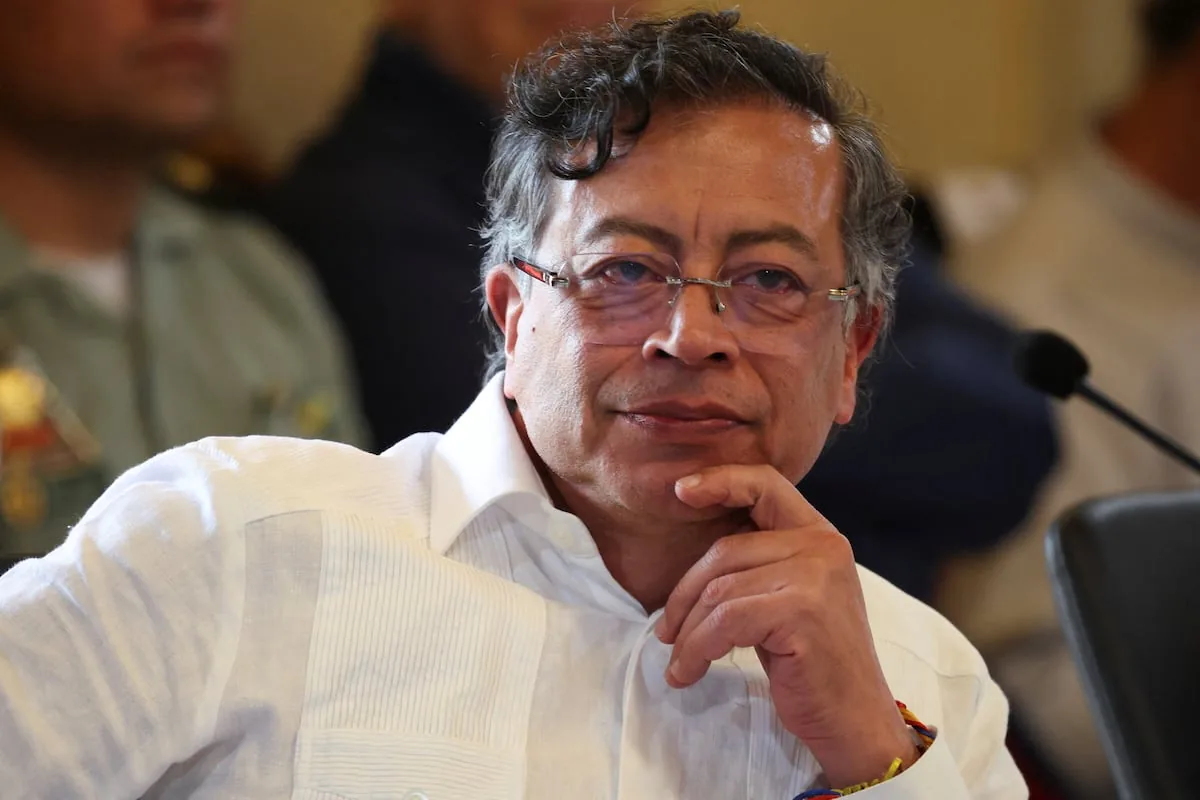
The effort by Gustavo Petro’s Government to reduce the fiscal gap through decrees has been unsuccessful. Not only because the Justice system has suspended or overturned several of its measures —such as the economic emergency of December 2025, which the Constitutional Court found unconstitutional— but also because the few that have bypassed these controls have had a smaller effect than expected. The most recent example is the wealth tax for companies with more than 10.474 billion pesos in net assets, which the same Court partially suspended last Wednesday. The Ministry of Finance had projected to collect 4.15 trillion pesos (about 1.14 billion dollars) in the first installment, but according to DIAN data only 2.43 trillion (668 million dollars) came in. The shortfall of 473 million dollars (1.72 trillion pesos) highlights the fragility of the projections of an Executive facing a growing fiscal deficit and an annual budget without sufficient income.
Read more First National Drill 2026: Date, Time, and How to Register Properties to Participate
The low collection has several explanations. According to El Colombiano at the end of April, some companies declared their wealth to DIAN and requested payment plans but did not transfer the money. Others decided not to comply with the rule: neither declaring nor disbursing. Lisandro Junco, DIAN director under the right-wing Iván Duque, posted on his X account a breakdown of collections by sector confirming the imbalance: the financial, real estate, and insurance sectors contributed 1.12 trillion pesos, almost half of the total. They were followed by commerce, transport, and accommodation with 368.612 billion, and manufacturing with 237.892 billion. Non-profit entities —which the Court has temporarily protected— barely contributed 20.726 billion in the first installment; a marginal figure that makes the suspension ordered by the high court more symbolic than fiscal.
Luis Carlos Reyes, the first DIAN director under Petro, warns that the problem goes beyond the failed collection of a tax created by decree and points out that the deficit has a deeper root: a faster growth of inflexible expenses than government revenues. “The Ministry of Finance has approached it incorrectly by artificially inflating collections to comply on paper with the fiscal rule, while cutting revenues; not through a tighter budget, but through suspensions of funds to entities,” he tells EL PAÍS.
The economic research center ANIF warns that the 2025 fiscal deficit —which reached 6.4% of GDP— is the fourth highest in the country’s history and is only comparable to periods of economic crisis. “The worrying thing is that Colombia is not facing a macroeconomic shock that justifies it,” said its president, José Ignacio López, last week during the event Responses to the Fiscal Challenge. “Net public debt is around 58% of GDP, levels not seen since the late 19th century,” he added. If not corrected, the research center projects it could exceed 71% in three years, a threshold that the fiscal rule considers incompatible with a sustainable path for the Colombian economy.
Reyes points out that, even with the dubious methodology of inflating collections, it was very difficult to maintain the fiscal rule, which was broken in mid-last year. “It is common to accuse the Petro Government of spending freely when it has actually made very strong investment spending cuts for various sectors,” he clarifies. The solution requires, in his view, a direct fight against evasion —which costs the State about six percentage points of GDP— and spending modifications that are politically very complicated. “We are in a situation that will not be solved on August 7 after a change of Government,” he concludes. ANIF calculates that the gross collection for 2025 fell 9.5 trillion pesos (2.6 billion dollars) short of the established target.
The collection problem goes beyond the wealth tax. According to DIAN, there are 382,599 taxpayers with outstanding obligations worth 30.8 trillion pesos (8.466 billion dollars). Although the Government offered tax reliefs that reduced late interest to 4.5% and penalties to 15%, only 126,230 taxpayers took advantage of these benefits, which expired on April 30.
Read more More than 800 ships and 20,000 sailors remain trapped by the Strait of Hormuz blockade
The precedent it sets
The suspension decreed by the Constitutional Court is limited. It applies only to the second installment and to a specific group of taxpayers: non-profit entities such as private universities or foundations, and companies in liquidation. With that, about 15,000 companies are still required to make the payment due today, May 4: commercial, industrial, and service companies with active operations in the country, branches of foreign companies, business holdings, and financial entities that exceed the defined thresholds. The Court’s argument to exempt the protected organizations from the second payment has been technical and forceful: charging a tax on illiquid assets —university campuses, laboratories, auditoriums— while the constitutionality of the tax is in doubt, would compromise the provision of basic services or cause irreversible damage to the creditors of a company about to close. The first installment, however, remains in force.
Andrés Quitian Calderón, tax lawyer, anticipates that the Court could validate the tax for all remaining companies and annul it for those protected by the suspension. “The reasons for the partial suspension of a legislative decree are usually analogous to those of the final decision,” he explains to EL PAÍS. Quitian estimates that the fiscal impact would not be greater, “precisely because of the limited collection this tax has shown.” He also points out that many non-profit entities chose to declare but not pay: “It remains to be seen if DIAN decides to audit in a scenario of high probability of unconstitutionality,” he elaborates. And he warns that the decision could open the door to tax planning schemes, as the precedent could give those entities “greater relevance as an associative form.”
In practical terms, Crowe Colombia’s tax expert, Pedro Sarmiento, recommends that companies excluded from the suspension comply with the payment of the second installment to avoid late interest and penalties. “For those companies that consider the tax violates their rights, the safest path is to pay under protest and later evaluate the request for a refund for undue payment,” he points out.
What follows depends on the substantive ruling. If the Court declares the decrees unconstitutional with retroactive effects, it could include a mechanism allowing taxpayers to request a refund of what was paid. But if it upholds them or modulates the effects toward the future, those who did not pay the first installment will have to catch up with the tax plus accumulated late interest.
Read more Six armed guards were guarding the ship’s drug with the giant cocaine stash