









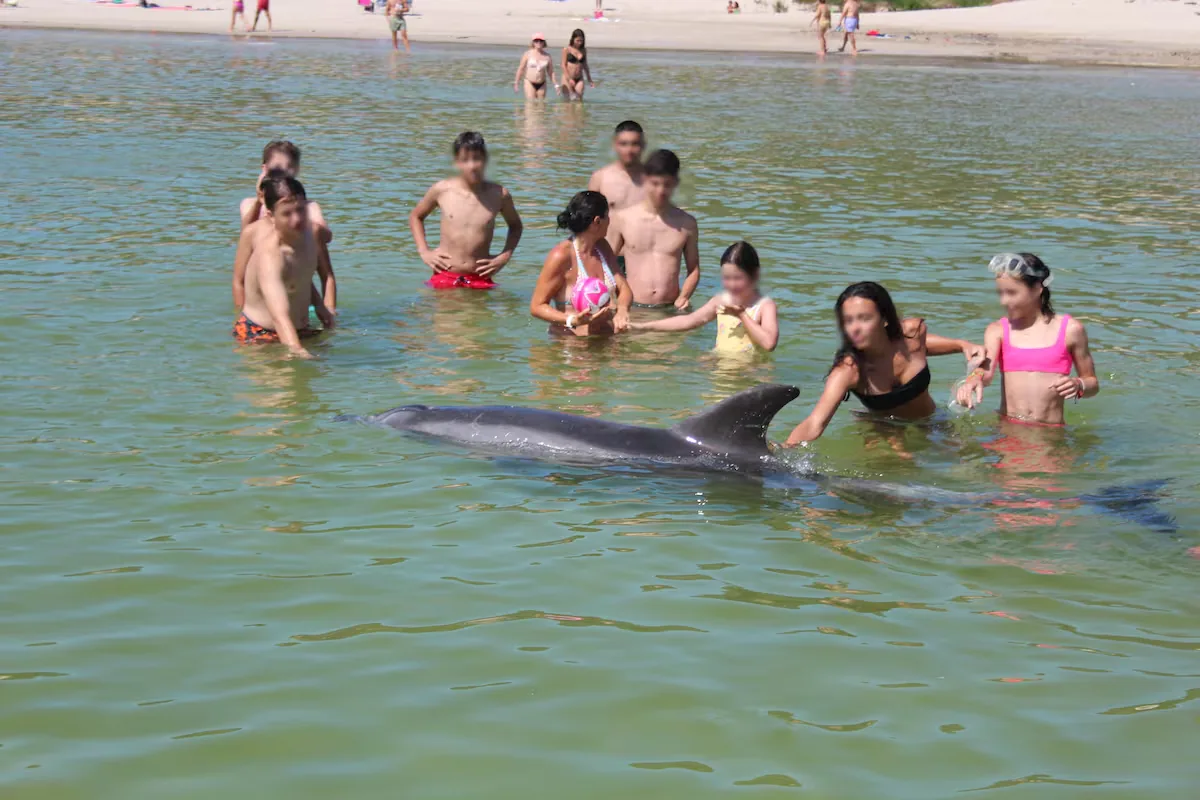
Manoliño, Spain’s most famous solitary dolphin, was first detected in 2019. Over time, he became a regular in the estuaries of Muros-Noia and Ferrol (Galicia); he was almost another neighbor. For five and a half years, he approached boats and bathers, allowed himself to be touched on the beach, and even hindered the work of divers collecting razor clams. He died in September 2025, run over by a boat’s propellers. A study has analyzed his history and behavior along with 16 other social solitary bottlenose dolphins ―those that interact with people― located in Spanish waters, most of them (14) in Galicia since 1970. Among them is Nina, a female filmed by Félix Rodríguez de la Fuente playing with children who hugged her and held onto her dorsal fin. They are not the only ones: between 1950 and 2022, solitary dolphins were recorded in 47 locations across 26 countries.
Dolphins live in complex groups, where they establish relationships that can last a lifetime. But, from time to time, some individuals break the rules: they live alone, approach the coasts, and seek contact with humans. The reason is unclear. The study points to various hypotheses: from the search for new territories to health problems, injuries, or rejection by their group. This behavior carries risks both for the survival and well-being of marine mammals and for the safety of people, who approach them as if they were just another pet. Nothing could be further from the truth.
“Manoliño, for example, who was a sweetheart, was also a three-meter, 400-kilo animal that if he slapped you, he’d turn your head inside out,” describes Alfredo López, one of the study’s authors and director of the Coordinator for the Study of Marine Mammals (CEMMA). He was seen helping to lift fishing nets and helping children from a sailing club into boats by pushing them from the water, showing freshly caught fish, or playing with a dog. But there were also incidents because he would remove diving masks, regulators, or hoses that supply air to the navalleiros, the divers who fish for razor clams by submerging between 10 and 12 meters.
From playing to biting
In the water, the advantage is always theirs. “They are incredibly fast, not only because of their agility, but because their mind seems to be several steps ahead of yours. It’s as if they guess what you’re going to do in the next second,” explains López. Another problem arises when they approach a crowded beach and bathers surround them. In these circumstances, they can feel harassed, as happened when Manoliño bit a woman on the leg, leaving her with several tooth marks.
The approach of dolphins to people, driven by their need for social interaction, is gradual and goes through different stages. The study identifies stages 0 to 5. It is fundamental, according to the expert, to prevent those in the early phases who are currently solitary from moving to the next steps and becoming social.
In stage 1, the dolphin begins to show itself, then starts following boats and showing interest in human activity. Once distrust is overcome, social and tactile behaviors appear, such as rubbing against boats or bathers. They can even use their penis as a tool to explore, touch, or move objects, such as ropes, without necessarily implying a sexual purpose. “It’s an exploration they carry out with their whole body as part of their curiosity, and we might interpret it as sexual when it’s not,” clarifies López.
In more advanced phases, they can also exhibit dominant behaviors, such as swimming at high speed, exhaling forcefully, ramming with their head, or performing jumps very close to people, and even over them. The fifth and final phase would be the cetacean’s return to its conspecifics, something that can happen at any stage, and which is difficult to verify.
Read more Is it possible to die of grief? Science confirms that intense grief increases the risk of death
Some are not strictly solitary, as was the case with Enol, who lived for three years, mainly in Asturias, between 1993 and 1997, always with his mother Ercina. He was not as friendly as Manoliño or Nina, and showed aggressive, dominant, and sexual behaviors towards the people he interacted with, in addition to biting many of them.
Gaspar, another case in the study, arrived in the Rías Baixas in 2007 and slowly went through the stages of sociability. First, he showed interest in oars, paddles, and small boats, which he sometimes overturned. His favorite activities included putting his head into the turbine outlets where water came out or getting tangled in boat ropes. He also wrapped ropes around his tail and fins, and on two occasions, he was seen interacting with a dog in the port of Corcubión.
But he could also become dominant when bothered. On one occasion, he grabbed an underwater welder by the fin and dragged him five meters, breaking a rib. And on another, he broke the arm of a person who jumped into the water to swim with him. He was last seen in 2010.
Manoliño also went through all the stages described in the study. First, he approached boats and people, but without interacting. In stage 3, he was already approaching fishermen working in the estuary and bathers, but he wouldn’t let them touch him. In stage 4, which he reached quickly, he sought contact with anyone in the water. This behavior changed radically when he was speared in his left flank in October 2022: he returned to stage 1. It didn’t last long, and he gradually began to approach people again.
But there were already warnings from the administration: he should not be fed, nor should people get into the water with him, nor touch him. If going by boat, it was recommended not to approach or accelerate abruptly.
The most important thing is to prevent solitary dolphins from becoming sociable, the study warns, and this is achieved through education and management by administrations. “We know that municipalities are reluctant to restrict access to beaches or ports if a similar situation occurs, but these are measures that could be included in a management plan for temporary application,” the scientists conclude.