








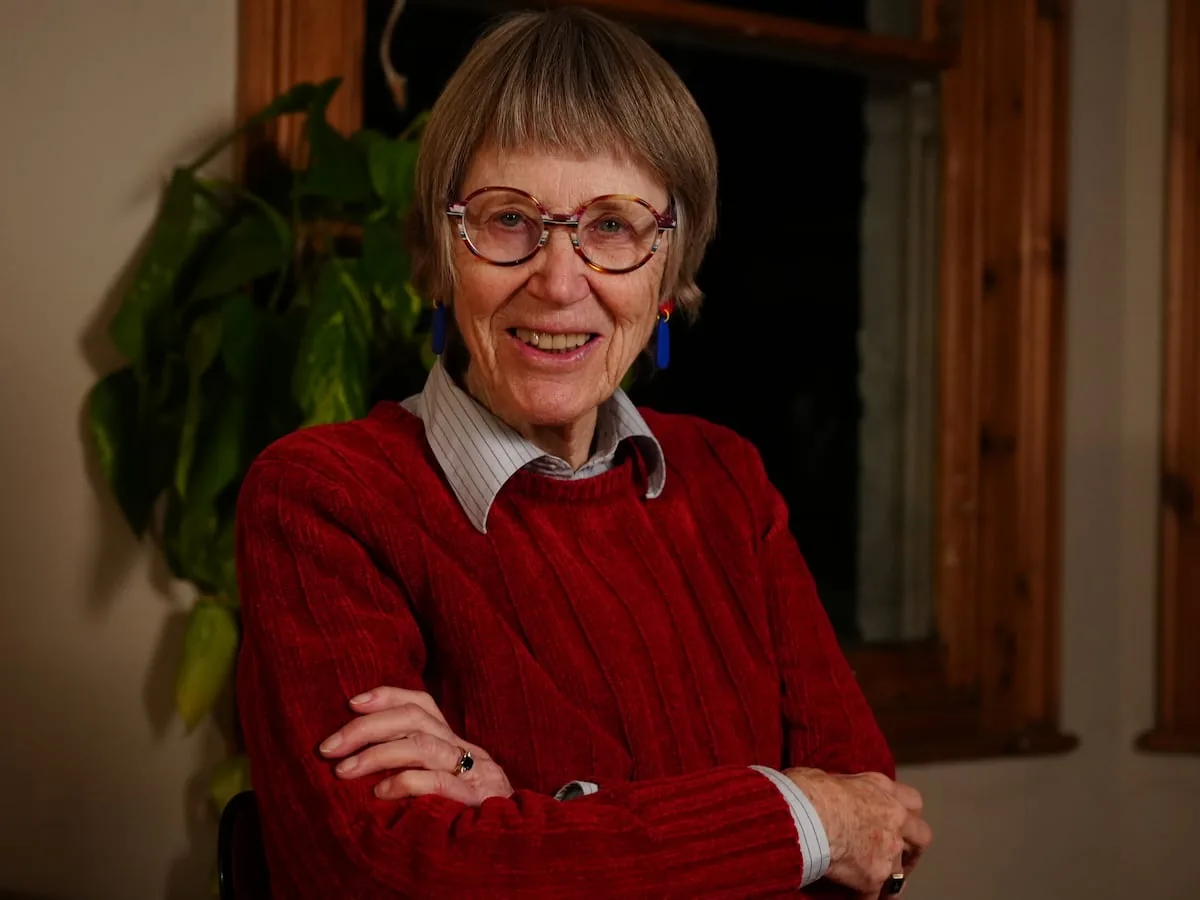
Over the last five decades, the work of American Nancy Cartwright (Pennsylvania, 82 years old) has “built a bridge between philosophy and the real practice of science,” according to the jury’s statement that awarded her the Frontiers of Knowledge Award this Wednesday.
The BBVA Foundation, which grants the award, highlighted Cartwright’s pioneering work and her innovative vision of “what science is and how it can be applied, beyond the mere combination of theory and experiment.” The jury also emphasized that Cartwright’s philosophical framework has analyzed the models and tools of social sciences, with the aim of substantiating “decisions on evidence-based public policies.”
The objective of Cartwright, a researcher at Durham University (United Kingdom) and the University of California, has been to provide a more precise and effective vision of the practice and results of science from a philosophical perspective. To this end, her work has focused on exploring the extent to which scientific theories and concepts adapt to the real world we live in, how scientific research is practiced in specific contexts, and how scientific results can be used to make evidence-based decisions. Cartwright believes that rigorous arguments require various types of evidence, from a wide variety of disciplines, to support the different types of claims in their premises.
The philosopher grew up reciting arguments “for and against the existence of God, the possible justifications for the existence of evil, or issues related to free will,” she recalls in an interview conducted shortly after learning of the award. Although she enrolled in Mathematics when she entered university, the experience of those metaphysical debates led her to become interested in Philosophy classes and she ended up opting for this discipline. “Philosophy should not be an idle activity, but had to be useful for changing the world,” added Cartwright, who initially specialized in the philosophy of Physics.
Read more Amnesia spreads among the witnesses linked to the PP who testify in Kitchen
Professor Luis Valdés, Professor of Philosophy at the University of Oviedo and nominator of the award winner, explains that Professor Cartwright “has made fundamental contributions to discovering how science truly achieves the successes it reaches. In opposition to abstract philosophical theories about science, she has contributed decisively to defining key issues of scientific practice such as causality and objectivity.”
On the other hand, Atocha Aliseda, professor and president of the jury, highlights that “this award recognizes an intellectual figure who, from philosophy, has made a great contribution to strengthening the understanding of scientific methodologies (basic and social). Cartwright’s entire body of work,” Aliseda pointed out, “has provided fundamental keys to determine how we can know that an experimental result is reliable, that a methodological strategy is appropriate for the objective of each specific investigation, and therefore how we can make the best evidence-based decisions.”
Read more Paul Seixas wins the Flèche Wallonne at 19, the youngest in history