








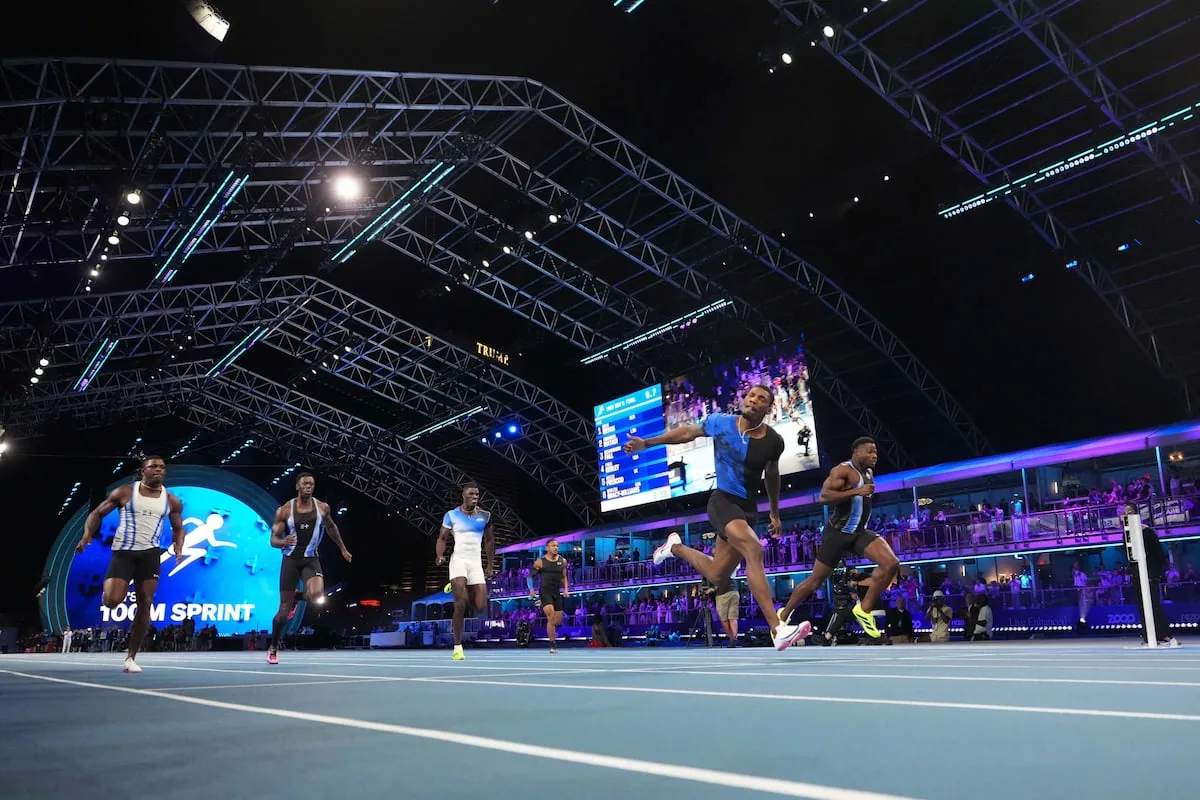
The night was closed by The Killers, vegan rock, but there were no deaths, no athlete’s veins burst nor their artificially hypertrophied muscles tore in the middle of the effort, ligaments and tendons held up in the Las Vegas parking lot where in 35 days a 100-meter elevated straight track with six lanes had been built, a 50-meter pool with four lanes, a weightlifting stage, and a long platform to seat thousands of people. Giant screens and many LEDs from six in the afternoon until one in the morning, prime time in the city of vice, the hour when life awakens.
Read more The «prom» phenomenon lands in Barcelona: hours-long lines for a graduation dress
By streaming, through half a dozen platforms, hundreds of thousands of people followed in parts the seven hours of the Enhanced Games, a delirious advertising platform in an exceptional space, outside the laws of sport, competition, and health. A dazzling commerce, a mediocre sports competition in which 42 athletes (36 of them previously doped with anabolic steroids, amphetamines, EPO, and growth hormone) competed for a global prize pool of 15 million dollars: 250,000 for the winner of each race, one million for anyone who broke a world record, which was only one, the Greek swimmer Kristian Gkolomeev, who swam the men’s 50m freestyle in 20.81s, seven hundredths faster than the legal record of the Australian Cameron McEvoy. Gkolomeev, who a year ago entered the enhanced culture and had already broken the record, used besides chemistry the forbidden physics of his polyurethane swimsuit that floats and penetrates, an illegal model for almost 20 years.
It was the last event of the night, the only chance for the sigh of relief from the CEO of the Enhanced Games, Maximilian Martin, who fell into a theatrical genuflection at the feet of the Greek giant and adored him.
Then, moved, he proclaimed that the future is already here. “Thanks to the power of enhancements, we can prove that we are better than we could ever imagine, and you are living proof of that,” he declared, according to the The Guardian journalist present there, before an enthusiastic audience made up of fitness influencers and biotechnology investors. “For the last three days, Enhanced has taken over the Internet. Enhanced is culture. And now people can also enhance and be the best version of themselves.”
The event needed that record because until then the most spectacular thing in Las Vegas had been the return of the eternally angry macho Fred Kerley, Olympic medalist in the 100m and world champion still of age to compete with the best, which he cannot legally because he is suspended for whereabouts failures for anti-doping controls. “I don’t need drugs to run fast. I can run fast anyway. I know I’m fast. I wouldn’t be here if I wasn’t fast,” he says in a report recorded during training in Abu Dhabi. “I can run faster than the others. As a man, a man only has his balls and his words. That’s why I signed up for the Enhanced, to show even more my talent. I have Olympic medals. I have world titles. They have nothing.”
After two false starts, he won the race in a mediocre 9.97s (-0.3 m/s wind), 21 hundredths worse than his best mark with doping control and 39 hundredths from Usain Bolt’s world record, his goal, and then insulted his five rivals, athletes loaded with substances at the twilight of their careers who did not miss the opportunity to show spectacular bodybuilder muscles. “Dude, they have to do better than that. They have to train a little harder. They have to get their act together and give it a little more,” he said, with an angry face even though he had just pocketed 250,000 dollars for a performance under 10 seconds. “Did you see that? A lot of false starts, a lot of jumps, a lot of people who don’t want to run the heats and all that. They have to do better than that.”
Neither Kerley, who wears white ultra Nike shoes, nor any other participant wore recognizable branded sportswear. Anonymous T-shirts. On their backs, a luminous sign and a message: “Because you know there is more, live enhanced.” And on the screens, an ad: “Build your enhancement protocol at enhanced.com.” Incitement to consumption and self-medication on the sales platform that supports the Enhanced Games. Trivialization of doping and its health dangers.
Between events, in the streaming Bryan Johnson spoke, one of the technocapitalists financing the venture and presenting himself as an expert in human enhancement. Anti-aging missionary Johnson, 48 years old, is a pale being under an umbrella that protects him from ultraviolet radiation (“90% of physical skin aging is due to the sun,” he explains; “this is an umbrella with UV protection, which protects me”), a venture capitalist and, according to Wikipedia, founder and former CEO of Kernel, a company that creates devices to monitor and record brain activity, and founder, chairman, and CEO of Braintree, a company specialized in mobile and web payment systems for e-commerce companies, acquired by PayPal for 800 million dollars in 2013. He boasts of being “the most measured man in history, with 1.5 billion data points permanently collected from his body” through hundreds of wearables. He finances the Blueprint anti-aging project under the motto “not to die.” And he talks as if testosterone, growth hormone, EPO, and amphetamines were aspirin. From whose sale he benefits. “More than 90% of participants have taken testosterone, which helps them develop muscle. It gives more strength and better recovery,” he explains to the delighted presenters with the help of graphics showing how IGF-1, an insulin-like growth factor, helps lose fat.
“Human growth hormone helps repair and recovery. EPO is not usually used in speed sports, but actually, they use it to increase capacity during training. And then some athletes use Adderall [amphetamines to increase concentration and training capacity]. And, regarding their body composition, they seek to obtain explosive energy, perfect every part of their tissue to have the necessary explosive power. That means being lean, gaining muscle, and having the capacity to win.”
Read more The reduction in ratios will mainly benefit public and charter schools with wealthier students