








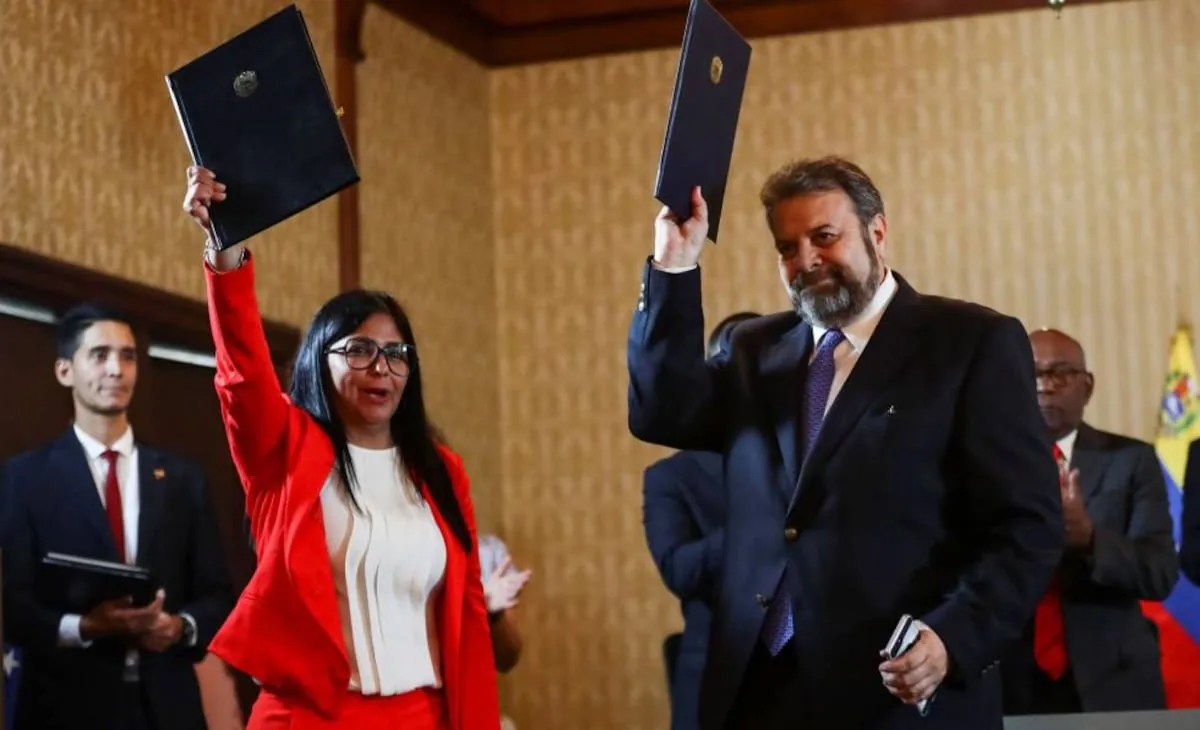
Venezuela will change its diplomatic representation in Spain. The acting president, Delcy Rodríguez, has decided to replace Gladys Gutiérrez — former magistrate of the Supreme Court and personal friend of Hugo Chávez — with Timoteo Zambrano, in an unprecedented appointment since the arrival of Chavismo to power: for the first time in more than two decades, the Venezuelan Embassy in Madrid will be held by a figure without a trajectory in Chavismo. The proposed appointment, confirmed by official Spanish and Venezuelan sources, still requires the approval of the Spanish Council of Ministers, scheduled for next Tuesday. With a long political career and a well-woven international agenda — which includes his closeness to former Spanish Prime Minister José Luis Rodríguez Zapatero — Zambrano became, since the early last decade, one of the most recurring names when assembling negotiating teams with Chavismo in moments of extreme tension.
In the same terms, the appointment of Enrique Ochoa Antich as ambassador to Germany is pending. Ochoa Antich is part of that moderate operation, the only one tolerated by the Chavista regime until January 3. Since Hugo Chávez came to power, Ochoa Antich has filed lawsuits against Chávez and Maduro before the Supreme Court for constitutional breach and embezzlement, while moderating the confrontation, maintaining that democracy will return to Venezuela with the Chavistas included.
The choice of Zambrano and Ortega Antich reflects Rodríguez’s renewed intention — conditioned by Washington — to soften the regime led by Nicolás Maduro after his capture on January 3. Among the ongoing initiatives is to include figures outside the officialdom in different spheres of power. People who facilitate dialogue from positions not identified with Chavismo, but not necessarily critical.
This has been the case with the appointment of Oliver Blanco as vice chancellor, who has been active in traditional Venezuelan opposition parties. For Delcy Rodríguez’s government, the choice of Zambrano goes further because he is formally an opposition deputy, although his vote in the National Assembly has recurrently supported the official legislative agenda.
Few names condense as many stages, alliances, and ruptures in Venezuelan politics over the last three decades as Timoteo Zambrano.
A native of Caracas born in 1955, a political scientist graduated from the Central University of Venezuela and former vice president of the Socialist International, Zambrano was trained in the militant school of Acción Democrática (AD), the founding party of the democratic-representative system that governed Venezuela between 1958 and 1998. From there came his first credentials, his first positions, and above all, a way of understanding politics as a permanent conversation between adversaries.
When Hugo Chávez came to power in 1999, Zambrano had just been elected senator. Three years later, in 2002, he sat at the Negotiation and Agreements Table sponsored by the OAS, the first international dialogue instance between Chavismo and the opposition. That was the first of many hemispheric attempts to ease a country that, since the arrival of Chavismo, had turned political conflict into a permanent climate.
In those turbulent years, Zambrano was one of the most visible spokespeople of the Democratic Coordinator, the first united alliance against Chavismo, which existed between 2002 and 2004 and collapsed after the opposition’s defeat in the Recall Referendum that ratified Chávez in power.
By 2005, Zambrano separated from AD and shortly after joined Un Nuevo Tiempo, the social-democratic party founded by Manuel Rosales in 2006, where part of the AD militancy from the nineties landed. Deputy to the Latin American Parliament after the 2010 legislative elections, Zambrano was also one of the founders and spokespeople of the Democratic Unity Roundtable (MUD), the second great unitary experiment of the anti-Chavismo.
The arrival of Nicolás Maduro after Chávez’s death, the brutal worsening of the economic and social crisis, and the resounding opposition victory in the 2015 parliamentary elections triggered a series of internal rearrangements that ended up pushing Zambrano and other moderates out of the MUD, a bloc that would dissolve in 2018.
While the social situation deteriorated, the opposition parties — already a parliamentary majority — hardened their tone, opened corruption investigations, and designed a legislative strategy to displace Maduro constitutionally. In 2017, the Supreme Court of Justice, controlled by Chavismo, stripped the National Assembly of its powers under the argument of an alleged “constitutional contempt.” The decision sparked months of massive protests and consequent repression. A year later, the MUD denounced fraud in the May 2018 presidential elections, which gave Maduro re-election.
Zambrano opposed that escalation and defended dialogue with Chavismo as the only viable way out of the political chaos. Since then, his relationship with the rest of the opposition fractured deeply and his public positions almost always became a matter of controversy.
That same year, in 2018, the future ambassador founded Cambiemos, Movimiento Ciudadano, a political organization integrated into the Democratic Alliance: a coalition of moderate organizations willing to negotiate with Chavismo on the terms it proposes, with some parliamentary and electoral presence. From Cambiemos, Zambrano has questioned the dominant “abstentionism” in much of the opposition and denounced the effects of international sanctions on the Venezuelan economy.
At the time of Maduro’s capture and the change of power hands in Caracas, Zambrano held a discreet but strategic place on the new board: member of the Permanent Commission of Foreign Policy, Sovereignty, and Integration of the National Assembly, with a fluid relationship with the surviving Chavista leadership and a communication capital that remains intact in Madrid. It is precisely that capital — that of an opponent whom Chavismo never fully felt as an adversary, and whom Washington does not reject — that Delcy Rodríguez is now mobilizing by sending him as Venezuela’s ambassador to the Kingdom of Spain.