








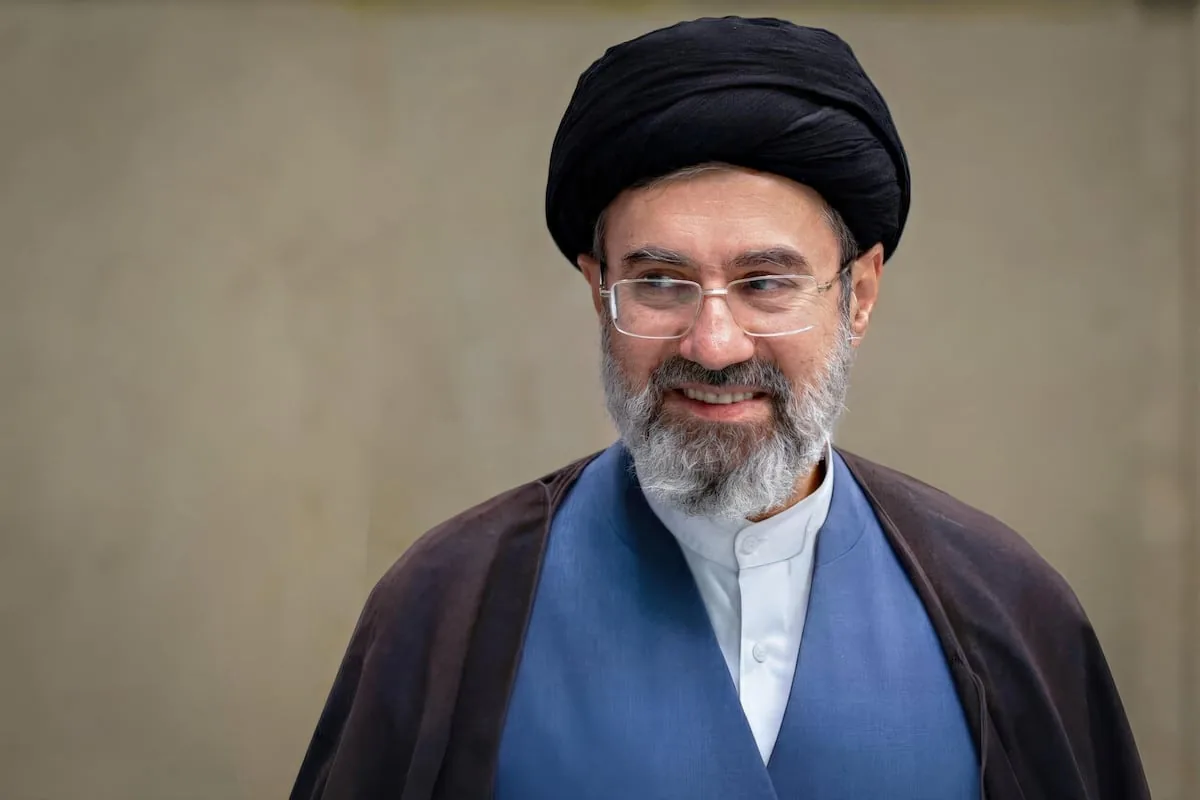
Iran has released this Thursday a speech by its new supreme leader, Mojtaba Khamenei, whose whereabouts are still unknown, in which, as in previous ones, the leader proclaims the victory of his country and the “humiliating defeat” of the United States and Israel, whom he defines as “the bullies of the world.” Read or broadcast by the official Iranian media without his voice being heard or his face seen on this occasion either, that message on the occasion of National Persian Gulf Day does not depart from the official rhetoric about the war. It does clearly outline Iran’s vision for the region for the day after the end of the conflict.
It is what the 56-year-old leader defines as “a new chapter,” a new regional and global order in which there is no place for the United States or Israel — those “foreigners who come from thousands of kilometers away” — and in which the peoples of the region “are companions of destiny,” he has stated in what seems a nod to his Arab neighbors. The war and Iranian attacks on those countries have turned a relationship that was already tense and marked by rivalry into an open wound that seems very difficult to heal.
The Iranian justification for those attacks has precisely been the US military presence in bases on their territories. Despite that small olive branch represented by that reference to the shared destiny of the countries in the area, the supreme leader has insisted on linking what he has called the “brilliant future of the Persian Gulf region” to the absence of the United States.
The “new regional order” sketched by the Iranian leader has revolved in his speech largely around the disputed management of the Strait of Hormuz. As he has done with other red lines for Iran — the nuclear issue and missiles, which he described as a “national capital” — Khamenei reiterated in his message that Iran intends to maintain control over that maritime artery in the long term.
The leader has tried, however, to present that project under a positive prism for the region. To do so, he has omitted the rejection of that possibility expressed by the great Sunni power of the Gulf, Saudi Arabia, and much more so by the United Arab Emirates, the country closest to Washington and Israel, and also the most bombed by Iran.
In that read text, Khamenei maintains that Iranian hegemony over that crucial maritime route through which one-fifth of the world’s oil normally transits not only benefits his country: “The new management of the Strait of Hormuz will bring welfare and progress for the benefit of all the nations of the region.”
The Iranian supreme leader has not specified how the Gulf countries could benefit from Tehran controlling maritime transit and charging tolls in the Strait of Hormuz, but that statement suggests that Iran could try to associate the Gulf States in that future management. Partly to give some legitimacy to a control difficult to fit into international law, but above all as a way to partly heal the wounds caused by the war and its bombings in those countries.
Tehran has shown willingness to share the income from those tolls with Oman, the other state with territorial waters in the Strait of Hormuz. However, some regional and Iranian media have evoked the possibility that Tehran might propose forming a consortium with other countries in the region to manage those waters. It is not clear whether this would include sharing the benefits of its economic exploitation with them.
Shared management of Hormuz was one of the topics discussed by Iranian Foreign Minister Abbas Araghchi with his Omani counterpart, Badr Albusaidi, on his trip to the sultanate last Saturday. The head of Iranian diplomacy traveled to Muscat from Islamabad, the Pakistani capital, which he left without waiting for the arrival of the envoys of the Donald Trump Administration, Steve Witkoff and Jared Kushner, which forced the US delegation to cancel a trip whose purpose was to resume negotiations to end the war. The dialogue then fell into limbo when on the 21st the US president extended indefinitely the fragile ceasefire still in effect.
A regional alliance
A member of the National Security Committee of the Iranian Parliament, Ahmad Bakhshayesh Ardestabi, had already stated by then that Minister Araghchi informed them in Islamabad that Iran was willing to open Hormuz, in exchange for Washington ending its own blockade. Araghchi, this deputy asserted, then referred to that possible regional consortium to manage the strait and charge tolls to ships.
According to the semi-reformist Iranian newspaper Etemad, Oman has suggested to Iran to include Saudi Arabia in that alliance that Tehran is considering to apply the new legal framework of the Strait of Hormuz, which the Iranian Parliament is already processing within a bill.
The newspaper later specifies that Tehran responded to Oman’s proposal — a conciliatory country with a marked negotiating profile — by requesting the sultanate to facilitate “the improvement of Iran’s relations with Arab countries.” After his brief stay in Oman, the Iranian foreign minister held a phone call with his Saudi counterpart, Faisal bin Farhan.
That conversation may “obey an attempt to involve regional actors in a definitive peace agreement” and also “in a framework for managing transit through the Strait of Hormuz,” the route through which the Gulf countries export most of their hydrocarbon production, pointed out earlier this week analyst Hamidreza Azizi on his blog Irananalytica.
Read more Almost 800 Catalan educational centers mobilize to suspend outings and camps next school year