








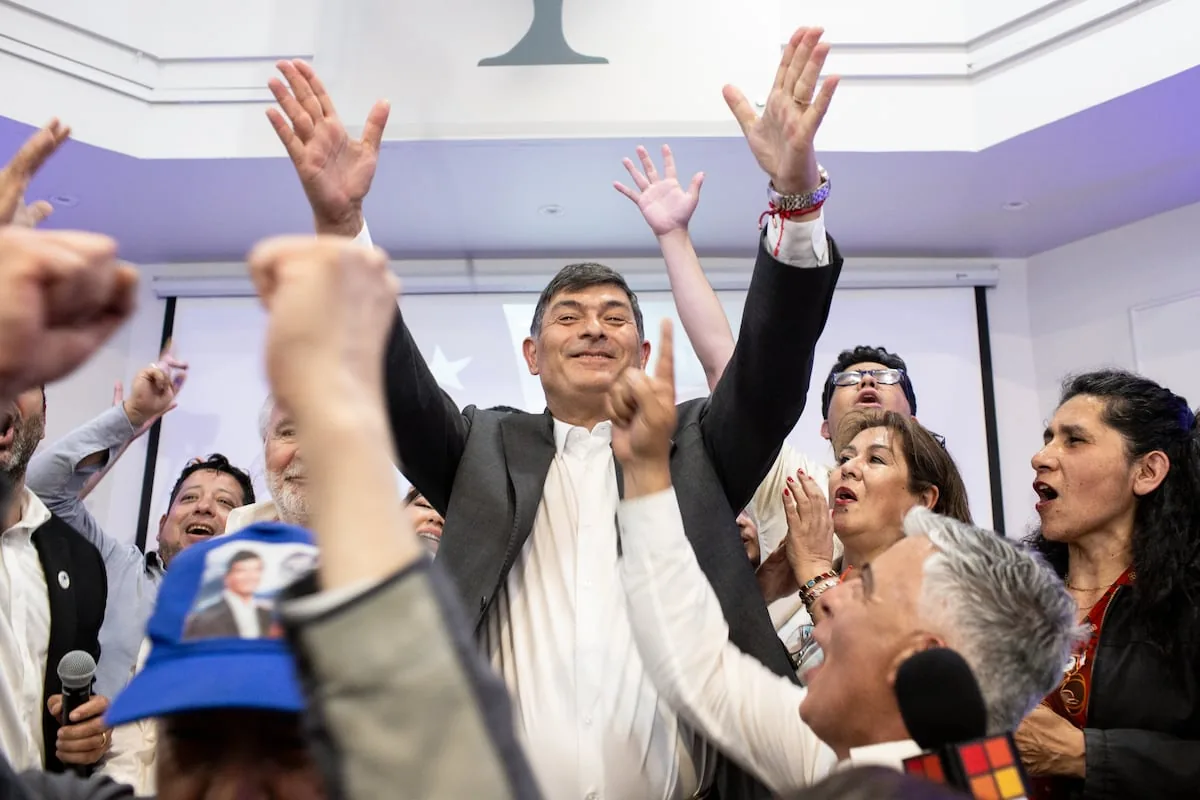
In Chilean politics, a ghost has been hovering for years that traditional forces, both on the left and on the right, have resisted taking seriously: Franco Parisi’s Partido de la Gente (Party of the People). But, as the years have passed, especially after the presidential and parliamentary elections at the end of 2025, the force of reality has shown them that it is a project that makes sense to an important group of Chileans, especially voters in northern Chile and popular sectors who view traditional politics with distance. Economist Parisi, in his third attempt to reach La Moneda, obtained third place in the first round, with about 20% of the support, in an election with mandatory voting and an automatic registration system in the electoral rolls, meaning with very high participation (his 20% is equivalent to 2,500,000 citizens). In the Chamber of Deputies, he obtained 14 congressmen – in recent weeks he was left with 13, due to the departure of deputy Cristián Contreras – which puts them in a privileged position to tip the balance in legislative discussions. This is what they have successfully demonstrated in recent hours: the Partido de la Gente, with Parisi in charge of negotiations on equal terms with the powerful Minister of Finance of José Antonio Kast’s conservative Government, Jorge Quiroz, has announced that it will vote in favor of the idea of legislating the mega-reform, after reaching an agreement with the current Administration. The party has not sealed its support for the specific articles, but it has secured benefits for the purchase of medicines, diapers, and the maintenance of a special tax statute for small and medium-sized enterprises (SMEs), three issues that make sense to a large part of the citizenry who are currently seeing the rising cost of living. It is a checkmate by Parisi, who seems determined to run a fourth campaign and become president of Chile in 2030. It is not strange to think that the political winds, this time, are beginning to blow in his favor. He holds the key: traditional politics, from the right and the left, including Kast’s Government, are not only taking the Partido de la Gente and what it means seriously, but are also making way for it. Parisi has established himself as a gravitating factor, the opposition seems to lack the capacity to react – will they manage to stop the mega-reform in the Constitutional Court? – and all this, in the privileged space of defining itself as a neutral force, “neither fascist nor communist,” as they repeated in the last campaign.
Read more Young people at Sant Jordi’s signings: “This book, once signed, becomes a treasure”
In November, after the parliamentary elections, we interviewed Mireya Dávila, a political scientist. She stated: “Parisi’s result poses a tremendous change of scenario.” This is what is beginning to show.
President Gabriel Boric has been criticized for allegedly having bequeathed an extreme right-wing government to Chile. Will Kast have a plan to prevent his legacy to the country from being a populist government?
My recommendations
Dear readers, I share with you some of our best chronicles, reports, interviews, and columns published in the last week.
Following President José Antonio Kast’s promotion of the voluntary departure of irregular foreigners, journalist Maolis Castro reported with Venezuelans, the largest group in this condition, on whether it was feasible for them to leave Chile. “Every day I want to return to Venezuela,” they told her, but they face many difficulties in doing so.
Read more Frisby Colombia loses the use of its brands in Spain
I invite you to read this profile written by Pedro Schwarze about Eitan Bloch, Kast’s influential international advisor. At 32 years old and now installed on the ‘Second Floor’ of La Moneda, the Argentine has lived in Chile since he was 15 and worked at the Israeli embassy.
Trinidad Steinert, the Minister of Security who carries Kast’s main promise, has had a complex start. Journalist Ana María Sanhueza wrote about the lawyer, daughter of a mechanic and a homemaker, who left a prominent career as a prosecutor of more than 20 years.
I recommend reading this interview with writer Javier Rodríguez, following the launch of ‘Huracán’, a novel whose eponymous protagonist is a greyhound through whose eyes readers glimpse the world he had to live in. “There is a political issue in putting the voice of a dog in a novel,” the literary editor and journalist told Pablo Marín in the conversation.