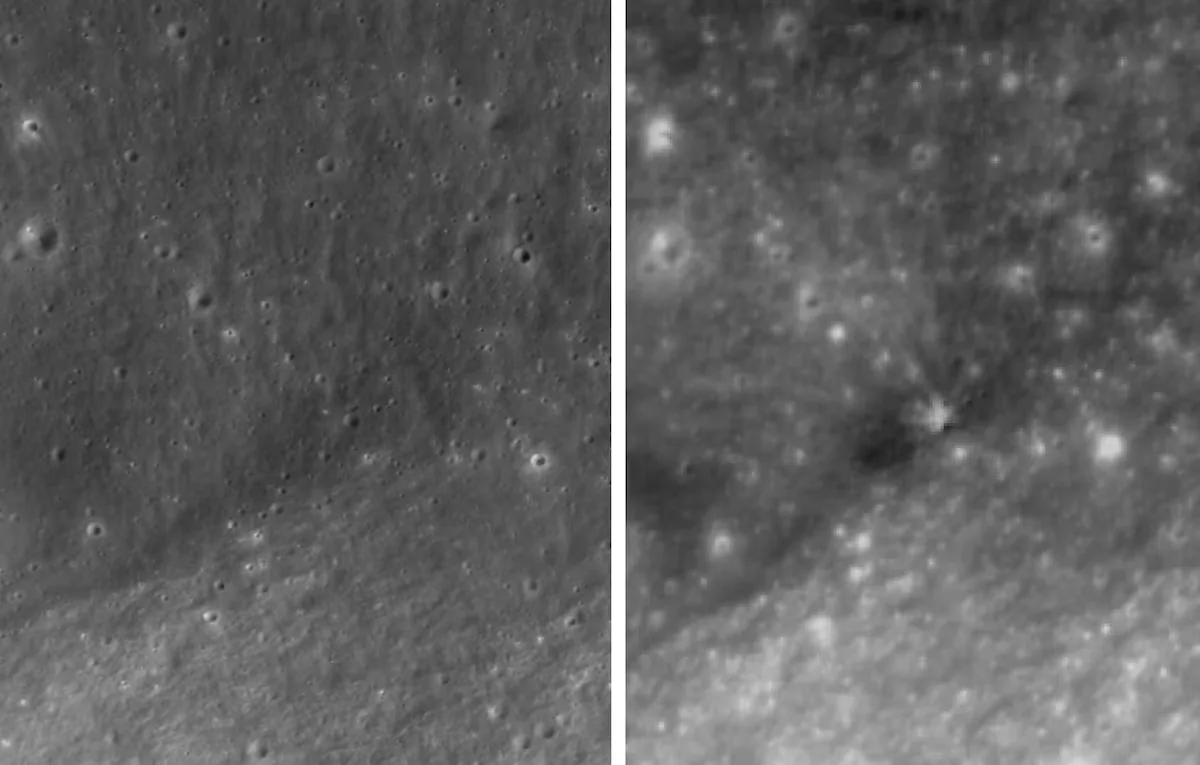









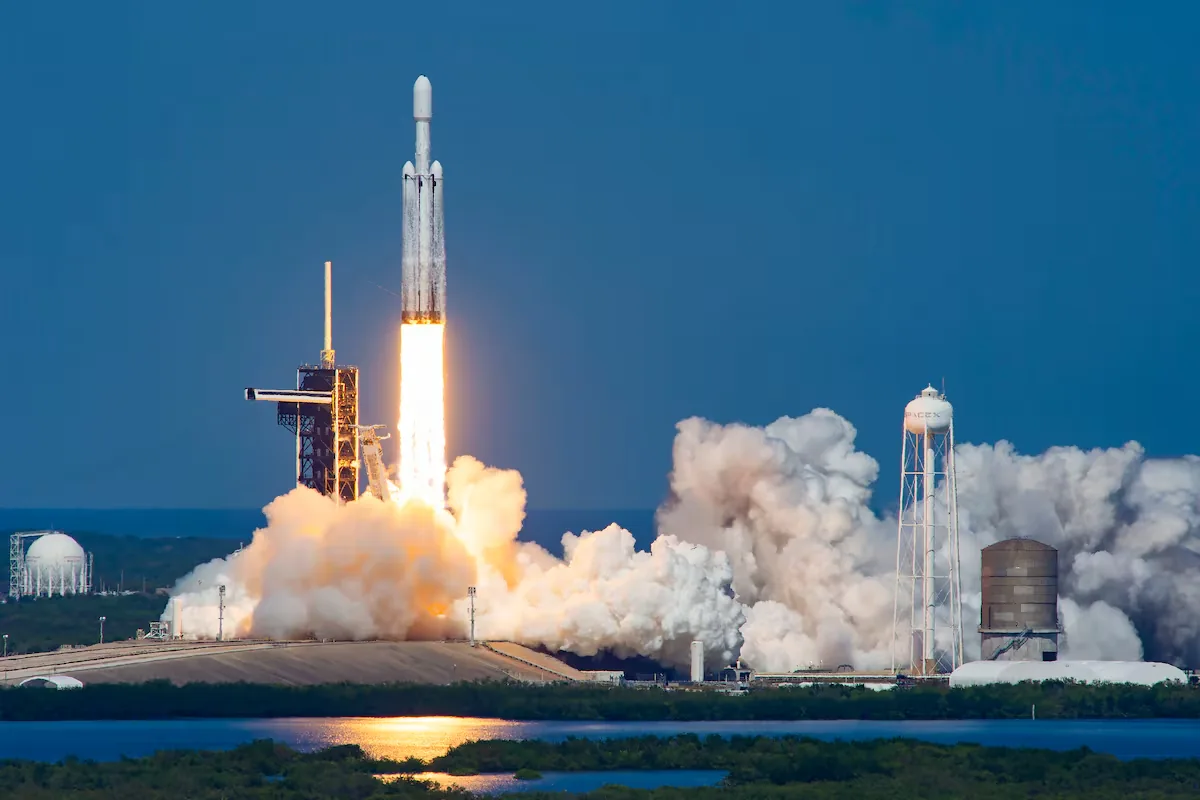
Millions of fragments from inactive satellites and abandoned rocket bodies, useless and uncontrolled, roam through space. And a SpaceX Falcon 9 rocket, from billionaire Elon Musk’s company, is one of them. After launching two private modules bound for the Moon in January 2025, it was left abandoned without enough fuel to return to Earth. After drifting uncontrollably for over a year, its journey will finally end abruptly next Wednesday, August 5. It will crash into the lunar surface at about 8,700 kilometers per hour, raising a cloud of gray dust that we might see from Earth.
The impact poses no risk to our planet, but for experts it has great symbolic value regarding the poor management of lost space debris. Moreover, it presents a rare opportunity. The crash will allow observation, almost in real time, of how a crater forms on the lunar surface from an impact. “The great advantage is that we know all the parameters of the impact,” explains César González, a science communicator at the Madrid Planetarium.
The object that will crash into the lunar surface is the upper stage of a Falcon 9, launched in January last year to transport the Blue Ghost lunar modules from Firefly Aerospace and Resilience from the Japanese company Ispace. These rockets consist of two stages: the first, larger one, propels the payload (in this case the modules) and then returns to Earth and lands on a barge, and can be reused. The upper stage, which enters orbit and cannot be reused, measures more than 12 meters and weighs four tons.
Today’s mission is our third launch to a lunar surface and just the first of several our Falcon fleet will launch for @NASA’s Commercial Lunar Payload Services (CLPS) program this year. These missions help humanity explore the Moon, Mars, and beyond, bringing us one step closer… pic.twitter.com/Go2yUccFb3
— SpaceX (@SpaceX) January 15, 2025
That launch was part of the Commercial Lunar Payload Services (CLPS) program, a NASA initiative integrated into the Artemis program to promote astronauts’ return to the Moon and establish a sustained presence on its surface. The project opened the door to private companies’ participation in transporting scientific instruments and technology demonstrators to the satellite. The United States, Europe, Japan, Canada, and other international partners collaborate in it.
Unlike natural collisions, from which only the traces they leave can be studied, in this case researchers know the object’s mass, its speed, its trajectory, and the angle at which it will strike the surface. “When the crater forms, we will be able to measure its diameter, its depth, and the energy released. Having all these data, we will understand much better how craters form on the Moon,” González points out.
The collision will also allow studying the behavior of the regolith, the fine layer of dust and rock fragments that covers the lunar surface after billions of years of meteorite impacts. “Each impact has pulverized the rock until creating that cover that practically envelops the entire Moon,” explains the expert.
According to estimates, the Falcon 9 will crash near the Einstein crater, close to the boundary between the visible and the far side of the Moon. “All the regolith that is expelled can be contrasted against the black background of the sky, which will facilitate its study,” concludes the science communicator. The crash will occur at 7:30 on Wednesday, Spanish peninsular time.
Although the scenario is unfavorable for observing a visible flash, since the impact will occur practically on the edge of the lunar disk and in a sunlit area, there is a small chance of detecting the material ejected by the crash, according to experts’ calculations. It is estimated that the impact could raise about a ton of regolith with energy that could launch some of those fragments up to three kilometers high before falling back, almost invisible from Earth. But the crater it leaves will be photographable by the probes studying the Moon.
Read more Esther Palomera and Gonzalo Miró will be the new hosts of ‘Malas lenguas’ on La 2
This is not the first time it has happened
But it is not the first time an uncontrolled rocket ends its journey by hitting the lunar surface. In 2022, an artifact was detected on a path to impact the Moon, initially thought to be a Musk Falcon. Finally, experts deduced it was a Chinese spacecraft that went out of control in 2014, which crashed in March 2022 after several years adrift. It was the first time a human-made object accidentally impacted the satellite.
For González, space debris in Earth’s vicinity “is a very serious problem.” According to the technician, an impact against an operational satellite could leave it “completely unusable” and poses a permanent risk to the International Space Station, where between five and nine astronauts live continuously.
Moreover, with the renewed push of NASA’s manned missions to the Moon and the growing role of private companies in space exploration, the communicator warns that the problem will worsen. “It is a situation that is in crescendo,” he notes. In his view, only a striking event could generate a change in attitude. “Our planet is completely surrounded by junk of all sizes. It seems that a disaster, a really serious incident, would have to happen for awareness to arise about the need to avoid continuing to leave debris in Earth’s orbit,” he laments.
As the race to establish a permanent human presence on the satellite accelerates, the regulatory framework remains nonexistent. “All this space junk now surrounding Earth will extend into cislunar space,” González warns. But regulation, if it comes, arrives years too late.
“We should have started a very long time ago,” he maintains. Although there are international treaties on outer space, he recalls they do not have the force of binding legislation for all countries nor is there an international body capable of enforcing them. “Everything works on good faith,” he summarizes.
It is estimated that about 140 million pieces of space debris orbit uncontrollably just around Earth, moving at more than 28,000 kilometers per hour, according to UN estimates. Among them, abandoned rocket stages like this one. The bodies of these vehicles are among the largest objects remaining in orbit after launches.
The Moon naturally receives impacts from thousands of meteorites. However, these types of collisions have important differences. The main one, besides their artificial origin, is the mass and speed of the object. “The Falcon 9 upper stage has an estimated mass of about four tons. Meteorites can be much larger and, above all, travel at considerably higher speeds,” González explains.