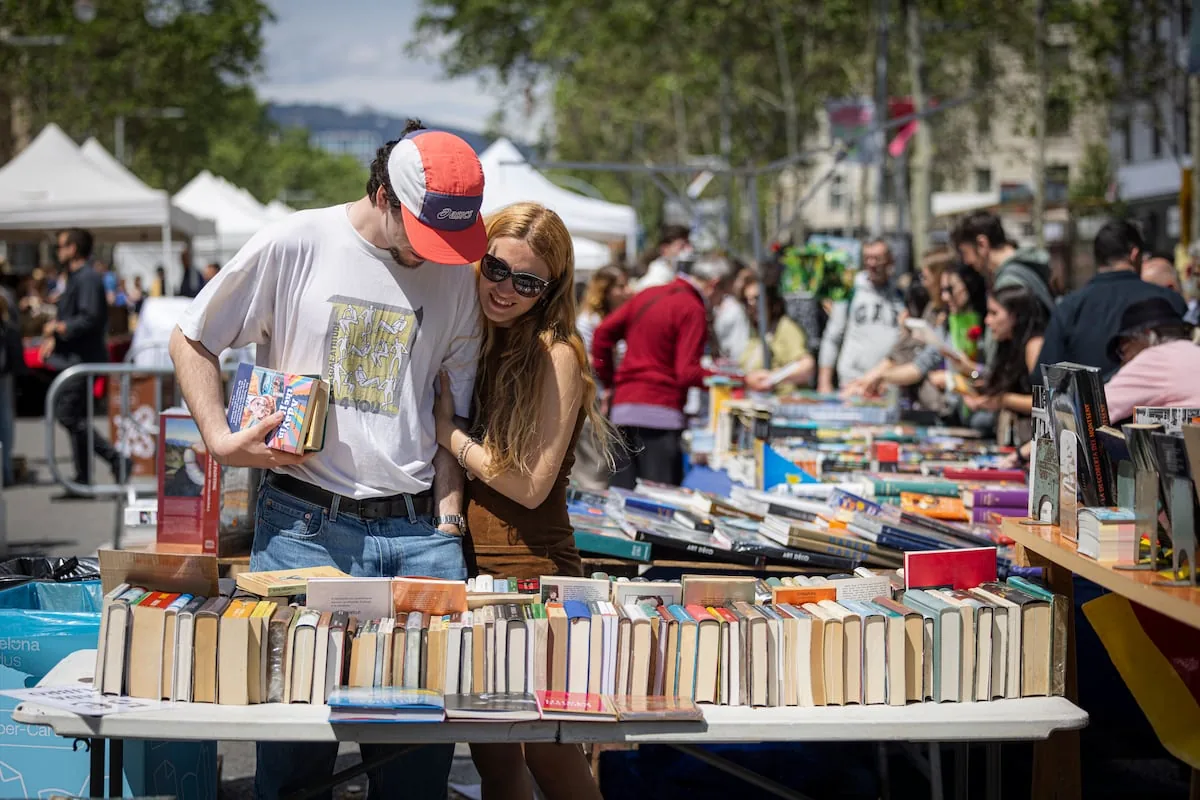










Between books and roses, Sant Jordi will also be a day of demands and political controversy. The Joventut Nacionalista de Catalunya (JNC, Junts’ youth wing) is preparing a street campaign to demand the withdrawal of the Creu de Sant Jordi (one of the highest recognitions a person can receive from the Generalitat de Catalunya) from writer Eduardo Mendoza. The post-convergent youth will distribute up to 7,000 leaflets on April 23rd at more than 40 tents across Catalonia as a protest against Mendoza’s views, who last week called for Sant Jordi to be named Book Day, something they believe would reduce the political significance of the day.
During the presentation of his new novel, The Intrigue of the Inconvenient Funeral (Seix Barral), the Barcelona-born author defended changing the name of the Diada, considering that the figure of the saint —patron of Catalonia— “has nothing to do with books or writers.” “He doesn’t fit in. Sant Jordi was an animal abuser and probably couldn’t read. He has nothing to do with books,” he said during the novel’s presentation, which tops the lists of best-selling Spanish narrative books in Catalonia. His words angered part of the Catalan independence movement, which has mobilized digitally to reclaim Sant Jordi, a festival deeply rooted both within and outside the nationalist sphere. “Sant Jordi is untouchable. It’s the day when Catalonia also explains itself to the world: books, language, and country,” interjected MP Anna Navarro, Puigdemont’s number two in the last elections, on X. Senator Eduard Pujol (Junts) also lashed out on the social network against the meaning of Mendoza’s words and against the sectors that support the writer. “They are bad people, and cowards. And now they feel emboldened by the tripartite.” Puigdemont himself also spoke of “revenge of the resentful” to refer to Mendoza’s words. On extremist and often anonymous social media profiles, there is also a call for a burning of the author’s books, taking advantage of the bonfires of San Juan.
Now the JNC intends to concretize the boycott. The entity urges citizens to directly ask the Government to withdraw the Creu de Sant Jordi awarded to the writer in 1995. “His statements against the Diada de Sant Jordi, which represents one of the emblems of Catalan identity, do not make him worthy of continuing to hold such recognition,” it claims. The leaflets to be distributed on Thursday explain step-by-step how to make the request to the Catalan Executive. They even propose a joint subject: “Petition to withdraw the Creu de Sant Jordi from Eduardo Mendoza.” The anonymous Segell Fosc, one of the promoters of the Menjòmetre search engine that questions the current subsidy system in Catalonia, has also launched a campaign on Change.org with the same objective, which has surpassed 6,500 petitions. Contacted by EL PAÍS, the Department of Culture of the Generalitat “rejects” Mendoza’s proposals but understands that they fall within “freedom of expression.”

Neither Eduardo Mendoza nor the publisher has wanted to respond to the criticisms of recent days, “because all noise contributes to creating a climate in which no one feels comfortable,” they state. However, the writer did address the conflict in a promotional interview for his new novel for El Periódico: “It was a joke! Because it seems that Sant Jordi is the patron saint of book sales, of writers and readers, but he is an intruder. He has gotten in there. It was Book Day because it was the death of Shakespeare and Cervantes. But honestly, I don’t care about Sant Jordi.”
Read more A Washington-backed company buys the only company that produces rare earths in Brazil
Different Approaches
Since the controversy erupted, personalities from the literary sector have spoken out about it with different approaches. Writer Ignacio Martínez de Pisón considers the reaction surprising, given that “Mendoza is a person everyone likes.” He believes that his statements should be interpreted as a “trait of wit and humor,” and that the reaction is “an ember of the Procés” that “has taken the statements too seriously.” Fellow writer Carlota Gurt states that Book Day “is not only Book Day, but also of the rose and lovers,” and changing the name would hide that. Furthermore, she believes that the proposal “aims to denationalize the day” and that “it does not align with the concord that is supposedly desired.”
Other voices deny that Sant Jordi’s day historically has nothing to do with book sales, as Mendoza’s statements suggest. As Marçal Font-Espí, the former president of the old book guild and owner of the Fénix bookstore, explains in a video circulated on social media, based on his collection’s archives, when Sant Jordi’s relics, patron saint of Catalonia, were moved to the Palau de la Generalitat in the 14th century, fairs were held coinciding with the festivity, where toys, fruits, and also flowers and books were sold. At that fair, books gained prominence during the second half of the 19th century, consolidating as a day of literature during the Renaixença. Since 1926, the body that united the book chambers under Primo de Rivera’s mandate conceived the Spanish Book Day festival, which was initially celebrated in October, coinciding with Cervantes’ birth: “It was an institutional festival; nowhere was that festival associated with a book fair, only in Catalonia,” explains Font-Espí. In 1930, with the fall of Primo de Rivera, the festival was changed to April 23rd, a date close to the writer’s death, merging the two festivals.
Read more The heartbreaking murder of eight children in Louisiana shocks the United States