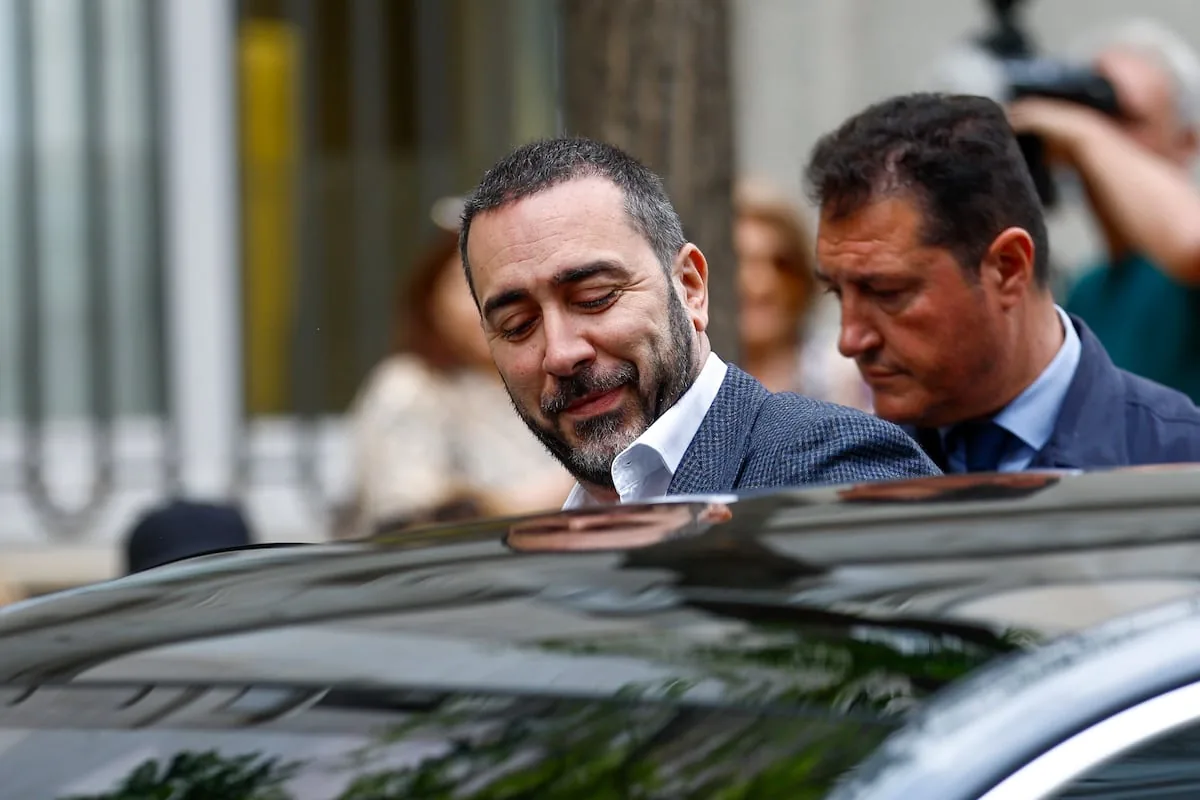










He started off elusive. Bent over himself, showing only a crown of hair that contrasts with a thick beard that disguises his notable weight loss. It has cost him, as he got hooked on the prison gym, of which he is now the master and lord. Little by little he loosened up, mainly in bursts of anger. And there his character showed, the one that for better or worse ― ended up on the bench ― made him the man who did everything in the Ministry of Transport. At the single window to reach José Luis Ábalos. All the witnesses who have appeared before the Supreme Court for the case that bears his name have agreed on that. Also, that he is “particular.”
That is how the former president of Adif Isabel Pardo de Vera started, with a discreet term that, as the story progressed, became clearly insufficient. She suffered it. She is an “institutionalist” woman and he did not fit the profile she was used to. “If not, Jose cuts my balls off,” she told her to get Jésica Rodríguez, the boss’s girlfriend, a job. “It was his usual language,” she replied resignedly. She resigned herself so much that she immolated herself and decided to act as a firewall. So that an “institutional” climate would continue to reign in Adif, she was the only one who dealt with him. García’s lawyer ― in constant communication with her client ― tried to correct. “Do you mean that he was spontaneous, that he used a relaxed tone?” she tried. “No, that he does not meet institutional standards,” the other snapped.
Read more Víctor de Aldama, one more in the Ministry of Transport
José Luis Rodríguez, a civil guard assigned to the Ministry of Transport, could not disagree more. “Mr. Koldo was an absolutely respectable person.” “Stressed” but “very respectful,” “very cordial” and “very kind.” How could he not occasionally give some of those masks that were kept in the official warehouse. Agent Rodríguez, at your service. Was it black market? “Negative!” But did he keep track? “Affirmative!” Everything in order. Move along.