







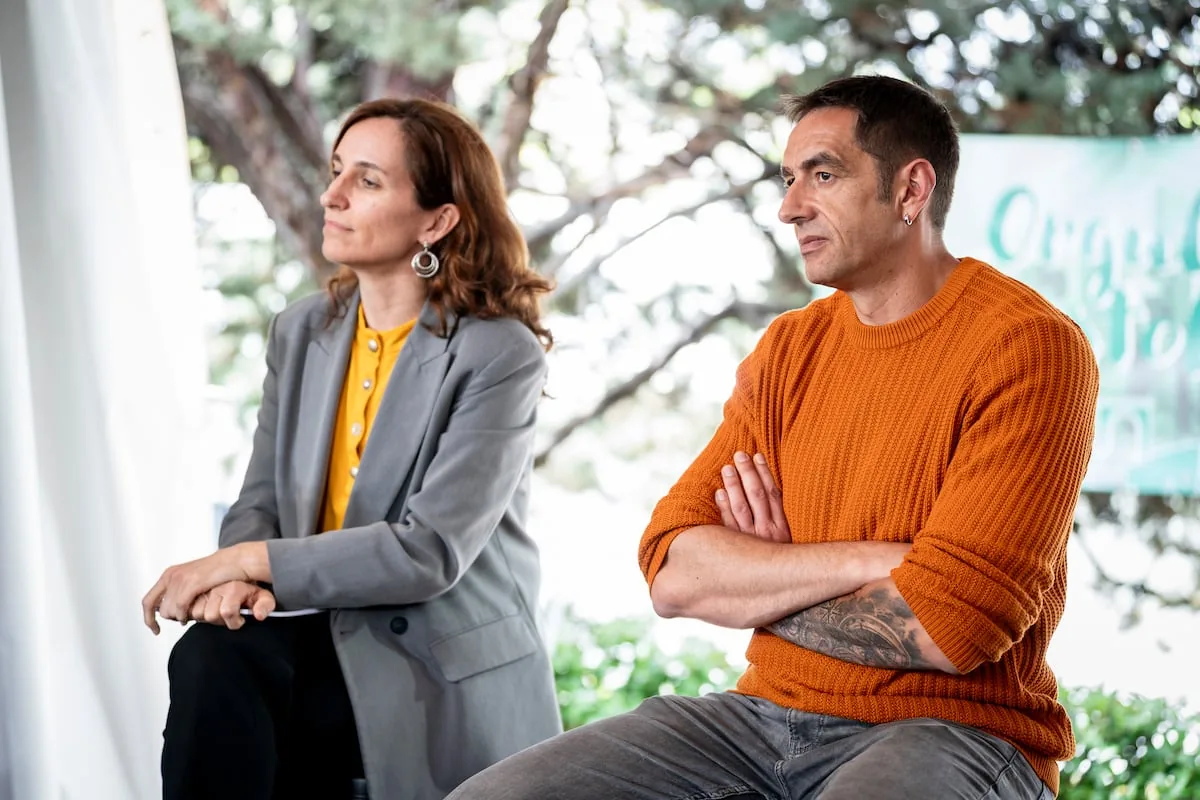
Great celebrations hold discord in their core. In 2018, Mónica García accompanied Emilio Delgado in what was supposed to be one of the happiest moments of his life: his wedding. They were good friends, party colleagues, peers who shared the same ideals. And they were united by the best glue there is: that of a common enemy. Both opposed Irene Montero and Pablo Iglesias, whom they blamed for having led Podemos astray. Delgado’s marriage did not last long and now the rift with one of the guests, Mónica García, whom he can no longer call a friend, has become visible to everyone.
Read more Immigrant regularization divides Spaniards: 38% in favor and 33% against
Emilio Delgado, 49, and Mónica García, 52, will compete for the leadership of Más Madrid in primaries that have strained the party at an unexpected moment. The winner will, de facto, have control of the formation and will be the one to face Isabel Díaz Ayuso in the 2027 elections. The fact that both knew about each other’s secret ambitions has created a distrust over these months that has permeated the membership. Something broke between them and has never been repaired since February, when the deputy in the Madrid Assembly, without consulting his party’s leadership, publicly debated with Gabriel Rufián about the future of the left. It turned out to be a dialogue full of reproaches and criticisms of the current direction of progressivism that had only one reading: Delgado was unhappy with his party.
And now he wants to lead a new left with more presence of the popular, of which he feels a representative in a party abundant with sociologists and graduates in Political Science who live in central Madrid.
Son of a bricklayer and CCOO unionist, and a housewife mother, raised between Móstoles and Vallecas, he sees himself capable of representing people from the outskirts, from the neighborhoods, the workers who now feel more identified with Vox. These are his keys to open his party’s safe and he is preparing for what is to come. Emilio wants to take power and transform reality; that’s what it’s about. These days he is reading Epifanía, by Israel Merino.
His aspiration has been perceived as a betrayal by Mónica García, Minister of Health, and all the people around her. They have taken very badly the fact that Emilio criticized the architecture of the primaries, a year after their approval and in a televised clash.
García, daughter of psychiatrists, has on her nightstand two books written by women, one of them with a feminist background: Oxígeno, by Marta Jiménez Serrano; and Comerás flores, by Lucía Solla Sobral. The minister has Rigoberta Bandini on Spotify as one of her most listened artists. Emilio listens more to Hoke, the rapper.
García finds Delgado’s attempt too aggressive. Her temperament, they say in her team, is different. An anecdote: one day before the debate on the state of the Community of Madrid, in 2021, Mónica García was walking with her three children in Retiro Park, a disconnection she usually does daily and that helps her clear her mind and review the next day’s agenda. That September afternoon, the Más Madrid leader saw Ayuso among the trees. Upon seeing her, the Madrid president approached her: “Don’t be too harsh on me tomorrow in the debate, Mónica!”
Read more Vox confirms its downward trend and loses almost one point in vote estimation in a month
It was a relaxed conversation that reflected the moment of that legislature. Since then, García is the image of a party that has overtaken the PSOE in the Madrid region and in the very capital of Spain. The close associates of the current minister acknowledge that she is a woman who is not afraid to delegate, who does not have the typical personality traits of those who reach the front line, with huge egos and worried all day about their image. “Under normal conditions,” admits a senior official from the Ministry of Health, “her profile would not have reached the top of a party.”
Graduated in Medicine and Surgery from the Complutense University in the 90s — Emilio has two higher vocational training degrees — her image was suddenly shared among healthcare workers when she served as spokesperson for the Association of Specialist Physicians of Madrid (AFEM) during the iron years of Esperanza Aguirre. She was one of the “white voices” of the region, when Ignacio González’s PP announced in 2012, abruptly, the privatization of six public hospitals. Fourteen years later, she is the current Minister of Health of Spain. “Few ministries have passed more regulations,” they point out in her team. “She believes in healthcare. Now, however, she faces an unprecedented doctors’ strike. The “emilists” believe this wear will cost her at the polls.
The break between them was reflected in a tense conversation they had on a debate program on La Sexta and a phone conversation revealed by EL PAÍS. The internal war between their supporters has broken out. Más Madrid will hold primaries again this year, still without a date. The leadership and main officials are with García, who controls the party after the pandemic. Emilio Delgado believes his rising popularity — gained in TV talk shows and not by the party’s effect, which he believes has hidden him in the last two years — is enough to snatch the leadership from her.
It will not be easy. Mónica García has already emerged victorious from other clashes. In seven years she has fought three major internal battles, covert and silent; the last with Íñigo Errejón, from which nothing leaked to the press. “That was tremendous,” recalls a senior party official, “we negotiated without anything leaking. But this is different. This was seen on television; what Delgado did can never be done.”
As happened between Pablo Iglesias and Errejón, here we also witness the end of a friendship. In that triangle, the current spokesperson in the Assembly, Manuela Bergerot, also plays a role, who has sided with Mónica. Bergerot and the minister remain very close, not so with Emilio, whom García lost sight of a bit when he went to the Ministry.
García has announced she is returning to Madrid and, despite being a minister, continues her usual routines in Retiro, where she goes running when she can, or with the dog, in full view of everyone. “I have never left Madrid,” she says herself in a phone conversation after the party’s most critical week. For Delgado, yes, he left; in fact, he believes he abandoned his role as opposition leader to Ayuso to make the leap to national politics. “They want us as opening acts,” he says himself on the phone. Only one of the two will convince the members.
Read more United States will deploy destroyers, planes, and 15,000 soldiers to escort ships trapped in Hormuz