

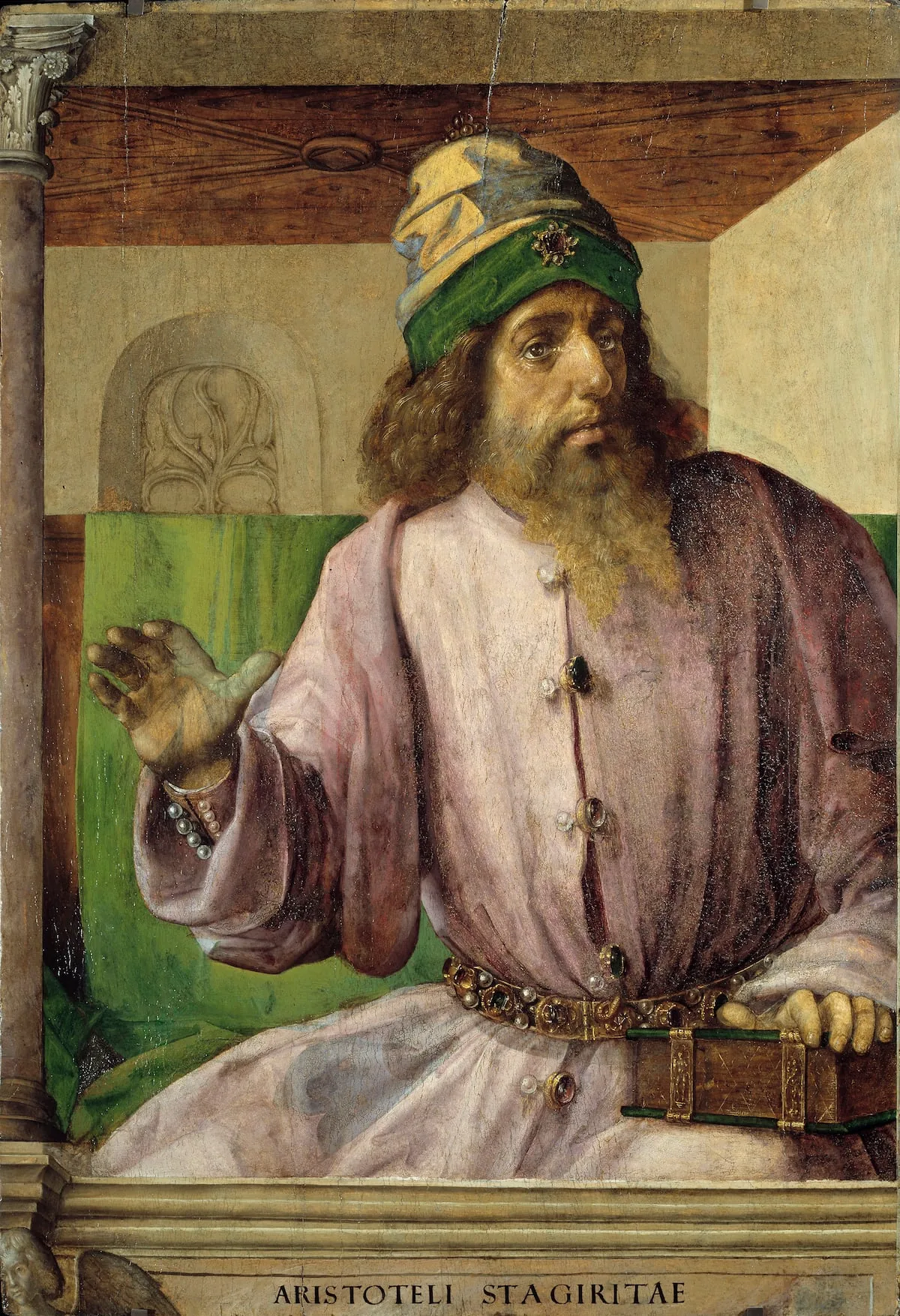
The publication of a new work by Aristotle is not a novelty in the philosophical and philological career of Miguel Candel. If he had already offered us two superb versions of Aristotle’s Politics and Metaphysics at Bernat Metge, with this On the Heavens he continues a life dedicated to the Stagirite and gifts readers of ancient philosophy in Catalan with a major text of classical cosmology and a treatise that for centuries inspired all those who thought about the order of the world. The editorial claim promoting it as “the most influential treatise of antiquity on the formation and nature of the universe” is not hyperbolic: De caelo is a key work for understanding the development of physics, metaphysics, and cosmology inherited by late antiquity, the Arab world, and scholastic philosophy up to the Copernican revolution.
Herbert Butterfield said that all past science seems blind superstition to all future science. It is true that today the reading of ancient cosmology is done from the distance of an antiquarian or a historian of science and philosophy. Surpassed by modern science, by the mechanics of Galileo and Newton, this edition allows the restoration of Aristotle’s intellectual vastness. We would show no small insensitivity and ignorance if we only pointed out the scientific errors and did not value the thinker who tries to describe a finite, geocentric, and geostatic universe, ordered and hierarchical, intelligible from the coherent principles of a physics of five elements: water, earth, fire, air, and ether. The distinction between the sublunar world, changing and mobile, and the supralunar, eternal and immobile, still challenges us today because it shows to what extent the question “what is the world?” is not only empirical but also rational.
Candel is one of the great Catalan mediators of Aristotle, and this is perceived during the reading in the balance between philological maturity and conceptual clarity, especially because opaque archaisms and anachronistic modernisms are avoided. This edition of this small great cosmological treatise does not disappoint at all in fulfilling the two imperatives to which the Bernat Metge collection has accustomed us: philological rigor to make Aristotle readable in 21st-century Catalan and exhaustive knowledge of Aristotelian terminology to avoid turning the reading into an exercise only suitable for specialists. As always, the presence of the revised Greek text, as Aristotle would say, meets the expectations of the curious who discover the debt of our cosmological vocabulary to ancient Greek.
A millenary work on physics and astronomy demands a rich apparatus of notes for constant contextualization. On the Heavens is a treatise in which Aristotle here and there discusses with the Presocratics, reformulates Platonic positions, and uses the technical vocabulary of his physics and cosmology, where distinctions and nuances only become transparent if the reader is pedagogically initiated into the whole of Aristotelian philosophy. In this sense, the merit of the edition does not derive only from the translation but from Candel’s ability to accompany the reader with commendable argumentative clarity, neither repetitive nor convoluted.
On the Heavens is not as widely read and known a text of the Aristotelian corpus as the Nicomachean Ethics, the Metaphysics, the Politics, or the Poetics, but it is essential to understand the Aristotelian philosophical system as a whole. Without this work, many Aristotelian assertions about nature, change, place, or movement would be directionless in the universe of crystalline spheres. However, we will not deceive the reader, because reading the canonical cosmological work over two millennia poses no small effort. The speculative and qualitative nature of Aristotelian philosophy, especially the Physics and the Metaphysics, is not always intuitive and easily understandable for the modern reader, and Aristotle’s way of reasoning often requires considerable hermeneutic discipline. We feel accompanied by the quality of Candel’s notes and introduction.
Dealing with “the nature of the heavens, the stars, and the Earth” and, in general, the harmonious architecture of the cosmos, is a sufficiently weighty claim for the work to continue being an essential reading of the Aristotelian corpus and ancient cosmology. On the Heavens is not only about Greek astronomy but about how the genius of a philosopher, perhaps the greatest philosopher of all time — and forgive us the Platonists — systematically orders all the layers of reality.
It surely will not be Aristotle’s most read book, but it is one of the most revealing for understanding to what extent ancient philosophy thought of the cosmos as a complete, finite, and rational order, as a form of intelligibility of the world that guided all those who, with their feet on the ground, before the splendor of the stars, looked enraptured at the sky, until the triumph of classical mechanics in the 17th century displaced man and the Earth from the center of the world and threw them from a finite world to an infinite universe.
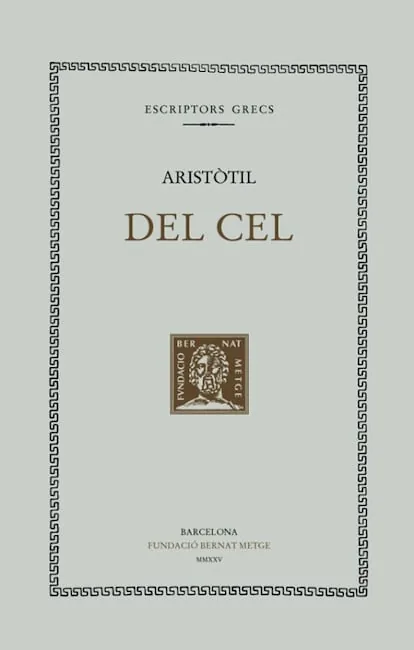
On the Heavens
Introduction, revised Greek text, translation and notes by Miguel Candel
La Casa dels Clàssics
400 pages. 39 euros