









Leviathan is one of the cornerstone works of modern philosophy in general and political philosophy in particular. It is also one of those books infinitely more quoted than read. But Leviathan is a literary artifact that goes beyond the general ideas we are supposed to attribute to it, a book in which images, metaphors, the resources mobilized, and the dialogue with the historical context are inseparable from the content. For all these reasons, having an edition in Catalan for the first time is an immense cultural milestone. And to gauge the importance of this edition and address the clichés about Hobbes that should begin to be revised, we speak with philosophy professor Josep Montserrat Molas, responsible for the translation along with professor Roger Castellanos Corbera.
Read more Review of ‘The Boys of Dungeon Lane’ | Paul McCartney makes melancholy a fragile work of art
Question. One of Hobbes’ most quoted phrases, a saying still very much alive in the English language today, is that without government, man’s life would be “nasty, brutish and short.” How should we say this phrase in Catalan from now on?
Answer. [We open the book to look for it] Apart from the three final adjectives that are usually highlighted, Hobbes’ full phrase says that without government, man’s life would be “solitary, poor, nasty, brutish, and short.”
Q. Why is this phrase so important?
A. It is a key phrase. It breaks the great model of understanding politics that had prevailed until then, which says that man is a political animal. This is the concept in which Hobbes and everyone had been educated, and this phrase says that, simply, this is not so. Politics is not natural: politics is an artifice, a construction. And politics is an indispensable construction because man’s natural state is not pleasant at all. The human being is not comfortable in nature. We do not live in paradise. Life is struggle, combat, necessity. Any non-naive observation of nature makes this clear. And we find ourselves in this nature as just another being. It is nothing strange, it is not a punishment; this analysis is a simple observation that does not imply elements of religious valuation. From this observation, which Hobbes was able to see and experience firsthand, men must build politics.
Q. The phrase is always used as an example of a very dark conception of human nature, influenced by Hobbes’ equally dark personality and biography.
A. Precisely, this edition aims to help correct the negative characterization of the figure. Hobbes liked to play tennis. He enjoyed drinking and the good life. He lived in a comfortable and luxurious world, as an attendant to great English lords. He was very aware of the joy of living. But he was also very aware of the brutality of a merciless civil war, the experience of a professional army that militarily occupies the country. Hobbes witnessed the king’s beheading. Leviathan is dedicated to the brother of a friend of his who died treacherously in these battles. For all these reasons, the cliché that Hobbes has a dark view of human nature must be fought: he sees it in all its aspects, with lights and shadows.
This edition aims to help correct the negative characterization of the figure
Q. Where does the energy for this philosophical upheaval come from?
A. Hobbes is part of the scientific revolution. He is a contemporary and participant in the same enterprise as Galileo and Descartes. And he not only defends science but also technology: he is a great enthusiast of optics, like Spinoza, and polishing lenses is a hobby that accompanied him all his life. At the same time, he was educated in the classical humanist model and does not reject it: his first work is a translation of The Peloponnesian War by Thucydides, and he ended his life making a verse translation of the Iliad and the Odyssey.
Q. Hobbes’ fundamental notion is that of the pact, citizens agreeing to cede power to the sovereign. Is this a vision of politics too authoritarian for our contemporary democratic perspective?
A. Hobbes is a thinker who thinks things through to the bottom, and therefore, from his thought, the most superficial political deployment can take many forms. That said, it must be taken into account that his formulation of the submission pact is that of a pact among equals. Hobbes insists on the absolute equality of all human beings: not as a positive value, but as the observation that anyone can kill anyone. Well, the submission pact says that one cedes power to the sovereign on the condition that the other does the same. What is constituted is a man or an assembly. The important thing is the unity of this entity to which the collective transfers power and agrees to submit to its authority. Hobbes does not care if it is a king or an assembly; what matters to him is that, once transferred, this authority does not disintegrate and is clear, that the sovereign is the one who ends up deciding. The point is that a decision must be made at a certain moment and that this decision must then be obeyed.
Q. Once instituted, is Hobbes’ sovereign too authoritarian?
A. Hobbes’ idea is that when the people speak, what they say is what counts. The problem with our democracy is that either the people are not allowed to speak, or when they do, what they say is not done. Because we find ourselves in a regime that, besides being democratic, is other things as well. Hobbes would say that if we want to play at being democrats, we must be consistent, and when the people say something, there is no possible appeal. Because if, when the people decide, we introduce other instances to which we can appeal to decide something else, then those are the ones who rule. The idea that all power is with the people is perfectly Hobbesian.

Q. One of the charms of this edition is that it reproduces the frontispiece of the original pages, at the same size.
A. The frontispiece is made to be looked at with a magnifying glass, with a lens like those Hobbes himself made. The charm is to stop at the details. In the image of the frontispiece that the artist made following Hobbes’ instructions, it is very clear that for Hobbes, politics requires nothing more than men, and that men are matter in motion and nothing else. If you look at it with a magnifying glass, the Leviathan is made up of all kinds of things: not only men, but also women, children, clothes of all kinds. Everything is loaded with meaning. In the first draft of the illustration, everyone had to look at the reader, but in the final version, they turn their backs and look at what they are building, which is the overcoming of what is seen in the lower part of the frontispiece: civil power and ecclesiastical power. The idea of the frontispiece is that in the lower half there is conflict (weapons for military dispute, but also for theological and religious dispute), but the moment everyone unites in the submission pact to the sovereign, everything becomes peaceful. That is why we see ships sailing where the wind blows, mail, commerce, etc. Hobbes’ idea is that things must be looked at with lenses. My need will always seem greater than that of the other because it is closer to me; it is a matter of simple perspective. The human error is not looking from the appropriate distance, and because of this, not using the appropriate word to apply reason well.
Read more No hormones: the odyssey to find Lenzetto, Spain’s scarcest medication
Q. John Gray is one of the most famous contemporary philosophers who most actively advocates Hobbes. His latest book is titled The new Leviathans, and argues that we must return to Hobbes, but the danger of the new Leviathans is that, unlike Hobbes’, they are not content with providing security and sovereignty, but try to shape the consciousness of their citizens.
A. The fourth part of Leviathan has a great title: ‘The Kingdom of Darkness’. It is the great story of mind manipulation. Hobbes explains how religion and university philosophy manipulate the clergy and intellectuals to transmit superstitions to the people designed to subjugate them. He makes a critique to dissolve these darknesses. And this critique must be understood to complete the meaning of the other parts. It is the idea that, ultimately, what happens in the inner core of the person should not be of interest to politics.
Q. Let’s talk about Hobbes’ language: can he be considered one of the pillars of the famous clarity of Anglo-Saxon philosophy, both in prose and argumentation?
A. Hobbes reflects on language: he says it is the instrument for calculation, and calculation is reason. To be able to make a language that tells the truth, we need clear definitions, that are not ambiguous, and to be able to move these pieces. Many arguments he constructs in Leviathan are of this type. What happens is that Leviathan is a work conceived for the moment when Hobbes returns from exile to Cromwell’s republican England, and he, who had exiled himself as a supporter of the royalist party, writes a text about how a republic should be governed. This artifact is full of images and metaphors designed to convince those in power that the book must be read at the university and replace the kingdom of darkness.
For us, the state is something very natural, and Hobbes wants to make clear that it is not
Q. You say this edition tries to play in the league of the greatest, making a relevant academic contribution to the international study of Hobbes.
A. It is the attempt to make an integrated version. On the one hand, we have a relatively recent edition by Noel Malcolm that is exemplary because it combines the English critical edition and the Latin critical edition, so you can compare them page by page. On the other hand, we have editions that usually take the English text in different stages of fidelity to the original. We have made a version situated exactly at the moment when Hobbes composes the definitive version. We could have stuck with the Latin version because it is the last one. But both for the history of the English edition, which has triumphed since the 19th century, and for what Hobbes himself does, which is not only a translation but many self-corrections and reworkings, we believe it is necessary to play with both. This has led us to make a series of decisions. If the Latin text adds, we add it, and if it subtracts, we indicate it. There are also variants that appear when he says things differently depending on the language, and this can lead to many paradoxes. And finally, we can read deliberate suppressions and additions of entire chapters.
Q. What has been the most difficult to translate?
A. Using republic to translate commonwealth from English, or the duo civitas and res publica from Latin. Too many translations translate everything as state, but Hobbes is very precise and only uses the term state (State) when talking about ecclesiastical and civil states, but not when talking about the republic. For the contemporary reader, our state is not Hobbes’ republic. Hobbes is talking about something that comes before the administrative deployment of regimes. For us, the state is something very natural, and Hobbes wants to make clear that it is not. It is because it is something deeper that the republic can be deployed in very different names and structures.
Q. This book continues the “Philosophy Collection UB. Magna Series,” with great works like Kant’s Critique of Pure Reason or Edmund Husserl’s Metaphysical Meditations. What is behind such an ambitious project?
A. This is something that must be done, and since it was not done, we did it. Catalan culture has struggled a lot to have the conditions to produce a work like Leviathan, both in terms of freedom of thought and freedom of language. It represents that we have been normalized for 40 or 50 years. But we should ask ourselves why works like Kant’s Critique of Pure Reason, Aristotle’s Metaphysics, or Hobbes’ Leviathan, until very recently, have not been available to students, academics, or cultured people who want to read these works in their language. This lack is precisely due to a lack of the political background that Hobbes denounces in his book.
Q. Was there a Hobbes gap in the Catalan tradition?
A. Alexandre Galí has a very interesting reflection on the deficit of philosophy in Catalan; he states that the big problem is the dominance of Catholicism. He says our deficit comes from Torras i Bages. Hobbes was a heretic, he was English, that “perfidious Albion,” and he had a very harsh view of power… Hobbes had all the odds against him to be excluded.
Read more ‘The drama’: immune to the massive cult of queen Zendaya
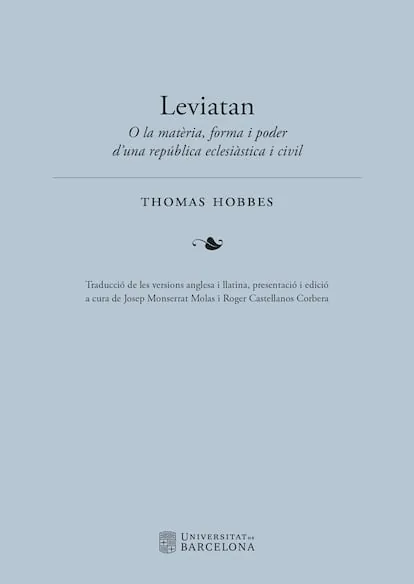
Leviathan. Or the matter, form, and power of an ecclesiastical and civil republic
Translation of the English and Latin versions, presentation and edition by Josep Monserrat Molas and Roger Castellanos Corbera
Edicions UB
736 pages. 45 euros