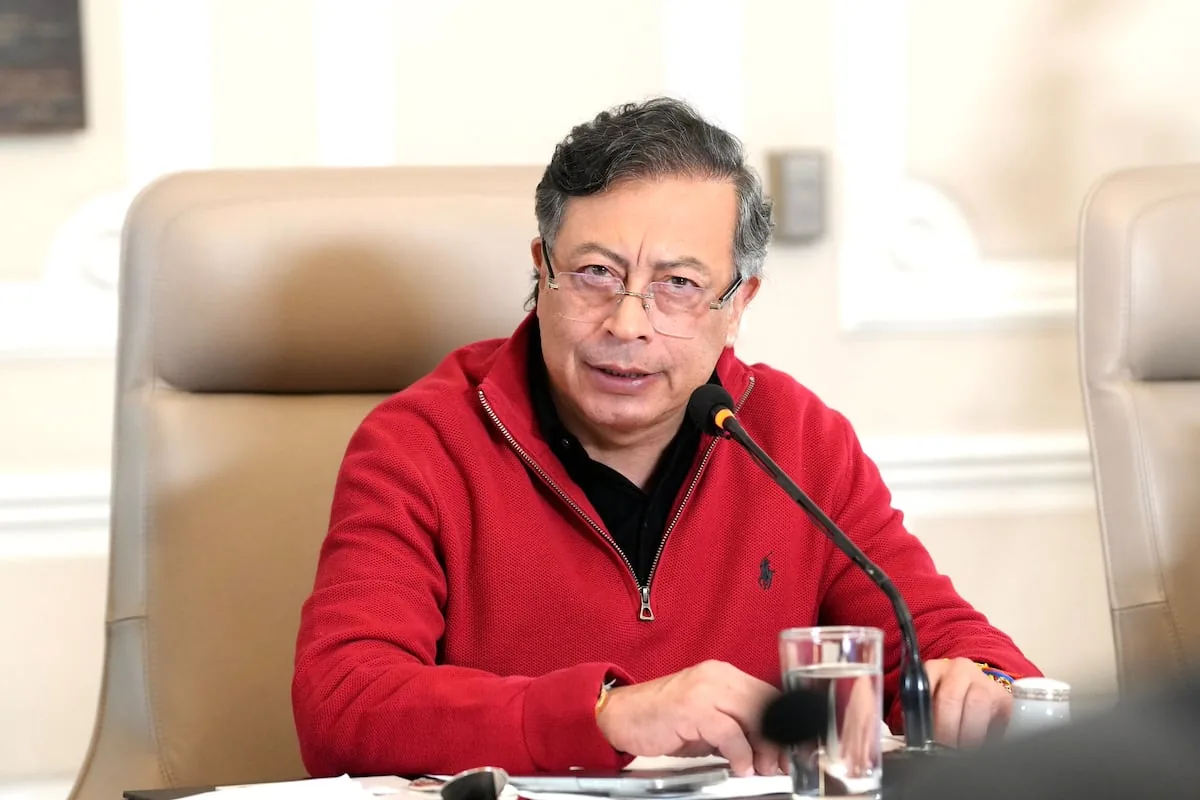




The Petro Government’s promise of total peace, which sought to include members of criminal gangs for the first time, is nearing its end without conclusive results. The Executive established four dialogue spaces with urban structures in Quibdó, Buenaventura, Barranquilla, and Itagüí, but failed to convert these approaches into lasting agreements or sustained reductions in violence. After more than three years since the first contacts, the Administration has not built a legal framework for submission to justice that offers clear incentives in exchange for abandoning criminality. Two of the tables remain indefinitely suspended, and none show signs of a disarmament or dismantling process for the illegal structures.
The fragility of these processes was once again evident last week with the suspension of the dialogue in Itagüí prison, after it was revealed that several leaders who are part of the peace table participated in an illegal vallenato party in the penitentiary. This definitively broke a table established in 2023, which had been marked by intermittent departures of spokespersons and questions about the suspension of arrest warrants against the main leaders. The Government maintains three other spaces: in Buenaventura, with the Shottas and Espartanos gangs, at a table that is on tenterhooks after the capture of two of its leaders; in Quibdó, with structures like Los Mexicanos, where progress has been limited; and in Barranquilla, with Los Costeños and Los Pepes, amidst an unstable truce.
Francisco Daza, a researcher at the Paz y Reconciliación Foundation, explains it: “the groups have found in the legal loopholes associated with the temporary suspension of their arrest warrants, a space to continue committing crimes or engaging in activities that are outside the scope of the dialogue and negotiation process.” For example, he warns that in Barranquilla, leaders have contributed to a reduction in homicides, but violence has shifted to neighboring municipalities. “If the Government is not clear about what it can offer as an incentive, some action to replace their criminal activity, then they will continue to commit crimes,” Daza warns.
In the case of Buenaventura, one of the Government’s main bets, Diego Fernando Bustamante, alias Diego Optra, was captured in Spain; and Jorge Isaac Campaz, alias Mapaya, was captured in Bolivia. In Colombia’s main port, the initiative began to take shape in 2022, when a truce was decreed between the two criminal groups and no homicides were registered for 90 consecutive days. The experiment seemed to be working, and the Government considered opening negotiations in other cities with high crime rates.
Paula Tobo, a researcher at the Ideas para la Paz Foundation, warns that truces have been broken many times, again due to the lack of a clear proposal from the State. “There have been many opportunities where the gangs have expressed their concern because the Government offers nothing in return.” Furthermore, she is critical of how the effectiveness of these processes is being measured. “In the port, it is the only place where one can completely attribute the decrease in crime to the dialogue table. In the other tables, other factors converge,” she points out.
Read more Latin America said goodbye to three species in 2025
She says this because the Government did not determine any verification mechanism for the truces, there was no monitoring by an external observer, and the possibilities of measuring the impact were minimal and subjective. “It was handled very lightly and, above all, it was not even known what they implied. In Buenaventura, extortion continued and intensified during the truces,” she warns. Fabio Ariel Cardozo, the Government’s chief negotiator for the dialogues in the Pacific port, acknowledges that the absence of a legal framework for the submission law affected the continuity of the negotiation. “Progress has been made, but with the recent captures of their leaders, that legal vacuum we have to know what to do with them in the midst of a dialogue attempt became evident.”
In Chocó and Antioquia, the panorama is complicated by the interference of the self-proclaimed Gaitanista Self-Defense Forces of Colombia (EGC), or Clan del Golfo, the country’s largest criminal structure, which operates through outsourcing in certain areas. “This has been one of the structural problems of urban peace: the scope of the armed groups that influence these urban gangs has not been dimensioned,” Daza explains. This influence extends to the Aburrá Valley, the area surrounding Medellín where the process in Itagüí prison operates. “There is a short circuit regarding the urban dimension of the EGC,” he says.
On the other hand, researchers agree that the processes have suffered from a lack of articulation between the national government and local authorities. At times when truces and drops in homicides were registered in Buenaventura or Barranquilla, none of the tables managed to translate these reliefs into sustained institutional interventions. The political disconnection ended up diluting these windows of opportunity because there were no coordinated deployments of security, social investment, or state presence.
Beyond some specific reliefs, and four months before the end of the mandate, the results of urban peace are still uncertain. And the next government will inherit fragmented processes, without a clear roadmap on how to resume —or reformulate— a policy that sought to open an unprecedented path, but which closes without having managed to consolidate it.
Read more Slow-motion vote count in Peru: distrust undermines the legitimacy of the presidential first round