




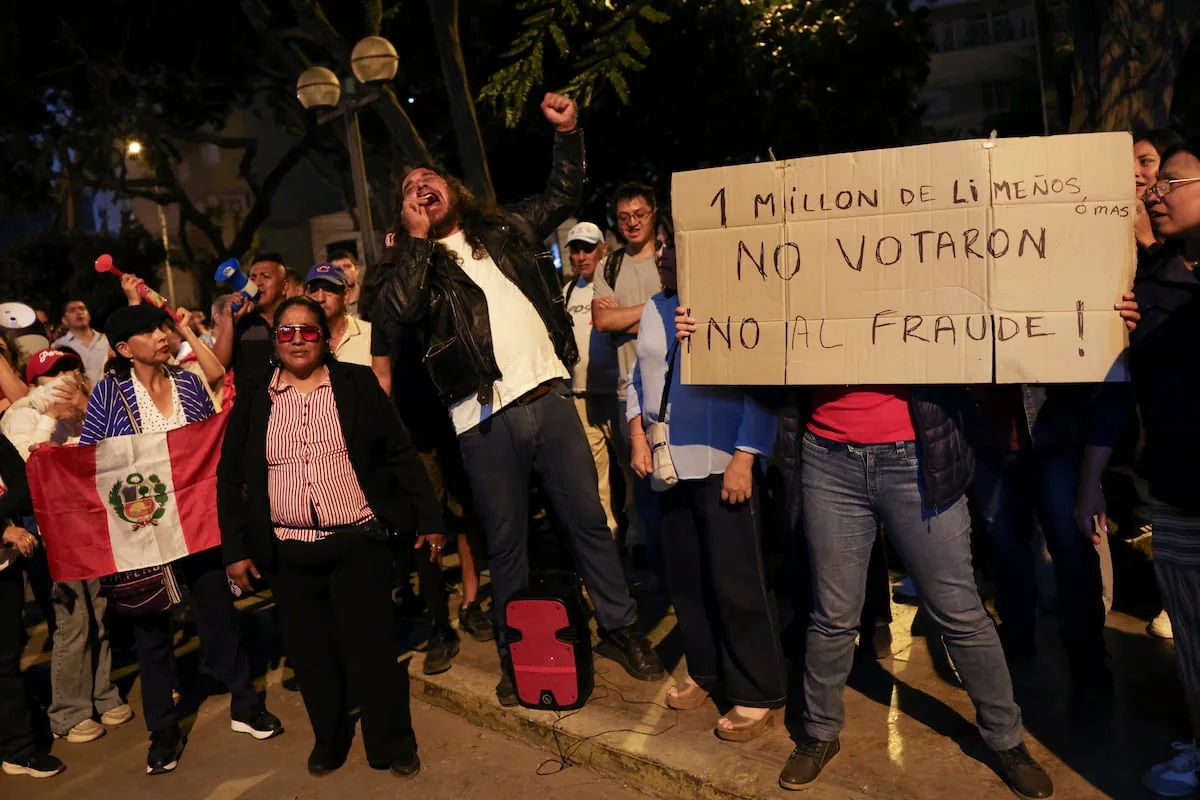
The elections in Peru have gone from anecdote to scandal. Eight days have passed since the country went to the polls and the only thing clear is that nothing is. The National Office of Electoral Processes (ONPE) continues to count ballots at a sluggish pace, amidst institutional silence and accusations of fraud. The count has stalled at 93.57% due to delays in processing rural and overseas votes, but above all in resolving thousands of challenged ballots.
A decade ago, in 2016, citizens waited ten days to know the results of 100% of the ballots from the first round, while in 2021 the delay was halved. However, without the implementation of digital voting, technological advances in Peru are inversely proportional to electoral processes. Yessica Clavijo, general secretary of the National Elections Jury (JNE), has estimated that official results will be obtained in the first half of May, one month after the first round and three weeks before the second, scheduled for June 7.
Keiko Fujimori (Fuerza Popular), with 2,689,000 votes, is the only one with a guaranteed pass to the runoff, in her fourth consecutive attempt to become president of Peru. Leftist Roberto Sánchez (Juntos por el Perú) and far-right Rafael López Aliaga (Renovación Popular) are fighting vote by vote for the right to face Fujimori. For now, the distance separating them is only 14,000 votes, but there are no certainties that Sánchez will consolidate a comeback that took him from sixth to second place, or that López Aliaga will regain positions.
Journalist and writer Hugo Coya highlights the Peruvian political system’s inability to produce clear outcomes. “Every result has become debatable and every process, questionable. The consequence is a progressive deterioration of democratic legitimacy: the rules remain in place, but the conviction that they are worthwhile weakens election after election,” notes the person who has covered six electoral processes.
From his point of view, Peruvians are stuck in a scene that has become all too familiar in every contest: tight results, slow-moving counts, and candidates talking about fraud, even before the final numbers are known. “Without clear majorities, any minimal difference acquires disproportionate weight and opens the door to self-serving interpretations. Uncertainty arises from both proven irregularities and those that are not,” says Coya about a presidential race where 35 candidates competed.
Last Sunday, Rafael López Aliaga called for a march to “defend democracy” in an emblematic park in Lima. In his speech, he called Keiko Fujimori a “traitor,” stating that she is an accomplice to the alleged fraud that he has not yet been able to prove —and for which he is willing to pay almost 6,000 dollars for evidence to each informant—; and he threatened the president of the National Elections Jury, Roberto Burneo, for the second time, demanding complementary elections before May 3. “If he doesn’t do it, I guarantee him nothing,” he coerced him. Days earlier, the Opus Dei member said he would rape him with a turtle.
“Peru, no to communist and terrorist dictatorship” was one of the signs at a mobilization that, although massive, did not have national reach. Despite his impetus, the former mayor of Lima has only been victorious in the capital, which concentrates 30% of the population. “Peru is being violated,” he shouted, with the red and white flag over his shoulders. López Aliaga has been criminally charged for inciting insurgency. Another of his targets has been Piero Corvetto, head of the ONPE, whom a large sector of the population holds responsible for the electoral chaos.
Camila Costa, director of the Peruvian Taxpayers Association, believes that, beyond the debate of whether fraud was committed or not, the accumulation of inefficiencies has seriously damaged the legitimacy of the process. “Political and technical responsibility cannot be diluted. Piero Corvetto must not only assume responsibilities: he must step aside and be judged by the law. The magnitude of the errors makes his continuity unsustainable if institutional credibility is to begin to be recovered,” she argues. The Attorney General’s Office has requested the Public Ministry to include Corvetto in the preliminary investigation for alleged aggravated collusion due to irregularities detected in the April 12 elections.
Ana Lucía Mosquera Rosado, a specialist in strategic communication and human rights, emphasizes citizens’ distrust in their authorities. “We are experiencing the beginning of a new social crisis that fragments society due to these high levels of polarization, compounded by an electoral process that has not functioned properly,” she says. Furthermore, she expresses concern about a crisis that “has unleashed violence, racist and classist polarizing discourses, which have been reproduced not only by voters but also by political leaders.”
Roberto Sánchez, Pedro Castillo’s political heir, has questioned the behavior of his rival, López Aliaga, and urged him to tone down his statements. “All of Peru hears the obscenity of his insults, which we strongly condemn. The insurgency and all those whinings. Learn to be a democrat, sir.” Meanwhile, Jorge Nieto, the presidential candidate for the Party of Good Government, who is currently in fourth place, does not reject the possibility of holding complementary elections. “What needs to be done is to clean up the election,” he stated.
Amidst the lethargy, the Special Electoral Juries have resolved 2,761 presidential ballots out of the 5,763 that were observed. They will soon be returned to the ONPE to be included in the general count of results.