



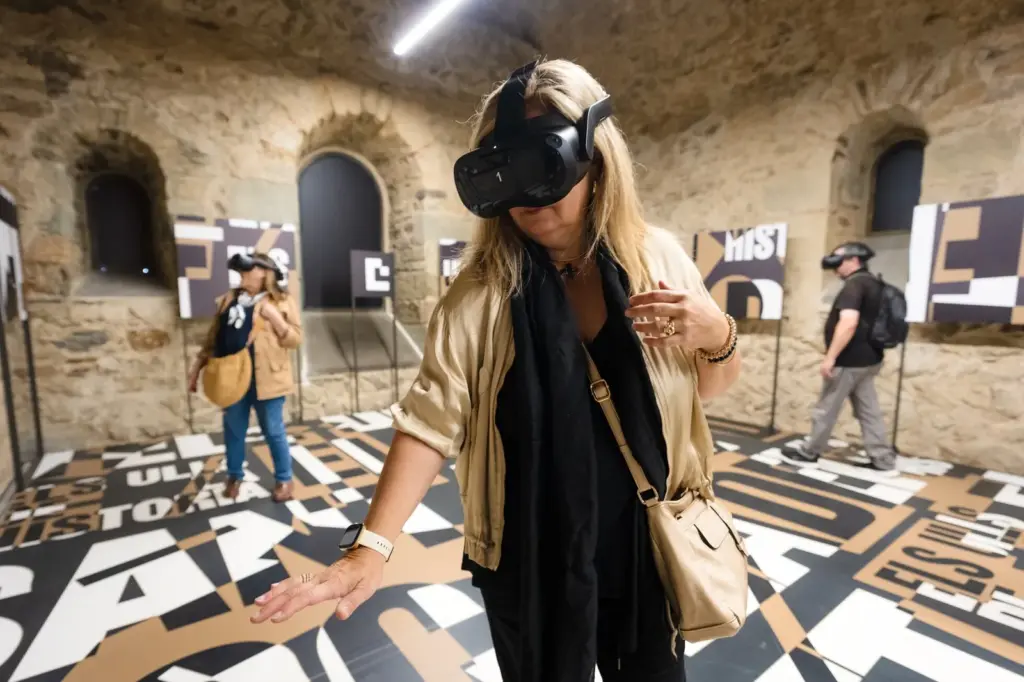
“Welcome to the monastery, I am Friar Ramon de Bellpuig, monk, almoner and doorkeeper of the Monastery of Sant Pere de Rodes, come closer…”. This is how the virtual reality experience begins, taking visitors back to the 14th century, following a documented story through a wedding in the village of Santa Creu (Alt Empordà). The project The Eyes of History, from the Department of Culture of the Generalitat, arrives at the Monumental Complex of Sant Pere de Rodes, 520 meters high in the heart of the Cap de Creus Natural Park (Alt Empordà) and, through an immersive experience, explains the link between the monastery and the village of Santa Creu and the Castell de Sant Salvador de Verdera in the medieval era. The experience shows what the relationship between common people and their lords was like, explores spaces that have now disappeared, and teaches how rents, debts, and relationships between peasants and the monastic community were managed.
Upon purchasing the ticket, visitors can pre-book a time slot in the virtual reality room, near the two superimposed cloisters. Once the virtual reality glasses are on, the experience, titled The Day After the Wedding, will transport them, now transformed into another pilgrim — one of those who came to the monastery to make offerings or give thanks for miracles — to the year 1314 and allow them to explore the village of Santa Creu, the gatehouse, the church, the crypt, and the domestic spaces of the monastery. Through the stories of different characters who lived in this place, such as a couple getting married, the banquet cook, the abbot, or a monk, visitors will discover, thanks to their explanations, how the monastery functioned and what its relationship with the community was like. A script of intertwined lives, where they will also discover what became of these characters and how they lived in those years.
The experience allows visitors to fly over the Serra de Rodes, from the village to the monastery, spotting the bay of Port de la Selva in the distance, also to rise inside the church, coming face to face with the Pantocrator that once presided over the apse, and to descend into the crypt.
The Minister of Culture, Sònia Hernández, who inaugurated this project this Friday, highlighted that it features “those voices that throughout history have perhaps been more disparaged, more ignored; sometimes a child speaks to us, other times a woman, and above all, taking into account what we call microhistory, everyday stories.” Daily scenes from seven centuries ago. This initiative, she said, “aims to restore the relevance” of the monastery “as an exceptional symbol of Catalan Romanesque,” allowing the monument to be understood not only as a monumental space but as a complex system of power and spirituality, and also as a place where the daily life of an entire community unfolded.
Read more Américo Villarreal shows his visa and denies accusations of links to crime: “My conscience is clear”
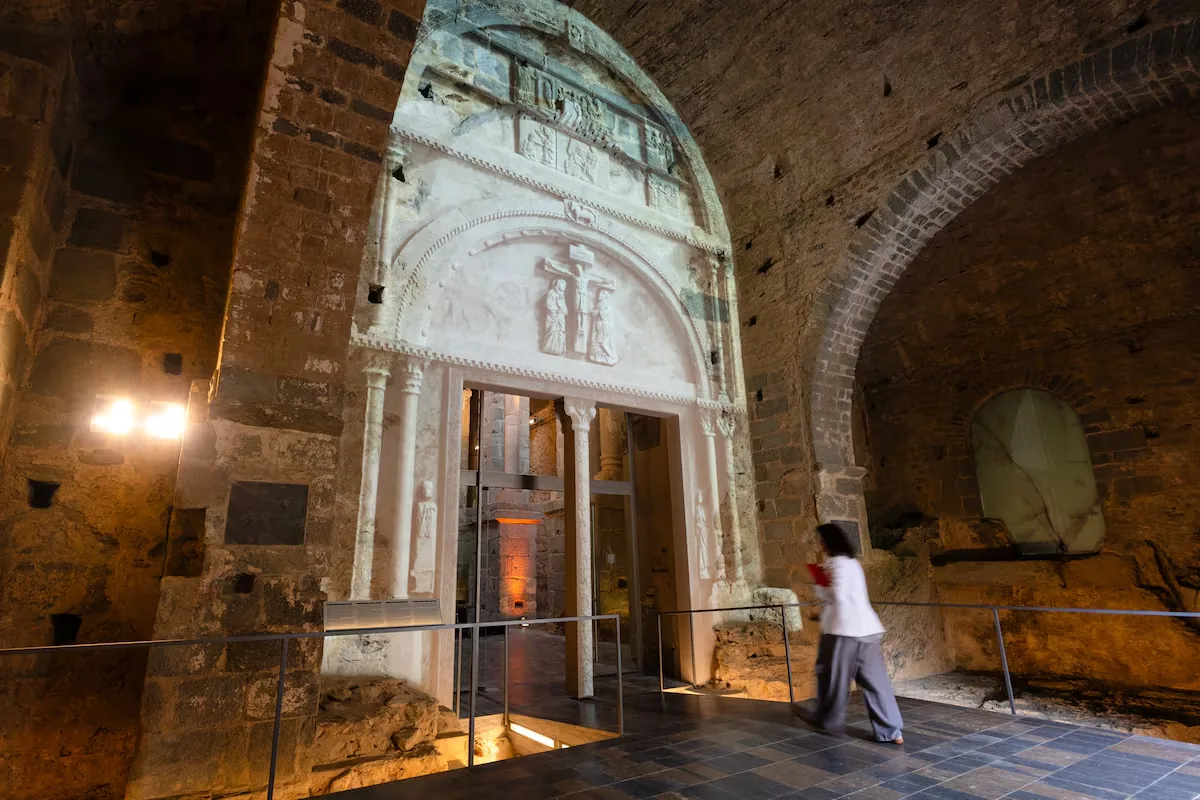
Furthermore, in the church’s narthex, Marmor Revictum (Revived Marble) has been installed, an audiovisual proposal that simulates what the Romanesque portal attributed to the Master of Cabestany might have looked like, according to the latest hypotheses by historian Manuel Castiñeiras. The proposal combines historical research and contemporary visual resources to evoke the original composition of the portal and its subsequent fragmentation. With this projection, visitors will be able to see the sculptural repertoire that decorated this portal and, at the same time, understand the symbolic function of that transitional space between the earthly and celestial worlds.
The project The Eyes of History, already consolidated and well-received, has already been implemented in five monuments of Catalan heritage: the rock art site of Roca dels Moros in Cogul, the Carthusian monastery of Escaladei, the Boí Valley Interpretation Center, and Miravet Castle. A total of 172,366 visitors have passed through them until May. The aim is to continue deepening the relationship between technology, memory, and cultural landscape, to make the understanding of the past more accessible and meaningful, and to renew narratives in favor of microhistory, the vindication of minority and/or marginalized voices, and the democratization of culture. Therefore, in a second phase, this project will be implemented in other emblematic locations such as Cardona Castle, the Roman theater of Tarraco, the Sedó colony in Esparreguera, the Iberian city of Ullastret, and the Andalusian site of Pla d’Almatà.
It will also be available to first-cycle secondary school students to become an educational tool. For this reason, the educational proposal focuses on learning situations with classroom work, but they will also experience virtual reality. They will be able to delve into the monument they have chosen. For this purpose, an immersive room will be temporarily installed in the educational center.
Read more Meta follows in Alphabet’s footsteps: plans a massive capital increase to finance AI investment