





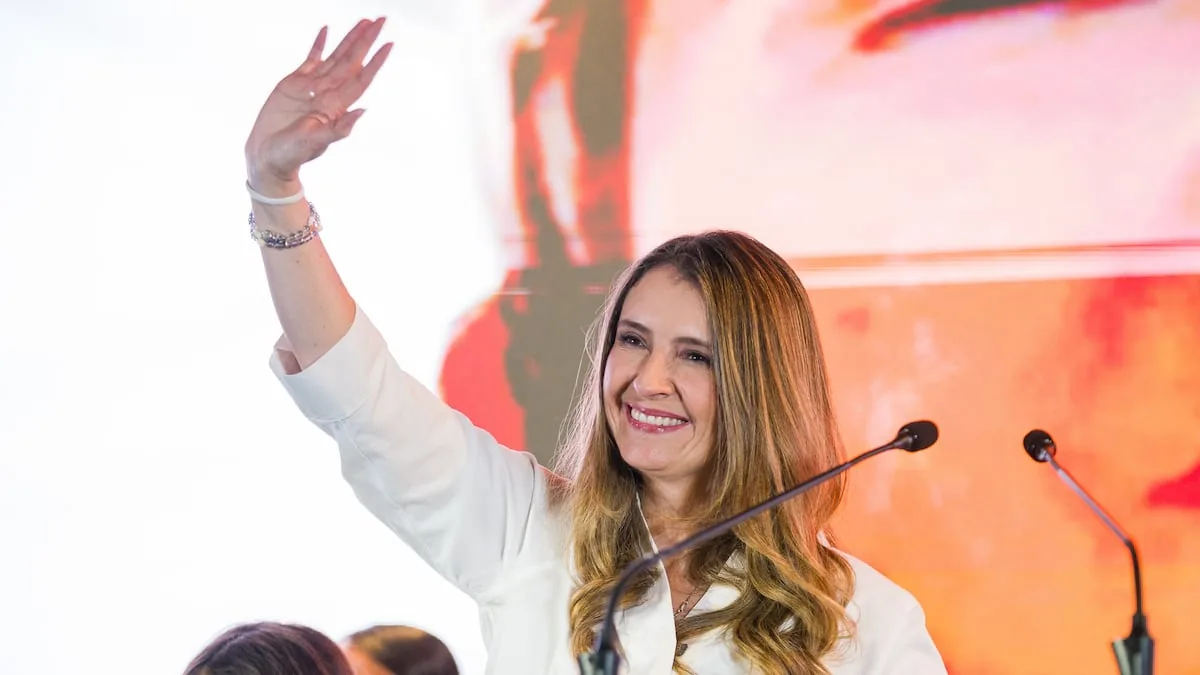
The electoral alliances and support board continues to be organized. The Conservative Party announced this Wednesday that it is joining the campaign of the Uribista candidate, Paloma Valencia. The same decision had been made on Monday by the Party of the U, as well as the former Senate candidate María Paz Gaviria, from the Liberal Party. On the other hand, the majority of the congressmen from the Green Alliance Party have decided to support the official candidate, Iván Cepeda, with whom they have started talks. Thus, the National Directorate of the party approved the process of splitting the collective, the final step of deep internal divisions, impossible to hide. With this announcement, the political center becomes even more blurred in the electoral landscape, as it has not even managed to gather support around the candidates that represent it, Sergio Fajardo and Claudia López, born from the heart of the collective.
Read more The State pays 676,000 euros to the parties for their security expenses in the first quarter
On the other hand, the former right-wing candidate, Vicky Dávila, has returned to the digital channels of the media she directed until mid-last year, the magazine Semana. On Sunday, an interview she conducted with the far-right former candidate, Abelardo de La Espriella, was published there, whom she was a harsh critic of for defending in the past the frontman of Nicolás Maduro, Alex Saab. Until very recently, Dávila was supporting the winner of the right-wing consultation, Paloma Valencia, like her other party members. She asked on the microphones that Valencia win in the first round. Now, on the Semana channels, she says she does not represent “any political project.” “Remember that I am no longer a candidate, don’t involve me in those entanglements,” she asks him in the conversation. “No, I have to involve you because you were there, the past does not forgive,” he replies.
The Conservative Party joins Paloma Valencia’s campaign
The Conservative Party announced this Wednesday that it will join the presidential campaign of the Centro Democrático candidate, Paloma Valencia. The party president, Efraín Cepeda, explained that the decision was made “unanimously.” “From this moment on, the Conservative Party has an official candidate and from here we express to our membership that this decision of the board is law for our members and we must put ourselves at the service of candidate Paloma Valencia,” said Cepeda. In this way, the Conservative, one of Colombia’s two historic parties, joins the Party of the U, which last Monday adhered to the Uribismo campaign, one of the two right-wing aspirations seeking to contest the Presidency against the official candidate, Iván Cepeda, leader in all polls and surveys for several months.
María Paz Gaviria adheres to Paloma Valencia’s candidacy
The former Liberal Party Senate candidate and daughter of former president César Gaviria, María Paz Gaviria, adhered to the campaign of Paloma Valencia and Juan Daniel Oviedo. A photo circulating on social media showing her hugging the Centro Democrático candidate evidences her support, as well as clues about her party’s decision, which will announce at the end of this month whom it will support in the upcoming elections.

The majority of green congressmen lean towards Iván Cepeda
Political differences within the Green Alliance Party became irreconcilable. The National Directorate of the Party approved, with 32 votes in favor, the request for the collective’s split, presented this Monday by Senator Jonathan Ferney Pulido Hernández, known as Jota Pe Hernández. “I thank you for allowing me to start my political career in this house, I will remain firm serving Colombia,” said the senator, one of the most critical of Gustavo Petro’s government, in a farewell-toned message.
For years, the centrist party had been showing signs of wear. Its ranks included senators who became almost opponents of the current administration, such as Katherine Miranda or Catherine Juvinao, along with others who supported most of its initiatives, like Ariel Ávila, Olga Lucía Velásquez, or Liliana Rodríguez. The fissures, which became evident during this legislature, have resurfaced during this presidential campaign, where support is divided. However, the majority of green congressmen lean towards Iván Cepeda.
This Monday, House Representative Jaime Raúl Salamanca Torres announced that the party had decided to form a commission responsible for building a programmatic agreement with the leftist candidate’s campaign. However, Miranda says she is unaware of the decision. For her, it is more coherent “with the defense of the Constitution and the independence of powers” to support Paloma Valencia and Juan Daniel Oviedo, the right-wing formula. Paradoxically, none speak of supporting the centrist candidates, Sergio Fajardo or Claudia López, born from the heart of the collective.
“Today the Green Alliance party decided to prohibit, prevent us from supporting Claudia López and Sergio Fajardo. They have been leaders of the Green Alliance Party. It is a very undemocratic decision, very aligned and in tune with President Gustavo Petro’s temperament,” questioned Senator Angélica Lozano, after the decision to start negotiating with the official candidate became known. “It is a final and sad closing stage of the party,” she concluded.
The Green Party creates a commission to build an agreement and support Iván Cepeda
Amid the support and alliances being woven in the Colombian presidential race, it has been revealed that the centrist Green Alliance party has decided to form a commission responsible for building a programmatic agreement with the leftist candidate Iván Cepeda’s campaign. “This agreement implies recognizing the Green Party’s proposals and priorities in the Government program of the Alliance for Life; as well as that the Green Party membership joins the presidential campaign of Cepeda-Quilqué,” states a handwritten text released by the party’s House Representative, Jaime Raúl Salamanca Torres.
However, Salamanca clarifies in a tweet that no official agreement has yet been reached. “Until there is a programmatic agreement with the Alliance for Life coalition, there will be no support for the presidential campaign,” he wrote on X.

Vicky Dávila, former presidential candidate, tries to return to journalism with Semana
Vicky Dávila jumped from journalism to politics ten months ago but now wants to return. The former director of Semana magazine until last year decided to run for president in June as an ‘outsider’ candidate, and initially seemed to have options to capture the anti-Petro right-wing vote. But another ‘outsider’, far-right lawyer Abelardo de La Espriella, who now appears as the second favorite in the polls, got in her way. Dávila publicly clashed several times with the penal lawyer, alleging he had too many shadows in his past—especially as defender of Nicolás Maduro’s frontman, Alex Saab. She then sought an alliance with right-wing candidates, making clear she would never ally with De La Espriella. Dávila lost the right-wing pre-candidate consultation in March and then jumped to support the winner, the Uribista Paloma Valencia. The agreement was that losers would support the winner, and some like former minister Mauricio Cárdenas, former mayor Enrique Peñalosa, and former senator David Luna are campaigning accordingly.
Dávila, however, reactivated her YouTube channel, but not to campaign for Paloma Valencia (like other right-wing pre-candidates) but to conduct interviews again. Last week she sat down with former president Álvaro Uribe. “You know my heart itches for journalism,” she told him.
More surprisingly, she then sat down this Sunday with Abelardo de La Espriella in an interview reproduced on Semana’s digital channels. “I want to tell you that I am not representing any political project here today, I am not a spokesperson for any candidate,” she said at the start. Alex Saab appeared tangentially. “Some people believe Abelardo de La Espriella financed his campaign with Alex Saab’s money.” An accusation the candidate denied: “I haven’t spoken to Alex for seven years.” Past differences regarding the consultation also appeared. “Remember I am no longer a candidate, don’t involve me in those entanglements,” she asks him about his decision not to join the consultation. “No, I have to involve you because you were there, the past does not forgive,” he replied.
The Party of the U adheres to Paloma Valencia’s campaign
The Party of the U announced this Monday its adherence to the campaign of Paloma Valencia, the presidential candidate of the Uribista Centro Democrático party. According to the party, both its collegiate leadership and its elected and serving congressmen have “majority” decided to join Valencia’s aspiration. “This decision responds to our responsibility to Colombians to support an option that guarantees the institutional stability of the State,” said the Party of the U in a brief statement emphasizing the need to strengthen security and the population’s quality of life.
“Don’t expect statements against peace from me”: Cepeda on party at Itagüí prison
The leftist presidential candidate, Senator Iván Cepeda, spoke for the first time about the vallenato party reported at the Itagüí prison, Antioquia, involving leaders of criminal gangs who have dialogued with the Government over the last three years.
“I believe that should be handled by prison authorities, of course,” he told reporters when asked about it. “But don’t expect statements against peace from me.”
The party videos were revealed by Claudia Carrasquilla, a councilor from the Centro Democrático party, just a week after the National Government announced it was canceling arrest warrants for spokespersons of the High Impact Criminal Structures (EAOCAI) of Medellín and the Aburrá Valley. After the controversy, the dialogue table with the leaders was temporarily suspended.
Cepeda’s brief words sparked criticism from several politicians, especially other presidential candidates. Through her X account, Paloma Valencia, from Centro Democrático, reproached Cepeda for remaining silent. “[Cepeda] won’t speak ‘against peace.’ But, what peace is he talking about? The same one from which criminals have benefited while the country faces high levels of violence.”
Sergio Fajardo, who had already spoken about Cepeda’s silence on other Total Peace complaints, joined the pressure on the leftist politician. “Cepeda’s silence is complicit and incoherent,” he wrote on social media, taking the opportunity to reproach him that, despite demanding debates four years ago with Gustavo Petro’s campaign, “today, in power, the silence is total.”

De la Espriella and Valencia would beat Cepeda in a second round, according to Atlas Intel
According to the polling firm Atlas Intel, Abelardo de la Espriella and Paloma Valencia would beat Iván Cepeda in a second round. It is the first time a poll shows this favorable result for the ultra and the Uribista, always trailing the Petro supporter in the most recent surveys.
According to the study ordered by Revista Semana, De la Espriella would obtain 48.8% of the votes in a runoff with Cepeda, who would get 39.8%. Valencia would get 47.1% against 39.6% for Cepeda.
In the first round, Cepeda remains the leader, this time with 38.7%, followed by De la Espriella with 27.9% and Valencia with 23.5%. While the Petro supporter and the Uribista grow, the ultra outsider stagnates compared to other measurements by the same polling firm.
Iván Cepeda calls to open up to alliances with the ‘political center’ while parties continue debating their support
Before two traditional parties announced they do not consider an alliance with the leftist candidate, Senator Iván Cepeda, he received support from a green party senator, Ariel Ávila, and there made clear he wants to extend his hand to the country’s political center. “I want to make a call to citizens who feel part of the political center,” he said. “The role of the center’s citizens in today’s world is decisive. It is not about a light center, empty balances, or comfortable neutrality. It is about a center with character, with decision, with the capacity to take a stance, and to position itself unambiguously on the right side of history.”
President of the Chamber criticizes Party of the U’s position against Iván Cepeda:
The President of the Colombian House of Representatives, Julián López, harshly criticized the leadership of the Party of the U, of which he was part and from which he resigned in 2025. He criticized the collective for deciding not to support Iván Cepeda, despite some of its members being closer to the leftist project. López, who has had harsh fights with the party director, Dilian Francisca Toro, since last year, described the collective as an “anachronistic, weak party, with timid and fearful leadership.” “They decide to play, for the presidency, with the far right that has impoverished Colombia,” he added.
Abelardo de La Espriella rejects the possibility that the Party of the U supports him
While the Party of the U expects to decide next week which presidential candidate the collective will support, the far-right candidate, who has tried to present himself as an outsider not from traditional parties, sent them a message. “I’ll make it easy: don’t count on me,” he told the party before they made their decision, calling them “the party of Santos, the party that was Petro’s government party.” The U is a party founded by former president Juan Manuel Santos in 2005, and in 2022 declared itself a government party when Gustavo Petro came to power.
The Conservative and Party of the U confirm they will not support Iván Cepeda for the presidency
This week several traditional parties are meeting to decide whom they will support for the presidential campaign. The Liberal Party spent all Tuesday meeting, with some pushing towards the Uribista Paloma Valencia and others towards the leftist candidate Iván Cepeda. No decisions were made.
The Conservative and Party of the U, however, decided to release statements this Wednesday announcing that, although they do not yet know whom to support, they already know they do not want to support Cepeda. The Conservatives clarified that they are between Valencia and the far-right candidate Abelardo de la Espriella.
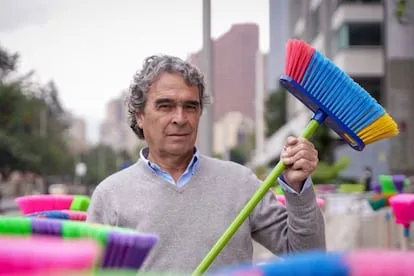
ELECTIONS IN COLOMBIA
Sergio Fajardo renews his anti-corruption discourse using dozens of brooms as a symbol for his campaign
The candidate who had emphasized his educational proposal returns to ‘not everything goes’ that became popular in the 2010 presidential campaign alongside Antanas Mockus
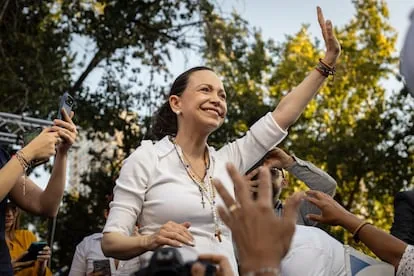
ELECTIONS IN COLOMBIA
Paloma Valencia and Abelardo de la Espriella seek the support of María Corina Machado
The Uribista candidate says the opposition leader has already offered her support “to safeguard the elections,” while the ultra seeks to distance himself from his past as Alex Saab’s lawyer
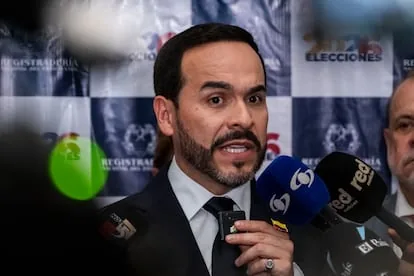
ELECTIONS IN COLOMBIA
Abelardo de La Espriella revives his campaign by accusing Petro of illegal interceptions
The far-right candidate presents himself as a political persecuted after the president mentioned an alleged private conversation of the penal lawyer to commit electoral fraud
Iván Cepeda meets again with Mexico’s president, Claudia Sheinbaum
The leftist candidate, Iván Cepeda, met again with Mexican president Claudia Sheinbaum during a visit he made to the North American country last week. “I thank Mexico’s president, Claudia Sheinbaum Pardo, for the constructive meeting we had at the end of my visit to her country last week. In this second meeting we have had, I was able to express again the recognition and admiration she enjoys in Colombia,” Cepeda said in a post on X.
This is the second meeting between Cepeda and Sheinbaum. The first took place in November, also in Mexico City. The candidate supported by Gustavo Petro has given his campaign international shine in recent months. Besides the Mexican president, he has met with Spaniard Pedro Sánchez and Brazilian Luiz Inácio Lula da Silva.

Clara López will resign her presidential aspiration to join Iván Cepeda’s campaign
Senator Clara López will resign her presidential candidacy to join Iván Cepeda’s campaign, several media outlets reported this Wednesday. The official announcement is expected next week at an event with the Historic Pact.
The candidate, registered last January 31, made the decision to avoid splitting the left-wing votes in the first round, according to sources close to the congresswoman to Caracol Radio.
Gradually, Iván Cepeda has gathered support from several of his former rivals. Last week, he received support from Juan Fernando Cristo in his first alliance outside the Pact. It is expected that, besides López, the support of green senator Ariel Ávila will also be formalized.
Acxan Duque defends himself against accusations: “What happened was an unintentional sending error, duly documented”
This Friday, through a statement, Duque’s defense insisted that the image was sent by mistake. “The complete chat thread proves both the original destination and the exact moment the erroneous sending occurred and will be made available to the authorities,” his lawyers state. They add: “Mr. Duque Gámez recognized the error immediately. He offered direct apologies to the affected official on the same communication channel before the situation became public. Also, that same morning, on his own initiative, he reported the facts to the Ministry of Equality’s Human Talent Office. And he resigned (…) without waiting to be asked, to avoid compromising the Ministry’s management or interfering with investigations.”
Medellín court concludes Iván Cepeda’s speech was based on Antioquia’s historical reality
Historic Pact candidate Iván Cepeda has announced that the Eighteenth Civil Court of Oral Jurisdiction of Medellín ruled in his favor, considering that his speech about paramilitarism history in Antioquia did not violate fundamental rights to honor, good name, and free personality development, thus denying the tutela requests filed by three citizens. On the contrary, the court concluded that Cepeda’s speech was based on the department’s historical reality.
According to the court’s decision, “Iván Cepeda Castro’s intention is to raise the resilience and transformation capacity of Antioquia’s inhabitants, not to stigmatize them or create a fictitious image of violence, paramilitarism, or drug trafficking.”
Paloma Valencia makes public a complaint about alleged sexual harassment in the Ministry of Equality
The Centro Democrático presidential candidate, Paloma Valencia, made public, through a statement and her social networks, a complaint about alleged sexual harassment committed by the Deputy Minister of Equality, Acxan Duque. According to the text, he allegedly sent a photo with sexual content to an official without her consent.
Valencia urgently requested the Procuraduría, the Ombudsman, and the Prosecutor’s Office to adopt urgent measures to protect the complainant. “In particular, she asked that work-from-home be guaranteed to avoid her remaining under the deputy minister’s control while investigations proceed,” the statement adds.
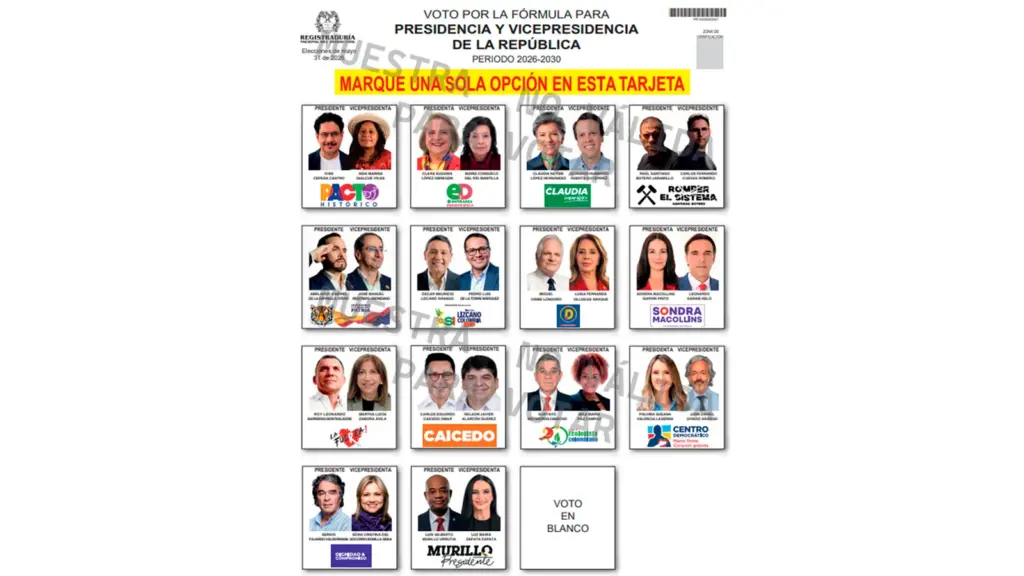
Colombian candidacy ballot. / National Civil Registry
This is how the electoral ballot was formed after the candidate position draw
By chance, with representatives from each party turning a ballot box, the candidate leading the polls, Iván Cepeda, will be the first to appear on the ballot that Colombians will receive on May 31, in the first presidential round. The other poll leader, Abelardo de la Espriella, will be in box 5; Paloma Valencia in 12, Claudia López in 3, and Sergio Fajardo in 13.
The draw was held by the National Registry on Wednesday morning, and only two presidential candidates attended: Sondra Macollins and Carlos Caicedo, plus vice-presidential candidate Pedro de la Torre, Mauricio Lizcano’s formula. The ballot will have 15 boxes: the last one is for blank votes. The rest of the positions were formed as follows:
1. Iván Cepeda, for the Historic Pact
2. Clara López, for Democratic Hope
3. Claudia López, for Unstoppables
4. Raúl Santiago Botero, for Break the system
5. Abelardo de la Espriella, for Defenders of the Homeland
6. Mauricio Lizcano, for the F.A.M.I.L.I.A. Coalition
7. Miguel Uribe Londoño, for the Colombian Democratic Party
8. Sondra Macollins, for The Iron Lawyer
9. Roy Barreras, for The Force
10. Carlos Caicedo, for the Caicedo party
11. Gustavo Matamoros Camacho, from the Ecologist party
12. Paloma Valencia, from Centro Democrático
13. Sergio Fajardo, for Dignity and Commitment
14. Luis Gilberto Murillo, for Luis Gilberto I am

Fajardo announces Juan José Echavarría as his finance minister if he becomes president
Presidential candidate Sergio Fajardo announced this Tuesday that, if he wins the elections, he will appoint Juan José Echavarría as his Minister of Finance and Public Credit. Echavarría, an engineer with a master’s degree in Economics from Boston University and a doctorate in Economics from Oxford University, is the director of the programmatic team of the former Medellín mayor’s presidential campaign. He previously served as manager of the Bank of the Republic, executive director of Fedesarrollo, and deputy minister of Foreign Trade.
Read more The National Court annuls Sidenor’s search for selling steel to Israel
ELECTIONS IN COLOMBIA
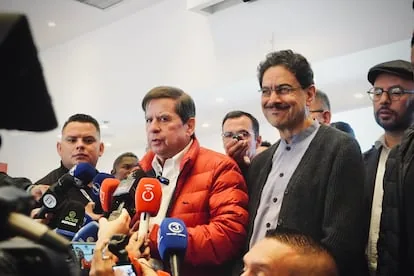
Iván Cepeda opens a new phase with his alliance with Juan Fernando Cristo, the first outside the Historic Pact
Colombian left opens to alliances with other sectors outside the official Historic Pact, a new stage for Senator Iván Cepeda’s presidential campaign. With the agreement just sealed with former liberal minister Juan Fernando Cristo and his party En Marcha, the favorite in the polls to succeed Gustavo Petro has taken a first step, a long-awaited gesture of openness, to convene a broader electoral coalition ahead of the May 31 first round.
Read the full report here

ELECTIONS IN COLOMBIA
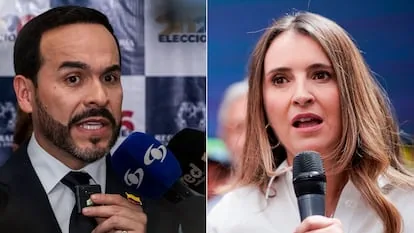
Paloma Valencia surpasses ultra Abelardo de la Espriella for the first time in a poll
Paloma Valencia’s candidacy takes off in the latest National Consulting Center (CNC) poll for Cambio magazine. The survey, released this Sunday, is the first from that firm known after the legislative elections. The formula that the right-wing senator forms with Juan Daniel Oviedo reaches a voting intention of 22.2%, when 20 days ago, before the elections that brought three presidential consultations to the polls, the Uribista politician registered only 4.1% support in the comparable measurement. The results are known two weeks after the definition of vice-presidential formulas that reconfigured the electoral ballot.
Iván Cepeda remains at the top in the poll with 34.5% voting intention, a slight drop from the previous measurement, which placed him at 35.4%. Still, he retains first place in the contest in practically any scenario. However, the CNC notes that in a possible second presidential round against Senator Valencia, there would be a technical tie. According to the measurement, Cepeda would get 43.3%, and Valencia 42.9%, when the measurement considers a 3% margin of error.
Iván Cepeda asks Álvaro Uribe to prove in court the accusation about Miguel Uribe’s assassination
Presidential candidate Iván Cepeda responded this Saturday to accusations by former president Álvaro Uribe Vélez seeking to link him to the assassination of Miguel Uribe Turbay. “I request that, as soon as possible, he present to justice the evidence supporting the accusation he has made against me regarding the assassination of Senator and presidential candidate Miguel Uribe,” he wrote in a public statement.
The response comes after former president Álvaro Uribe Vélez reacted to an interview given by the presidential candidate to EL PAÍS. Without presenting evidence, he accused him of having a plan to kill him: “He is right to want to instigate that they kill me. He already did it with Miguel Uribe.” According to the far-right party leader, the alleged link between the crime and the candidate lies in his role as mediator in the Peace Agreement with the FARC, from which Jesús Santrich and Iván Márquez later departed. Both led the creation of the Second Marquetalia, a structure pointed to as possibly responsible for the assassination.
Senator Iván Cepeda insisted that accusations of such gravity must be processed in judicial settings and not in public debate. “Responsibility to the country demands going to institutions and allowing justice to clarify the facts based on verifiable evidence,” he wrote on his X account.
Álvaro Uribe, after EL PAÍS interview with Iván Cepeda: “He wants to instigate that they kill me. He already did it with Miguel Uribe”
Former president Álvaro Uribe Vélez, through his press office, sent a response to the interview EL PAÍS did with presidential candidate Iván Cepeda. In the document, the right-wing ex-president claims, without evidence, that Cepeda has tried to physically kill him. “He has tried to have me physically killed and also tried to ruin my reputation and have me imprisoned.” According to Uribe, the meeting the official candidate had with one of the Inpec unions “seeks to buy witnesses and have me imprisoned.”
In the writing, the ex-president insists, without support, on accusing Cepeda of having a plan to assassinate him. “He is right to want to instigate that they kill me. He already did it with Miguel Uribe.” According to the far-right party leader, the link between the crime committed against Miguel Uribe and the presidential candidate is, according to him, that he was a mediator in the Peace Agreement with the FARC, from which Jesús Santrich and Iván Márquez later departed, who founded the Second Marquetalia, now pointed to as possible author of the assassination.
Álvaro Uribe also questions Cepeda about the accusation regarding his mention in the computers of the former FARC commander, Raúl Reyes. “Cepeda would not be able to withstand this question before a judge. He has not answered it to the country: neither to Colombia nor to El País of Madrid. Why does he appear in Reyes’ computers as the one who organized mobilizations for the FARC?”
He refers to a march Cepeda called on March 6, 2008, not in favor of the FARC, but to recognize victims of state crimes. The presidential candidate denounced “political persecution and false information” before the Inter-American Commission on Human Rights. Interpol certified the email mention, while the Supreme Court dismissed the files.
Read the full interview with Iván Cepeda at this link.
María José Pizarro, on investigations against Petro for narco financing: “There is no argument to ‘investigate’ a man like the president”
Senator María José Pizarro, debate chief for candidate Iván Cepeda, spoke after information published by The New York Times that two U.S. federal prosecutors are investigating President Gustavo Petro for possible links with drug traffickers. On her social networks, the Historic Pact legislator said: “There is no argument to investigate the president, who has denounced throughout his political life the alliance between political power and mafias.” Pizarro also wonders: “Could this be a foreign interference strategy in Colombia?” She then criticizes right-wing political figures who support a power “legally pursuing” Petro, apparently referring to Uribista candidate Paloma Valencia, who has asked U.S. authorities to get to the bottom of the investigations. Later, Pizarro concludes: “Political and judicial decisions in our country are made, as a sovereign nation, by the Colombian people.”
Petro denies having links with drug trafficking, after it became known he is being investigated in the United States
Colombian President Gustavo Petro responded through his favorite social network, X, to the news published by The New York Times that he is being investigated by two U.S. prosecutors for alleged links with drug trafficking. The Colombian leader quickly denied it: “I have never in my life spoken with a drug trafficker,” he wrote, clarifying that in Colombia there is not a single investigation about a relationship between him and mafia members.
“On the contrary, I dedicated ten years of my life, risking my existence and causing my family’s exile, to denounce the links between the most powerful drug traffickers and politicians in the Congress of the Republic and local and national governments,” in what he calls “the era of paramilitary governance.” In that sense, the president counterattacked and pointed out that it is the far right that is articulated with drug traffickers in the country.
Paloma Valencia asks U.S. authorities to “get to the bottom of the investigations” about Petro
The Uribista presidential candidate, Paloma Valencia, has asked U.S. authorities to “get to the bottom of the investigations and tell the world whether the alleged links of President Gustavo Petro with drug trafficking are true or not.” The senator called the news published this Friday by the New York Times “very serious,” in which the newspaper reported that two federal prosecutors from that country are investigating Petro for possible links with drug traffickers. The investigators are probing, among other things, possible meetings and whether his presidential campaign requested donations from them.
Read the news about the investigation here.

Paloma Valencia rises but remains behind Iván Cepeda and Abelardo de la Espriella, according to Gad3 poll
The Uribista presidential candidate, Paloma Valencia, has increased her voting intention, according to a Gad3 poll for RCN published this Thursday. However, according to the survey, she remains third in favorability, behind the official candidate, Iván Cepeda, leader in the polls for months, and far-right lawyer Abelardo de la Espriella, second, although several percentage points behind the progressive senator. According to the survey, Cepeda has 35% voting intention, De la Espriella 21%, and Valencia 16%.
Although the Uribista candidate is still not the most direct competitor to Cepeda, she is the one who gained the most favorable points in the last month for Gad3, quadrupling the 4% she had in February to reach 16% in March. De la Espriella, meanwhile, lost five percentage points (had 26% in March), while Cepeda achieved a slight increase from 34% to 35%. The candidates following them are already far behind in the race, at least according to the polls: Claudia López went from 3% in February to 4% in March, while Sergio Fajardo went from 2% to 3% this month.
Scenarios of a possible second round also did not reveal major changes compared to past polls. If Cepeda and De la Espriella faced off, the progressive senator would win with 45% against 36% of his rival. Both increased in the last month for this item: Cepeda went from 38% to 45% and De la Espriella from 33% to 36%. In a scenario against Fajardo, Cepeda would win with 44% against 32%, and in one against Valencia, the official candidate would again win, although narrowly, 43% against 40%, which is already within the margin of error. For that scenario, Valencia had a notable increase of 15 percentage points in the last month: in February, she had the support of 25% of respondents.
In other scenarios, if De la Espriella faced Fajardo in a second round, the populist lawyer would win with 33% against 25% of his rival. And if the final round were between him and Valencia, the survey registers a 27% tie in voting intention, with a peculiarity: in February, De la Espriella had the support of 34% of respondents for this same hypothetical scenario, while Valencia barely reached 13%. That behavior seems to indicate that the Uribista candidacy has indeed managed to convert votes in her favor, while De la Espriella has been losing them.
The vice-presidential preference presented by the survey also brings striking numbers. The first is that 28% of respondents would prefer Aída Quilcué, Iván Cepeda’s formula, whose election was initially read as a reaffirmation of his progressive candidacy, rather than an attempt to seek rapprochements with the center. Juan Daniel Oviedo and José Manuel Restrepo, Valencia and De la Espriella’s formulas, respectively, tie with 18%, while Edna Bonilla (Fajardo’s formula) and Leonardo Huerta (López’s) are both at 3%.
Abelardo de la Espriella and Paloma Valencia clash over Uribista campaign endorsements
Paloma Valencia and Abelardo de la Espriella’s campaigns, the two best-positioned right-wing presidential candidates, are in full tension. The far-right lawyer, who on Wednesday ruled out any alliance with traditional political parties, has criticized his rival for the endorsements she has received. According to De la Espriella, the Uribista aspiration has indeed received support from traditional parties and Santismo. “All those people who are with Paloma knocked on my door and I did not receive them because this is extreme coherence. One cannot be independent when receiving money from everyone,” he said.
Senator Paloma Valencia responded to her opponent’s accusations, assuring that anyone is welcome in her campaign, but she has not offered positions in exchange for support. “I have not committed a single ministry, a single position, and people know me for my transparency and clean hands.” The statements come days after a group of several ministers from the governments of Álvaro Uribe, Juan Manuel Santos, and Iván Duque came to reinforce Valencia’s campaign. Also, Cambio Radical’s decision, which will lean towards one of the two candidacies, is pending.
The tensions between Valencia and De la Espriella occur after the Uribista candidate’s victory in the March 8 interparty consultation, which boosted her candidacy and began to show her as a strong alternative that could gain ground over the far-right lawyer, who until then was the most solid option of conservative sectors for the May 31 first round. Until now, both campaigns had maintained cordiality, and in fact, De la Espriella had offered to join Valencia and campaign for her if she advanced to a possible second round against a leftist candidate. Almost two months before the vote, the right faces its first fractures.
Mauricio Lizcano announces Pedro de la Torre as his new vice-presidential formula
Presidential candidate Mauricio Lizcano has announced that Pedro de la Torre, a man with a scientific profile, will be his new vice-presidential formula, after Luis Carlos Reyes, known as Mr. Taxes, withdrew as his running mate for family reasons. Lizcano presented De la Torre as a man who “comes from effort, study, and merit,” not from traditional politics. It is a more scientific profile that Lizcano has shown as an example of overcoming.
De la Torre is a chemist graduated from the University of Atlántico. He holds a degree in Applied Sciences from the University of Talca (Chile), did a postdoctoral in X-ray Crystallography and protein biochemistry of ciliated cells at Ohio State University (United States), and has been a research scientist at Harvard University. He works on research to restore hearing and vision in animal models and formalized the first agreement between Harvard University and the University of Atlántico, where he is a candidate to be rector.
Justice Minister clarifies that INPEC cannot campaign for Iván Cepeda
Justice Minister Jorge Iván Cuervo has clarified through a tweet that INPEC, the official institution in charge of guarding prisons, should not campaign for Iván Cepeda. “This does not reflect the institutional position of the Ministry nor INPEC,” said the minister, referring to a previous post on social media by UTP Colombia, the largest union in the penitentiary and prison system, in which it expresses its support for the Historic Pact candidate.
“Public servants cannot participate in politics supporting specific campaigns,” the minister clarified after Óscar Robayo, the union president, gave Cepeda his “full support,” speaking on behalf of the union workers. In the video, Robayo thanks him “for all these years of struggle for the improvement of human rights and the entire prison system, for humanizing the prison system,” and concludes: “Your dream of being president is our dream as penitentiary workers.”
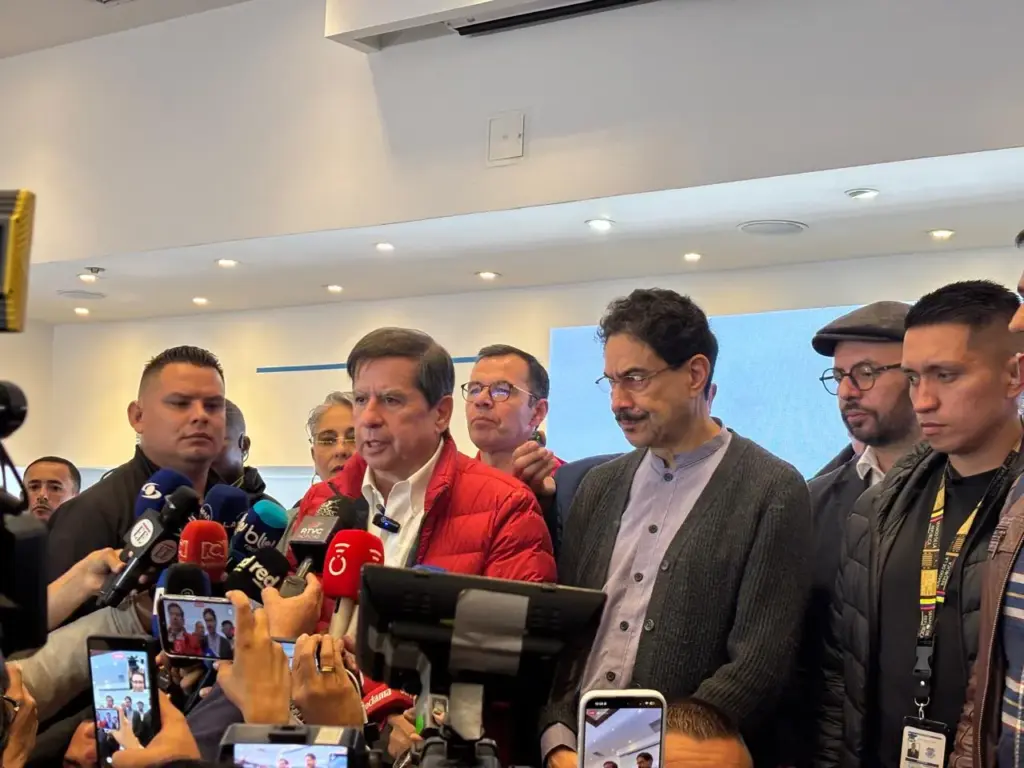
Juan Fernando Cristo with Iván Cepeda, after joining his presidential campaign, this Thursday, in Bogotá. / Santiago Torrado
Juan Fernando Cristo seals an alliance with Iván Cepeda: “Colombia must deepen social reforms”
Former Interior Minister Juan Fernando Cristo, of liberal origin, officially backed Senator Iván Cepeda’s presidential campaign this Thursday, in what they have called the Alliance for Life.
“Colombia must deepen and accelerate social reforms,” Cristo said. At the same time, he added, it is necessary to rectify the course of those policies that did not have the expected results, such as total peace, which proposed negotiating simultaneously with all armed groups. Gustavo Petro’s government paved the way, he said, but now it requires advancing with less confrontation. He also warned that calling a Constituent Assembly “is inconvenient and untimely.” “We fully agree on the need for a national agreement,” he emphasized.
This is Cepeda’s first formal alliance with sectors outside the official Historic Pact. Cristo, leader of the small party En Marcha, who considers himself essentially a reformist liberal, declined his own presidential aspiration last Friday. Since then, approaches to the poll favorite to succeed Petro were taken for granted.
Besides having been senator for four terms, Cristo had already held the political portfolio during Juan Manuel Santos’s period (2010-2018), before briefly accepting that position again with Petro. From the Interior Ministry, he pushed a shock plan to accelerate the implementation of the peace agreement with the FARC, very delayed in this government. He is also the author of the emblematic Victims and Land Restitution Law. In the 2022 electoral cycle, he was part of the centrist coalition that backed Sergio Fajardo’s candidacy.
When it was his turn, Cepeda dedicated much of his speech to praising the liberal tradition that laid the foundations for important transformations in Colombia. He especially recognized its “vocation to fight injustice without falling into authoritarianism.” “It is a heritage we cannot forget or allow to be distorted,” the Historic Pact candidate pointed out. In the end, he highlighted, liberalism and progressivism “do not contradict each other.”
De la Espriella rules out any alliance with traditional parties
Presidential candidate Abelardo de la Espriella ruled out this Wednesday any alliance with traditional political parties. “We who have never betrayed the people will win this,” said the far-right lawyer in a press release in which he assures he rejects all usual practices in the “old politics” and states that his aspiration has not received any financing from large economic groups. “The most important alliance we already made is with the Colombian people and with God,” says the brief text, revealing that, for at least four months, several leaders have sought to join his campaign. “Adding just to add makes no sense when those seeking to join are the same who have endorsed corruption,” he adds. Later, he adds: “Whoever negotiates with the devil ends up entangled. We will not give up our principles.”
Juan Fernando Cristo calls a meeting to launch his alliance with Iván Cepeda
Former presidential candidate Juan Fernando Cristo has called a meeting this Thursday in Bogotá to launch his alliance with Iván Cepeda. The En Marcha party leader declined his aspiration last Friday. Since then, several versions pointed to Cristo, who was minister in Gustavo Petro’s government, possibly approaching the Historic Pact candidacy. The meeting to formalize the announcement is scheduled to take place at the Tequendama Hotel, in downtown Bogotá, at 8:30 a.m.
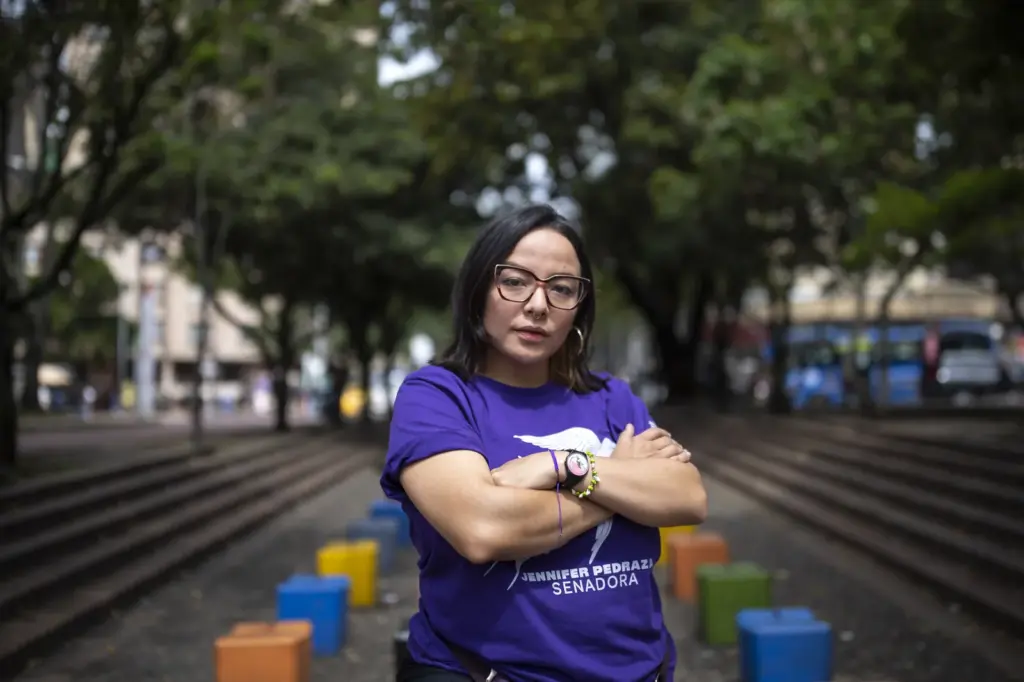
Congresswoman Jennifer Pedraza, in Bogotá, Colombia, March 3, 2026. / ESTEBAN VEGA LA-ROTTA
Jennifer Pedraza is appointed as Fajardo’s debate chief
Congresswoman Jennifer Pedraza, newly elected senator in the March 8 legislative elections, will be Sergio Fajardo’s debate chief. The 30-year-old legislator has been the only representative of Dignity and Commitment, the party born from the merger of Jorge Enrique Robledo’s movements and the former Medellín mayor, again a presidential candidate. “Since I arrived at Congress, my perception of politics has changed a lot,” Pedraza explained in a recent interview with EL PAÍS.
“Frankly, I see that most of Congress is in the hands of very dishonest people, to say the least. If Colombia took a leap to a more honest, less corrupt politics, that would lead us to a more ideological debate and we would have made a historic transformation in our democracy. For me, Fajardo represents that, the possibility of having discussions and debates that are healthy in democracy, and starting to move away from the kleptocracy we are in. It would be a great step, which Fajardo already took when he was governor of Antioquia and mayor of Medellín. We have to offer people an alternative different from the past of Centro Democrático and Petro’s current scam.”
Read the full interview here.
The MOE finds a 99.8% correspondence between pre-count and legislative election results
The Electoral Observation Mission (MOE), a civil society organization that serves as an observer of electoral processes in Colombia, has delivered a report giving a reassuring account of the results of the Congressional elections held last March 8.
The document, which offers a balance on the post-electoral stage, establishes a high level of correspondence (99.8%) between the pre-count results and the election scrutiny. However, it draws attention to statements made by high-level officials about candidacies, competing parties, and results, as they consider they have not met standards of “prudence, verifiability, and institutional responsibility.”
The report was presented to the National Coordination and Monitoring Commission of Electoral Processes in a meeting called for this Wednesday by the Ministry of the Interior. However, it is released just after the minister of that portfolio, Armando Benedetti, requested the Registry to allow the Government to audit the software used for the electoral pre-count, amid doubts expressed by the Executive about the possibility of electoral fraud.
Petro’s government insists on asking the Registry to let it audit the software used for the electoral pre-count
Interior Minister Armando Benedetti has informed through his X account that, together with the Minister of Technologies and Communications, Carina Murcia, he has asked the Registry not only to show them but to let them audit “the source code and software used for the pre-count and scrutiny ahead of the presidential elections.”
With this request, which again stirs the complaint repeatedly made by Gustavo Petro’s government about the possibility of electoral fraud, a shadow of doubt is cast over the scrutiny system. The Registry, which has defended its autonomy from the Executive, assures that the code cannot be available to just anyone, including the Government, because that would make it vulnerable to hacking or manipulation. Benedetti goes further in the tweet, saying “they also want parties on election day to have access to that software’s information and during the week of scrutiny.”
Read more Bayern Munich — Real Madrid live | Four changes by Arbeloa in the starting eleven