









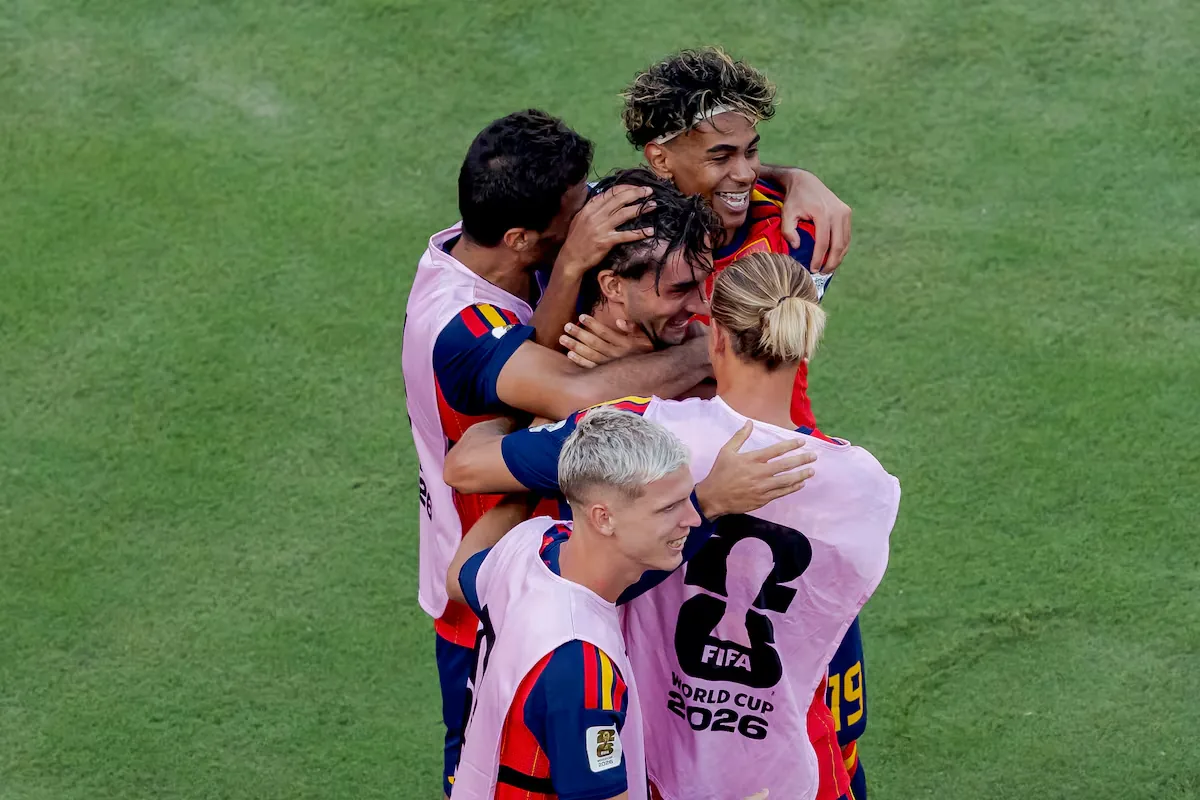
“Tenderness is suspicious and physical contact is only acceptable for competing or fighting,” wrote journalist Pablo Maca on his social media when talking about the stir caused on social networks by the photographs in which Marcos Llorente and Ferran Torres kiss and hug on the beaches of Ibiza. Displays of affection between two heterosexual men became a subject of ridicule and many people inquired about their sexual orientation. “That is also patriarchy. Because patriarchy also harms men, confining them to a narrow masculinity where hugging a friend or showing any affection puts their manhood in doubt. It teaches them that tenderness is suspicious and that physical contact is only acceptable for competing or fighting,” says Maca.
Read more FIFA accepts defeat: Gianni Infantino backs down from his proposal to privatize the World Cup
His post has been shared by the always combative Borja Iglesias. The affectionate gestures during the World Cup between midfielder Jude Bellingham and forward Erling Haaland, friends after meeting as debutants at the German club Borussia Dortmund, are already part of various clips in which internet users have accompanied the affectionate gestures between them with the song See You Again, by Tyler, the Creator, making their friendship take on an erotic tone in the digital sphere.
Ulises García Figueroa, a doctoral student in ethnomusicology, masculinities, and gender, clarifies that the real problem is not the displays of affection between two heterosexual people, but two situations related to the gaze of others: heteronormativity and homophobia. “Heteronormativity is the set of expectations and guidelines that society considers normal or even desirable when we think of a heterosexual person. These norms are not monolithic: they change over time and across cultures. Heteronormativity watches over and disciplines people to fit into a category in the eyes of others, and that makes it difficult for heterosexual people to show mutual affection without their heterosexuality being questioned,” he explains to ICON.
He points out that homophobia adds a layer of violence, stigma, and persecution when behavior deviates from what is expected in heterosexual people. “As part of hate speech, homophobia assumes that the only normal way to exist in the world is to be heterosexual and that anything outside that set of expectations must be corrected or suppressed. This violent view of interpersonal relationships not only affects homosexual people, their well-being and integrity, but also instructs heterosexual people on how they should behave to avoid prejudice or punishment,” he assures.
Two men together
In the reality show Love Island USA, a kind of Temptation Island across the pond, it is common for muscular men to talk lasciviously while wearing tiny swimsuits about the female participants of the program while lifting weights. That is why the friendship between Zach Georgiou and Bryce Dettloff has undoubtedly been the most talked-about relationship of the season. From a heated scene where they help each other stretch their hamstrings to another where Bryce approaches Zach’s bed in the middle of the night and shows him his penis to do a “thickness check”, as Bryce claimed, there are countless moments in the show where their friendship has been the subject of gossip. Although in other editions there were already deep friendships between men, Rikki Wise has commented on her podcast, Reality Receipts, that this season the showrunners have wanted to capitalize on their friendship to generate a subplot encouraged by the success of More Than Rivals (a series about a relationship between two men that has hooked, especially, women). “I think these kinds of things happen every season, but now they feel more comfortable betting on them as if it were one of the main plots,” she says.
Read more The penthouse file remains a mystery protected by the Ayuso Government
“Therapy Unfiltered was one of those post-pandemic era series focused on talking about feelings that really connected especially with heterosexual men,” says one of its protagonists, Michael Urie, to Kevin Fallon, host of Obsessed: The Podcast, before applauding that the series has bet on heterosexual male protagonists—like Harrison Ford, whom he refers to as “the hero of every straight man”—who are not afraid to show vulnerability. “Seeing these men talk about their feelings gave permission to many heterosexuals to talk about what they felt,” he added. The curious thing is that the podcast episode is called Why Straight Men Secretly Love This Super Emo Show, because apparently, if a heterosexual publicly admired the series, his masculinity would be compromised. A sign that the shadow of suspicion not only looms over hugs and affectionate gestures between two heterosexual men but also over those who lower their emotional guard.
A wonderful example of a series that combines physical contact with emotional openness is DTF St. Louis. And precisely for that reason, explains Alexandra Schwartz in The New Yorker, it has “a fantastic and sci-fi-like nuance.” Are there paranormal events? Not at all. What there is is something much more alien: two middle-aged American men who seem to have grown up in a world where the phrase no homo was never uttered; a world in which the fact that two heterosexual men openly and repeatedly confess their feelings for each other is not taboo, suspicious, or even remotely strange,” says the journalist. The protagonists of the series profess their love for each other, exchange compliments, and even ride bicycles holding hands (there was much talk about Ferrán Torres and Pedri holding hands in a viral video where they were riding a roller coaster). These scenes are not unusual among women but raise suspicions when two heterosexual men offer each other emotional support and physical contact.
Lionel S. Delgado, an expert in manosphere and equality workshops, explains to ICON that emotional impenetrability is a risk to mental health. However, he does not blame men for it. “I try to focus on the culture that sustains these behaviors: emotional stoicism and the idea that you have to know how to control your inner world seem to be the last bastion of stability in a world in crisis, and neoliberalism promotes the idea of the brave genius who strives and sacrifices for a mission. The imaginary of care that we defended from the early years of the last wave of feminism is far away.” He also points out that relationships between men within the LGTBIQA+ community are not free from this problem. “Those of us who have related to other men know that it is very difficult to build intimacy that does not have sex at the center. Friendships between men within the collective also require a lot of effort. So I think the problem is more widespread; there is a crisis of bonds globally, not only among straight men. But it is true that within these groups, the problem is more acute,” clarifies the author of Sad and Wild (Planeta de Libros).
Although it is indicated that 18% of men in Spain suffer from unwanted loneliness (women account for 21.8%, but this has barely been discussed) and although the WHO has declared loneliness in men a public health problem, if society continues ridiculing those who show affection, the harmful model of masculinity will remain intact and friendly relationships between men will always be questioned.