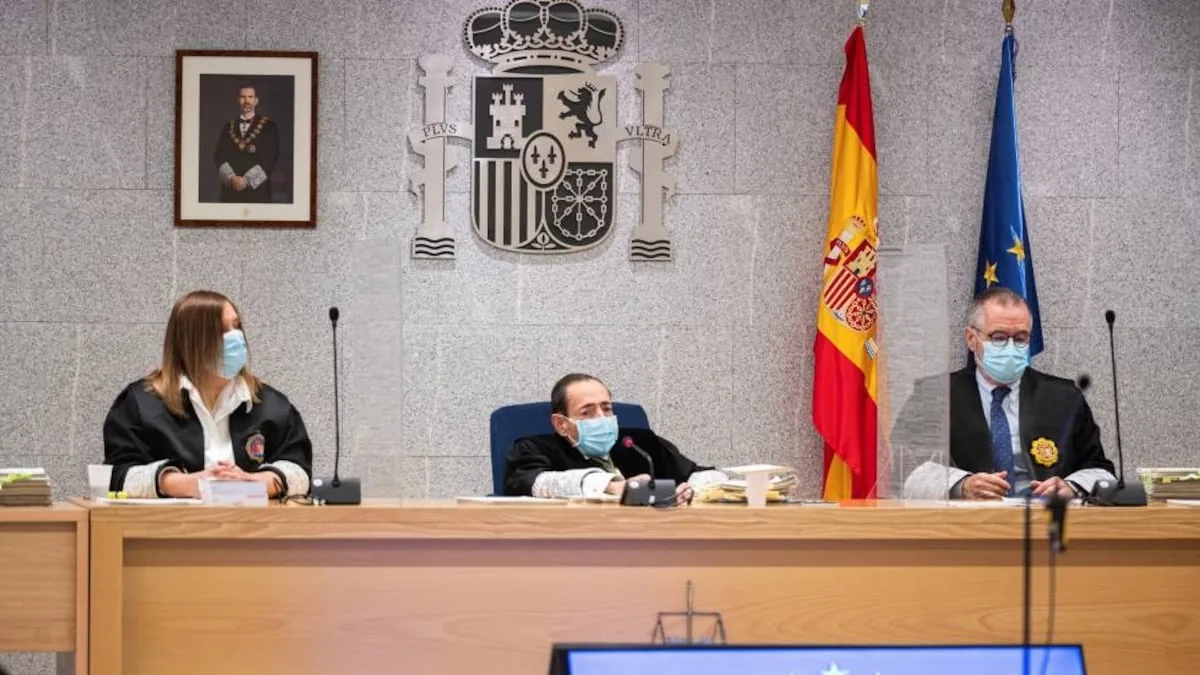


The National Court has annulled the search carried out by the National Police on February 9 at the headquarters of the company Sidenor in Basauri (Bizkaia) within the case opened to investigate the sale of steel by that company to Israel. According to the three orders accessed by EFE this Wednesday, the Fourth Section of the Court — as an appeals chamber — has ruled in favor of the Prosecutor’s Office and the president of Sidenor and defendant, José Antonio Jainaga, who requested the annulment of the search, ordered by the investigating judge of the National Court itself, Francisco de Jorge.
Read more Bayern Munich — Real Madrid live | Four changes by Arbeloa in the starting eleven
This judge is investigating whether the president of Sidenor and two executives of that company committed a smuggling offense and participation by complicity in another crime against humanity for selling batches of steel to the company Israel Military Industries (IMSI), a weapons manufacturer.
The judicial procedure began in October following the acceptance of a complaint by the Palestinian Community Association of Catalonia, appearing as a popular accusation.
Jainaga expressed his willingness to cooperate and explained that the export contract for the steel under investigation was not for military use, but the investigating judge ordered the entry and search at Sidenor’s headquarters, against the Prosecutor’s Office’s opinion, a search in which dozens of police officers participated.
Hasty search
Now, the Fourth Chamber has issued three orders, dated Monday the 13th, in which it sides with the Prosecutor’s Office. In the main one, the chamber states that the scope of the search related to facts investigated for a possible smuggling offense is “hasty,” as argued by the appellant and the prosecution.
“Especially since at all times the investigated parties have been willing to provide all the documentation requested, in addition to the already very abundant documentation provided, and it is also hasty because there are pending proceedings that could have influenced the authorization, from which the disproportion is also concluded because there are less burdensome measures already agreed upon and not carried out,” the Court established.
In fact, the order considers that these proceedings must be based on sufficient indications or, at least, on “well-founded suspicions” in objective circumstances “that the crime may have been committed, without it being interpreted that the search related to complicity in a crime against humanity can be carried out.”
Therefore, the order stipulates that “the minimum requirements demanded for the execution of a measure limiting some fundamental right are not met, so its annulment is feasible” (that of the search warrant).
“Risk of prospective investigation”
It has also warned that there is “the risk of a prospective investigation” when the complaint is based on four steel exports carried out between August 2024 and July 2025.
These are four export operations made to the company Imi Systems from the port of Barcelona, but the Sidenor search extended to earlier dates, as the agents involved took as a reference the time period from January 2021 to July 31, 2025, “making the measure, ultimately, totally disproportionate,” according to the order.
“Thus, regarding the objective scope that the proceeding may reach, the search is also null, without its purpose being duly justified,” the Court ruled.
In the other two orders, the Court rejects that the Gaza doctor Refaat T.A. Alathamna can appear as a popular accuser, accepting the Prosecutor’s Office’s thesis that he cannot be considered a private accuser because he has not been harmed or offended by the alleged crime of genocide or crimes against humanity.