
In the current, increasingly accelerated political scenario, it is difficult to clearly orient oneself. What is evident is that national policies are increasingly influenced by events that transcend our borders. This has been happening for a long time, but the thunderous emergence of Trump has forced us —at last!— to become aware of something already obvious: the thorny yet inevitable network of external interdependencies that thread through our politics and must now be faced head-on. Let’s call it “world-politics” in contrast to the usual localism of politics, always more attentive to what is close at hand.
Read more Ignacio Isusi, actor: “I’m a posh boy who has gone off the rails”
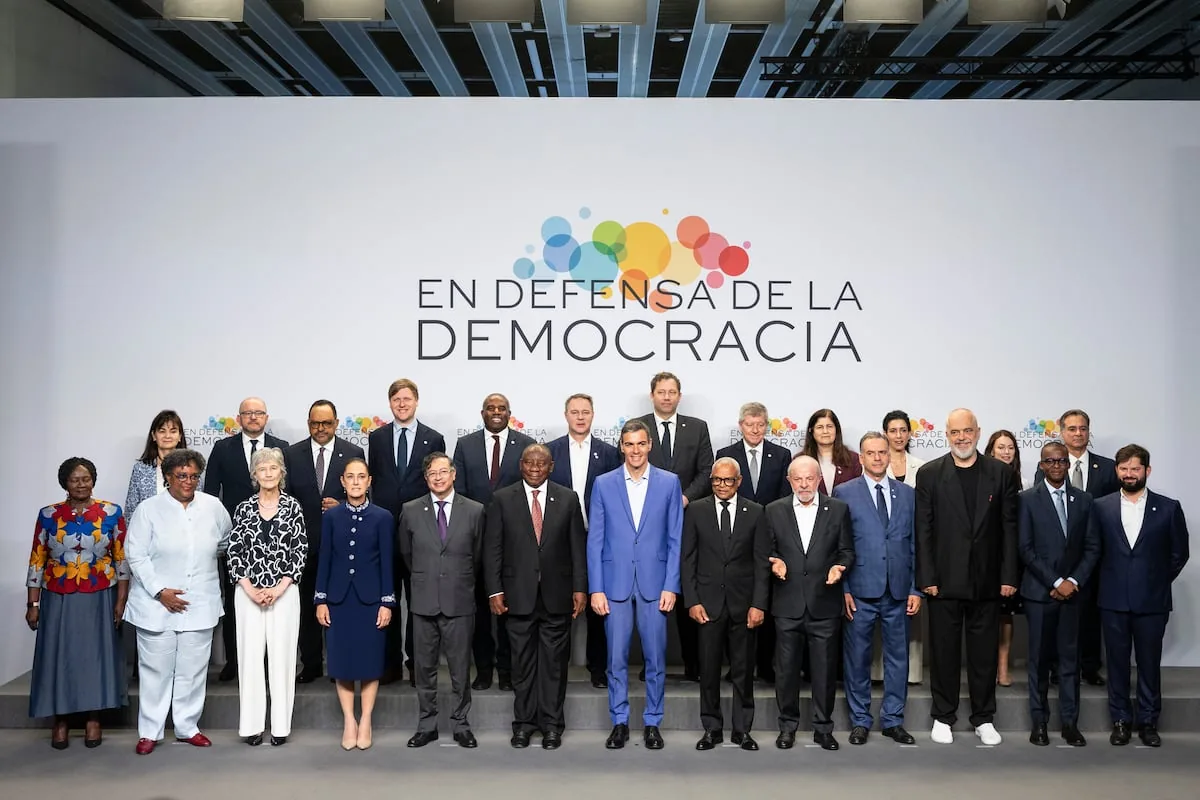
In our country, the emergence of this new axis has resulted in a curious shift in discourses and sources of confrontation, although for now it only seems to have one clear beneficiary, Pedro Sánchez. Faced with a national political situation bogged down in usual conflicts and adverse dynamics for his party, the president has found a source of opportunity to reverse this trend by embracing a new international activism. He has built a political profile of global projection, establishing himself as Trump’s nemesis and a benchmark for a new “global progressivism.” It is another example of something that cannot be denied him: his instinct to reinvent himself according to circumstances and to detect the weaknesses of his adversaries. While he dons his cosmopolitan suit, his left-wing allies remain trapped in the parochial progressivism of the “peoples of Spain,” and the PP ignores how to emancipate itself from the stale scent of neo-Francoist nationalism imparted by its potential and inevitable partner.
It is also evident that this shift towards an “epic politics” is not without risks. The strategy seems clear: to temporarily distance himself from domestic policy issues to return to them with a new aura, with his figure magnified to contest the final battle, the national elections. It is not a minor move; the axis around which everything pivots in our country’s political circus revolves around Sanchismo/anti-Sanchismo, so strengthening his personal brand is key to mobilizing and uniting the left-wing electorate. The question is whether this gamble comes in time. The Andalusian elections will be the first test, although, if the polls are correct, a poor result for the PSOE in them should be almost taken for granted. Added to this is an external factor that is difficult to control: a virulent reaction from the always unpredictable Trump that could be interpreted as a reaction to Sánchez’s activism and have negative repercussions for our country. Although in that scenario, the main political cost should fall on Vox.
Read more José María Sánchez: judge, professor, and king of parliamentary strife
The interesting thing, in any case, is the nature of the new dynamic we have entered. One politics more focused on its conventional forms of action, on grassroots activism and exploiting the usual themes, and another that aspires to higher flights. Under normal conditions, if such a thing can be applied to politics, one would expect a majority inclination towards the former. Now I have my doubts. The dislocation of the international political habitat is of such magnitude that clinging to traditional political routines is equivalent to completely ignoring the new context we are in. So much is at stake, such is the damage caused by Putin and Trump, that it becomes imperative to demand clear pronouncements on how to reverse it. In this, Sánchez is showing more agility than Feijóo, who is fixed on one gear and lacking ideas to counteract it. But what ultimately matters is the attitude of the citizen himself, whether he wants to continue inhabiting the province or open himself to the wide world.
Read more Lucía Prieto Godino, the scientist who has transferred a behavior from one species to another