






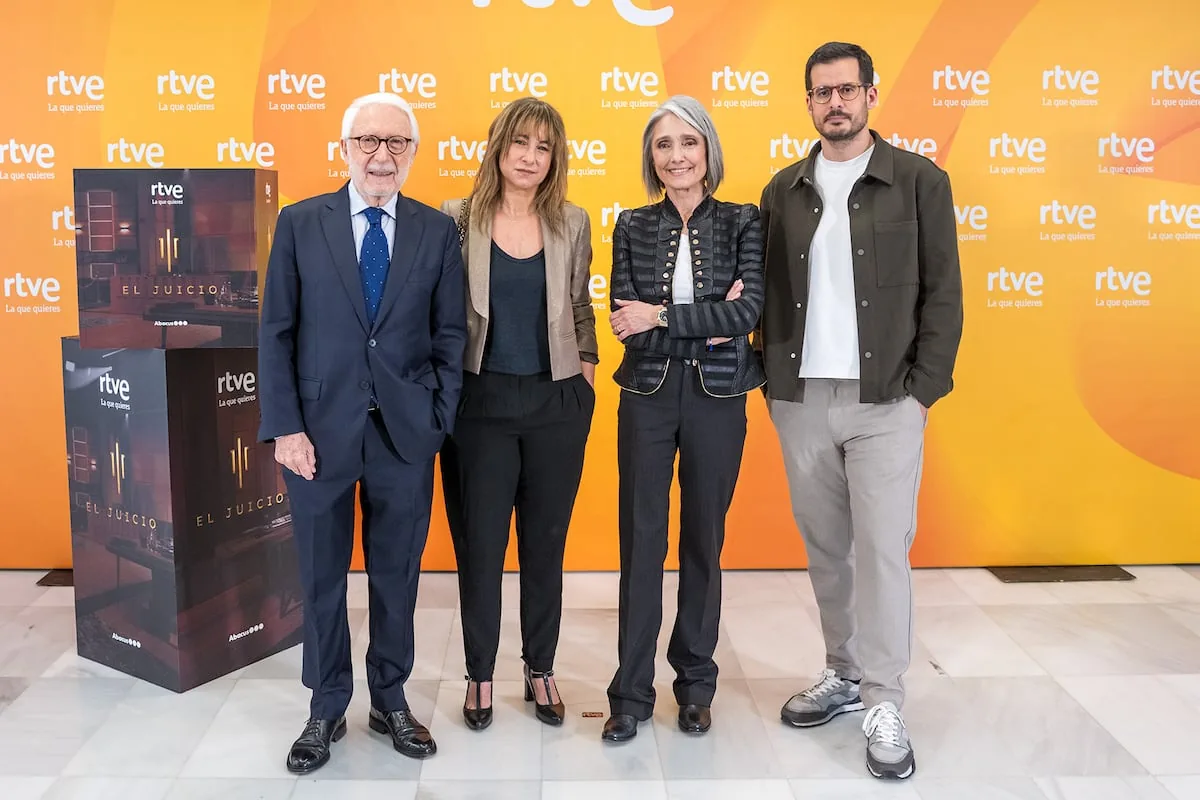
Next Wednesday, April 29, TVE reopens its television court with the premiere of El juicio (The Trial), the show with which José Luis Sastre makes the leap to television and which he combines with his work as deputy director of Hoy por Hoy on Cadena SER. The format, which will be broadcast on that day of the week on La 2 around 10:15 PM, right after Cifras y letras (Numbers and Letters), pays homage to a classic of the public channel, Tribunal popular (Popular Court). In essence, the program uses the structure and ritual of a judicial process to build a two-hour debate on social issues and matters that concern Spanish citizens: housing, healthcare, youth, food… Each week, a popular jury made up of nine anonymous citizens will give their verdict on one of the major social concerns, while Sastre will be responsible for providing informative context to each topic.
Read more An Education official who published a book with denigrating descriptions of teachers resigns
Coming to @la2_tve, “El juicio” (The Trial), a weekly program presented by José Luis Sastre.https://t.co/ZgJQU9hav8 pic.twitter.com/riQo86JPHT
— Telediarios de TVE (@telediario_tve) April 20, 2026
El juicio (The Trial) has a triple language, explained Marc Roma, executive producer of the format, this Monday during the program’s presentation to the media. On the one hand, it revives the tradition of a court show, to which a certain element of a reality show is added, “by revealing each week the opinions and personal circumstances of the jury members who represent Spanish citizens.” The third aspect of the show is journalism, which José Luis Sastre is in charge of. The journalist will not be on set. Each episode will include reports in which he will interview people affected by the chosen topic in each installment.
Being in the places where things happen, asking the people who are affected by them, has allowed the face of Cadena SER to “give another meaning to those data we talk so much about in radio and television news,” he comments. “El juicio (The Trial) is a studio program, but also about being on the street, in hospitals, schools, and fighting against the polarization and information bubbles that the algorithms of our phones lead us to,” Sastre defends. The topic he found most complex to portray was healthcare, “or at least it was the one where I most felt the need for us to keep talking beyond the figures,” he explains.
An anonymous jury
Nine anonymous citizens between 25 and 64 years old have been chosen to form a jury that seeks the social, generational, and territorial diversity of the country. The demographic criterion of Fifty5Blue, an agency previously known as Kantar Media, was used. Among them are a retiree, a migrant, a self-employed person, an educator… The creators of El juicio (The Trial) selected the nine final components from a pre-selection of 36 prepared by the market research company.
Journalist Ana Pardo de Vera and jurist Montserrat Nebrera play the role of lawyers. In addition, lawyer and journalist Ricardo Fernández Deu returns to public television as a judge, 35 years after participating in the remembered Tribunal popular (Popular Court), where he was the defense lawyer facing Javier Nart. Among the guests who will occasionally attend one of these six televised trials or answer Sastre’s questions off-set are former Barcelona mayor Ada Colau, writer and activist Elizabeth Duval, actor Juan Echanove, singer-songwriter Joan Manuel Serrat, and writer Martín Caparrós, among others.
“Spanish trials are not usually like those in this program. This more Americanized, more theatricalized version seeks to be attractive to the viewer and allows us to offer an educational and pedagogical point of view,” notes one of the show’s lawyers, Montserrat Nebrera. “Throughout the episodes, we realize that everything is very nuanced and we remember that life is full of grays,” she continues.
For Ricardo Fernández Deu, the fact that more than three decades have passed since Tribunal popular (Popular Court) stopped broadcasting, “with a Spain and a television completely different from today’s,” makes El juicio (The Trial) a very different proposal, in his opinion, he explains to this newspaper. Ana Pardo de Vera and Montserrat Nebrera celebrate that in this format they can argue with much more time and tranquility than in the political talk shows in which they participate on different channels. El juicio (The Trial) has become “an unprecedented experience on television until now,” comments Pardo de Vera.
Sergio Calderón, director of TVE, defends that El juicio (The Trial) “is a bet to strengthen La 2’s prime time,” whose impact is at its highest levels in the last 17 years. The executive insists that TVE’s programming strategy is designed for La 1 and La 2 to complement each other every night. And, on Wednesdays, El juicio (The Trial) will coincide with a Spanish fiction series, Barrio Esperanza (Hope Neighborhood), which has just premiered on La 1 with a 15% audience share.
Aimar Bretos is another voice from Cadena SER who will jump to television in the coming days with La noche de Aimar (Aimar’s Night) on La Sexta. It is possible that his program will also occupy the Wednesday prime time slot on the Atresmedia channel, in direct competition with his radio colleague. Sastre takes the confrontation naturally. “The fact that two radio voices are in television’s prime time demonstrates the continued relevance of the medium,” the journalist celebrates.