







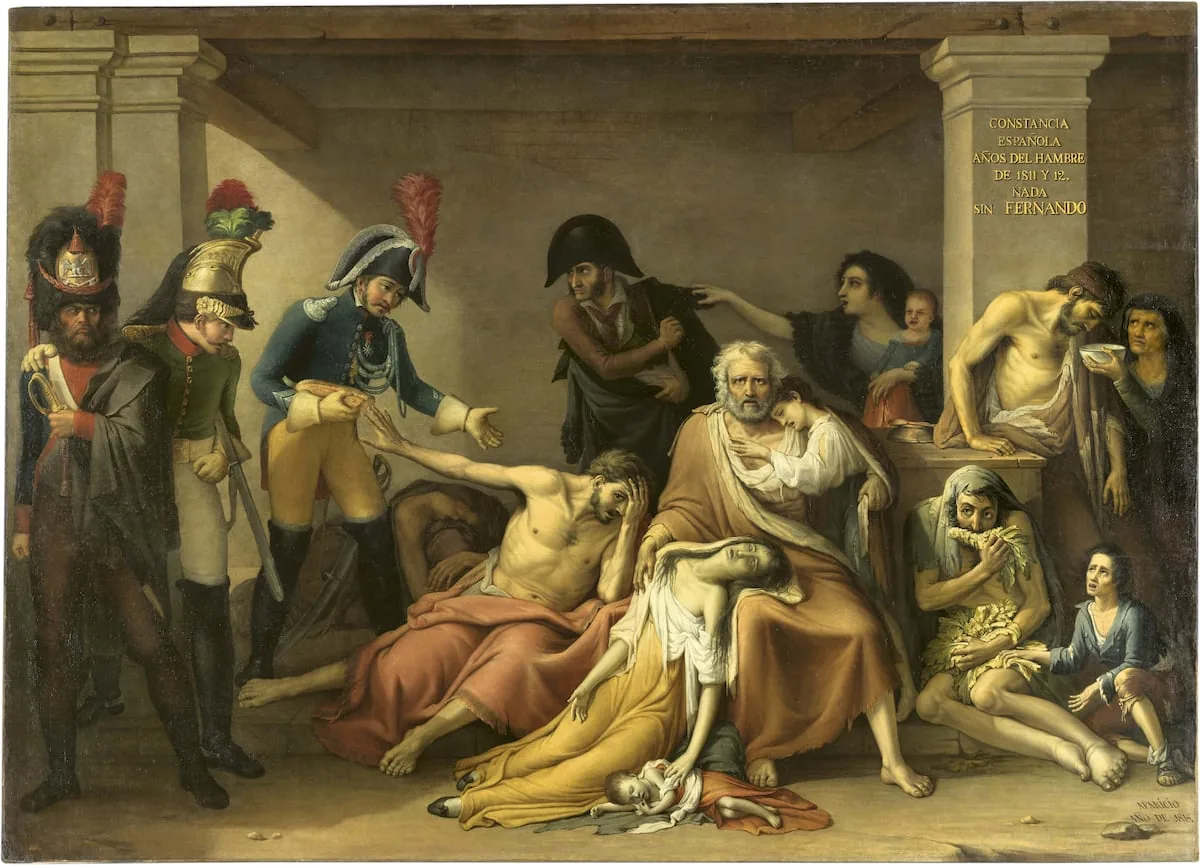
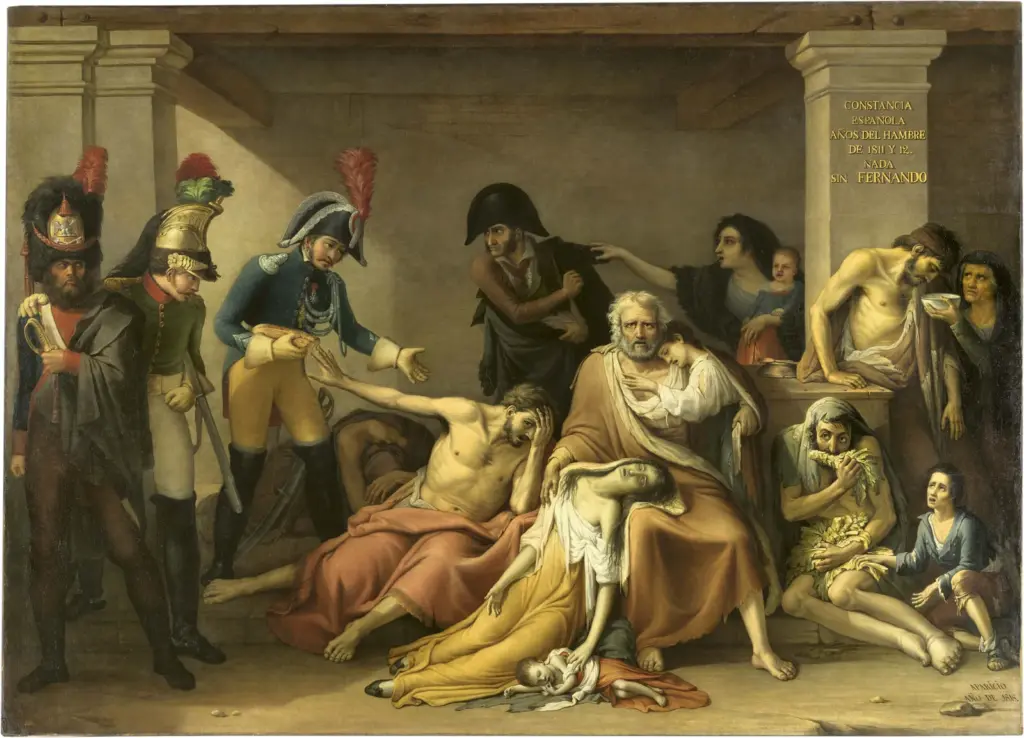
It is a monumental painting, larger than Velázquez’s ‘Las Meninas’. It is over four meters wide and three meters high. Its dimensions reinforce its political importance in the Fernandine era.
Read more Yomif Kejelcha, the athlete who made history and whom no one will remember
It was painted in 1818, brought to the Prado for its inauguration in 1819, and hung in the third room, the heart of the museum, alongside royal portraits and other paintings with political messages.
On the column, an inscription in golden capital letters appears: “Spanish Constancy. Year of the Famine of 1811 and 12. Nothing without Fernando.” This message was part of the political propaganda at a time when King Ferdinand VII was “the desired one.” A person extremely loved by the people of Madrid for having freed them from the French invasion.
The scene takes place in the arcades of the Plazuela de la Provincia, opposite the Plaza Mayor, whose construction has disappeared over time. In this place, common people could see the kings in person.
One of the three French soldiers offers bread to a dying man who rejects it. After the food crisis between 1811 and 1812, this food represented 80% of a Madrilenian’s diet. Faced with scarcity, the city council even authorized unusual ingredients in bread, such as potatoes.
The family in the center of the scene symbolizes all phases of hunger: the dead daughter and baby, the dying father and another woman, and the son-in-law who rejects sustenance from the invaders. The children function as a symbol of sacrificed innocence, similar to the iconography of the French Revolution.
This character eats vegetable scraps from the ground (cabbages, abandoned roots). One of his legs is visibly swollen and deformed, alluding to the chronic diseases left by the famine years later.
The overturned bowl is another symbol of scarcity and hunger.
The woman holding a baby tries to prevent the figure of the Madrilenian “majo,” wearing a half-cheese hat, from attacking the French.
In the central family, several aspects are concentrated that gave special modernity to the piece and the author: the gesture of the son-in-law inspired by the painting ‘Marius in Minturno’, by the painter Drouais, Jacques-Louis David’s favorite disciple.
The colors of the garments that appeared with the restoration of the piece (brown, orange, yellow, and crimson) are the same as those in Madrazo’s painting ‘The Death of Viriato’, both exhibited together at the Academy in 1818.
Antonio Gisbert, a liberal ideologist, removed this painting when he became director of the Prado in 1872 and stored it due to its references to absolute monarchy.
The work went from popular icon to oblivion and began a journey through the Ministry of Public Works, the Senate corridor, the Museum of Modern Art (in the basement of the National Library), where director Pedro de Madrazo, son of Aparicio’s rival, kept it out of sight. In 1927, it was finally deposited in the Museum of History of Madrid, where it remains to this day.