








After eight months detained at the ICE Camp East Montana center, ZOR claims he is locked up in a place “without law.” In a lawsuit filed in a federal court in El Paso, Texas, this immigrant recounts that officials at this center have tried to deport him six times despite a judge prohibiting his expulsion to his country; he says he was beaten by another detainee in view of officials who did not intervene to stop the beating; he narrates that a guard snatched his crucifix and threw it in a trash can; that he does not eat enough; that he has had recurrent respiratory and skin problems due to excess dirt.
Read more At least 20 injured after a tram derails in Berlin
“This place is exhausting, even after a couple of days,” ZOR (quoted under a pseudonym for protection) said in a statement shared by lawyers from the American Civil Liberties Union (ACLU), one of the civil rights organizations representing him in this, the first class action lawsuit filed against Camp East Montana before the Western District Court of Texas.
Together with three other immigrants and with the testimony of a group that has already been released, ZOR sued on Friday night the Immigration and Customs Enforcement (ICE), the Department of Homeland Security (DHS), and some of its heads. They all tell stories of abuse.
Cameroonian Gerald Akari Angye told lawyers that guards at Camp East Montana beat him “hard” just for asking to be allowed to speak with a lawyer before signing the documents for his transfer to another center: “He was hospitalized and put in a wheelchair due to the injuries he suffered. He was isolated in a cell upon his return from the hospital,” reads the 78-page document.
In a statement shared by the ACLU, Angye said that although he had been tortured in his country, he never thought he would suffer “such severely violent” treatment by guards in the United States: “I still wear a splint on my hands and wrist. I feel pain and I am afraid to be here.”
The lawsuit also includes the testimony of an immigrant cited under the name Navdeep, who has been detained at Camp East Montana for five months. He says that due to a preexisting injury, he could not put his hands behind his back because it caused him a lot of pain. When the guards at this center ordered him to do so and he could not obey, they violently pushed his arms back and handcuffed him. Like Angye, he was locked in an isolation cell.
“We could die here and it feels like no one would care. With everything that happens behind closed doors, I worry that the people running this place could cover up the truth about a death or other injustices that occur,” he said.
In the class action lawsuit, these immigrants denounce that the conditions at this ICE center, the largest detention capacity in the country, “constitute a punishment” and that daily life is marked by a “system of degradation” that does not provide them with adequate food or access to soap, shampoo, toothpaste, or outdoor recreation. They condemn that detainees can be locked in isolation cells simply for not obeying orders, as happened to Angye and Navdeep, or be victims of abusive treatment to force them to accept deportation.
A DHS spokesperson responded to EL PAÍS that the allegations about inhumane conditions at Camp East Montana are “completely false.”
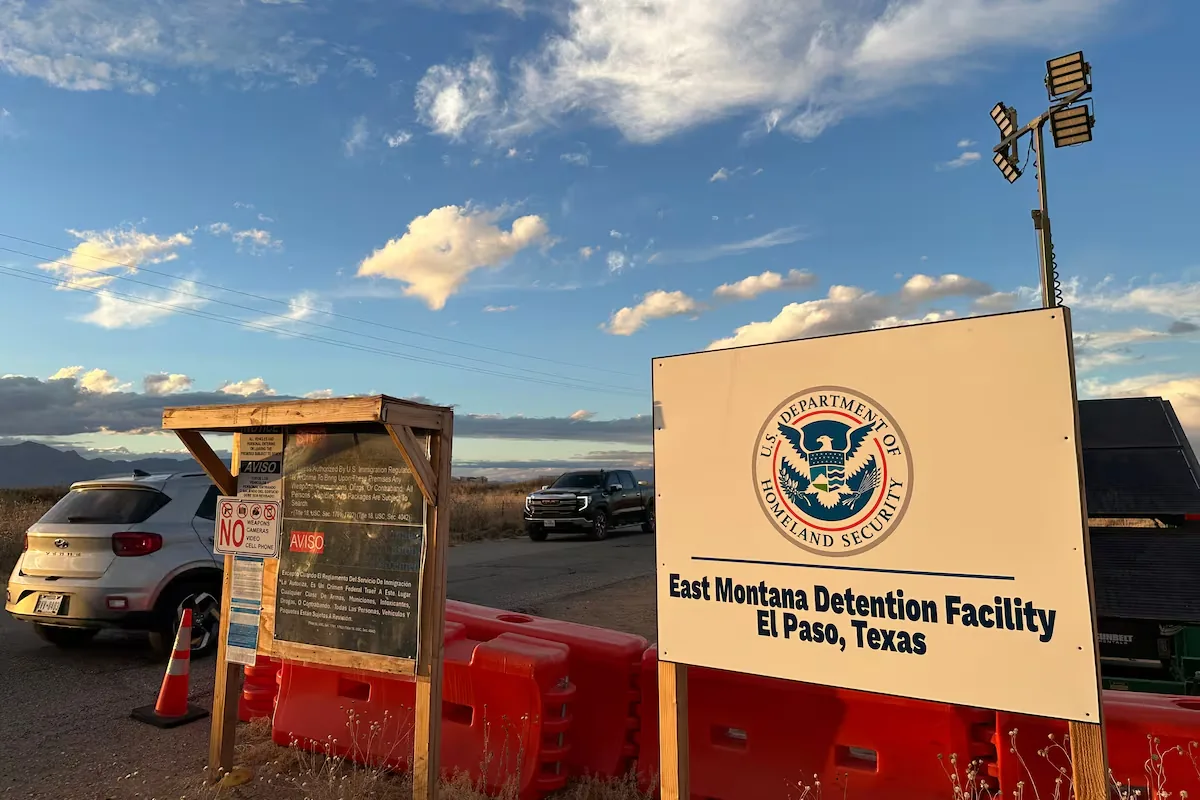
The ICE detention center Camp East Montana is located at the Fort Bliss military base in El Paso, just a few miles from the Mexican border. There, in the middle of the sandy and hot Chihuahua desert, the federal government erected tents to house an estimated 5,000 immigrants. In April, it reached an average of 2,505 detainees per day, according to estimates from the nonpartisan data research institute TRAC, founded by Syracuse University. It has been presented as the largest immigrant center in the United States.
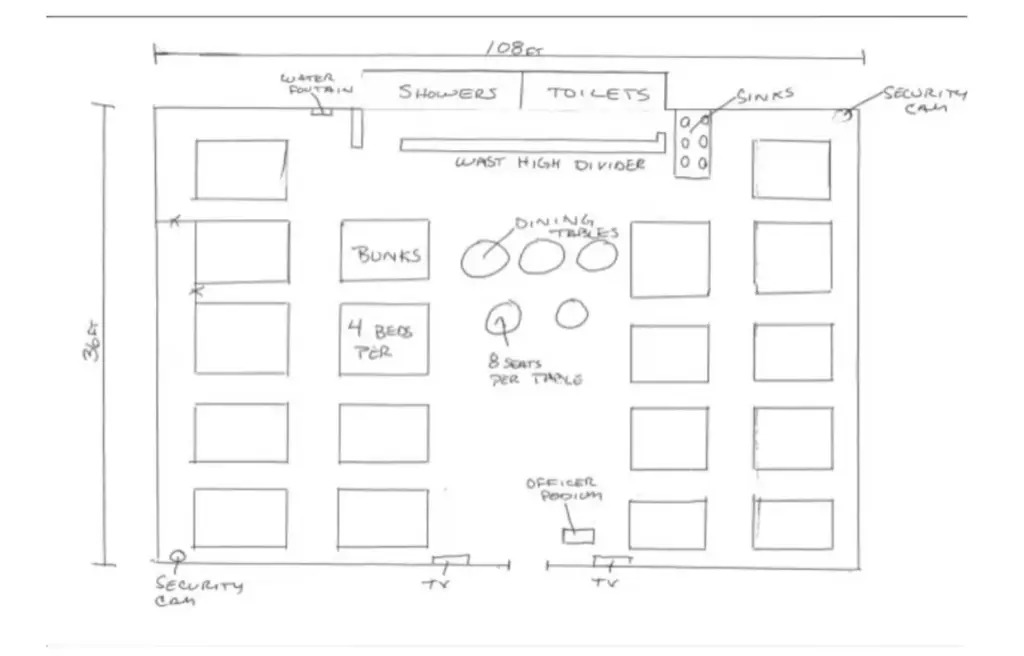
In the lawsuit — filed by the ACLU and ACLU of Texas, the Texas Civil Rights Project, and the law firm Farella Braun + Martel — the immigrants claim that the tents in which they remain locked all day have no windows to see sunlight. They say that approximately 72 people live together in the same space where bunk beds are crowded, dining tables — which have chairs for everyone — and bathrooms and showers — without privacy — as seen in the drawing below.
“Therefore, the smell of urine, feces, and body odors is always present in the unit,” they describe.
Nine months, three dead, a heap of complaints
In nine months of operations, Camp East Montana has been in the headlines for allegations of human rights violations that have given it even more prominence than any other ICE center in the state. The most notable are the deaths of three immigrants detained in just six weeks.
One of these deaths occurred in January 2026, that of Cuban Gerardo Lunas Campos. In court documents, six detainees in El Paso described that the man begged for days to receive his asthma medication. They claim it was not provided and that he was confined to a solitary cell. In a statement, ICE explained that during that time officials tried to stop a self-harm attempt; and that when they made “spontaneous use of force,” Campos lost consciousness. They said they tried to revive him, but he died.
But shortly after, the El Paso Medical Examiner’s Office revealed the report and classified the death as a homicide due to “asphyxia resulting from compression on the neck and torso.” The autopsy, obtained by several media outlets, concluded that it was a consequence of being physically restrained by Camp East Montana authorities.
The lawsuit filed on Friday in a Texas court states that one more person died shortly after being released from Camp East Montana, “where they were denied the chemotherapy needed to treat their cancer.” DHS did not respond to questions sent about this case.
The document denounces that detainees are not consistently provided with the medications they need, not even when they inform staff of their needs for insulin, antiretrovirals, or more specialized treatments. “People can go days and weeks after their arrival without receiving their medications” and without being examined.
The lawsuit also questions that minimum adequate conditions are not guaranteed for people with preexisting illnesses. It narrates, for example, the case of a diabetic person with high blood pressure who reported receiving the same food as the rest of the detainees, even though it was labeled as a special diet for them. Consuming it caused nausea, dizziness, and headaches.
They denounce that immigrants do not receive immediate medical attention even when discomfort is evident and the affected person ends up fainting. In a recent case, on May 23, they say a woman reported severe pain in the lower back with difficulty breathing, walking, and with fever. “She cried for hours in pain” until she fainted. She was treated after convulsing, they claim in the document.
A DHS spokesperson responded to EL PAÍS that “ICE takes the health and safety” of its detainees seriously. They insisted that “the well-being of people in our custody is a priority,” that a comprehensive medical evaluation is conducted within the first 12 hours after arrival at the detention center, and that they have access to medical appointments and care 24 hours a day.
Almost thirty congress members requested in a letter in February the closure of this ICE detention center “for the sake of anyone in the facility, to end abuses against detainees.” Their descriptions of daily operations at Camp East Montana coincide with those narrated by the four immigrants in the lawsuit: “poor” detention conditions; poor quality water and food, which makes them sick; limitations to see the sun or recreate; dirty units due to overflowing water in the bathrooms; “inadequate” medical care and “irregular” access to lawyers.
Three months have passed since that demand made from Congress. The detention center remains open.
“Camp East Montana is nothing more and nothing less than a civil rights disaster,” concluded Kyle Virgien, one of the lead lawyers of the ACLU National Prison Project. “We sue to ensure that no other human being has to endure the inhumane treatment that the Trump Administration has inflicted on our clients.”