









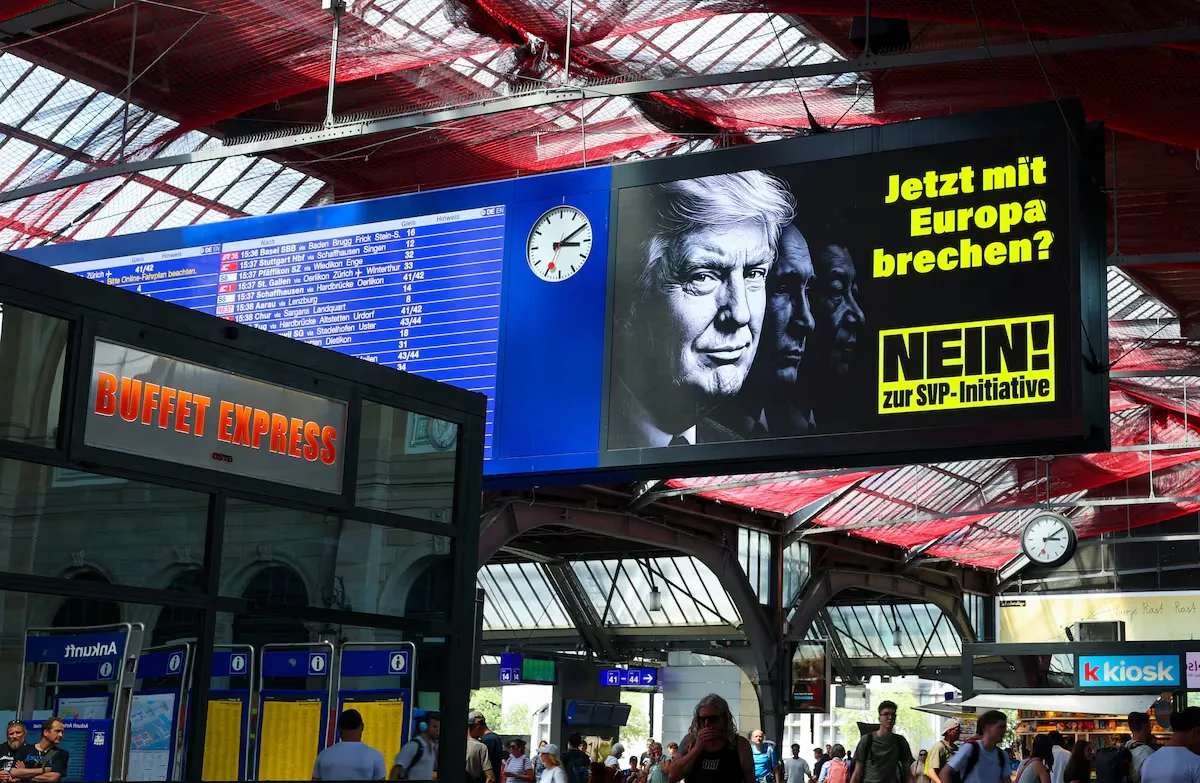
The debate surrounding immigration has been ongoing in Europe for years, leading to increasingly restrictive measures, while far-right forces grow in parallel, fueling the discussion. The EU is resorting to tightening rules in a migration pact that now also endorses deportation centers outside its borders. Faced with these recipes for containing immigration, the Swiss People’s Party (SVP/UDC, in its German and French acronyms) has come up with an unusual experiment: setting a cap on the country’s total population. Swiss citizens will vote in a referendum on June 14 on whether to support this lockdown. The latest polls, although predicting a close result, give a slight advantage to the no vote.
Countries like Canada or Australia apply a points system to select foreign workers, the United Kingdom requires visas, and in Donald Trump’s United States, the persecution of immigrants and deportation have been imposed. Switzerland combines the entry of EU citizens through the free movement of people agreed with the EU ―the country is not part of the Union― with quotas for skilled workers from third countries.
For the Swiss People’s Party (SVP), the largest group in Parliament (with nearly 30%) and with a strong anti-immigration stance and rejection of closer ties with the EU, “too many” foreigners and asylum seekers have always entered, and it has tried with various initiatives to set limits. Now it proposes that the country not exceed 10 million inhabitants by 2050. The population is already 9.1 million today, of which just over 27% are foreigners, and of those, 67% are from EU countries (Italy, Germany, Portugal, and France are the most represented nationalities). Its proposal thus targets the free movement of people agreement with the EU, a pillar of the relationship with Brussels and of Swiss access to the single market without being a member of the club.
Since its entry into force in 2002, the population in Switzerland has increased by about 1.7 million people, mainly due to immigration, with nearly one million coming from the Union, attracted by an economy that constantly seeks them to continue growing ―refugees, mainly from Afghanistan, Eritrea, Syria, and Turkey, account for only about 12% of entries―. This has placed Switzerland among the fastest-growing countries on the continent.
An “uncontrolled” immigration that forces “to act once and for all” by putting a lock on entries, argues the populist right’s campaign. The proposal has generated a wide debate in the small and wealthy country, where other parties, employers’ associations, and trade unions warn of the economic and social consequences of closing doors to immigration and a possible rupture with Brussels. It is the “chaos initiative,” summarizes its slogan.
However, the Swiss People’s Party (SVP) gains support beyond its base. It does so with arguments rooted in everyday life, such as saturated trains and highways, wage pressure, housing shortages, and “soaring rents.” It even resorts to ecological banners like nature protection, by naming its proposal the “sustainability initiative.”
The co-president of the Swiss Socialists (SP), Cédric Wermuth, believes that part of the support for the initiative stems “from a discontent, undoubtedly justified, regarding the distribution of wealth and opportunities in society.” “But I do not consider the solution viable nor those who propose it credible,” he adds.
The “no” camp accuses the SVP of selling populism and half-truths. It does not deny the need to act in areas where immigration strains resources, such as housing, but emphasizes the dangers to the economy and services like healthcare, where foreign workers, from doctors to caregivers, are abundant, and of isolating the country from the EU. “We must be aware that this is happening in the midst of an economic war, declared by Donald Trump —and, as far as I’m concerned, also by Putin— against Europe, but also specifically against Switzerland, and that, at best, we would be embroiled in a years-long conflict with our most important and stable trading partner, which remains the EU,” says Wermuth.
Read more Primavera Sound breathes a sigh of relief after an edition that overcame the adversities
And this perspective worries businesses. Foreigners make up 35% of the workforce, many highly qualified, and are represented in all sectors, from industry, mechanical engineering, watchmaking, and construction, to gastronomy and healthcare, including the service sector or research and teaching staff in universities.
The foreign workforce is “of vital importance” for the country, emphasizes Rudolf Minsch, chief economist at the employers’ association Economiesuisse. “Switzerland could not be the number one country in innovation without qualified foreign personnel. Furthermore, it is a privilege to have them. Switzerland is one of the few countries in the world truly capable of motivating the best talents to work here. Without them, it would be impossible for us to maintain this status,” he asserts.
Large companies like the pharmaceutical firm Roche, with about 15,000 employees, half of whom are foreigners, warn that a cut in migrant labor will affect their business position. “The approval of the initiative would cause great uncertainty,” says Minsch, and moving away from bilateral agreements with Brussels “would entail considerable economic risks.” And incomprehension abroad because Switzerland would adopt the measure “from a position of incomparable wealth” and as one of the “main beneficiaries of European integration,” adds Wermuth. The Union is Switzerland’s main trading partner ―with a GDP per capita of about 83,000 euros compared to the European average of 41,600 in 2025― and is the destination for 50% of its exports.

If the initiative succeeds, the federal government would be obliged to adopt measures as soon as the population reaches 9.5 million people, something that, according to official scenarios, could happen as early as 2031. The populists would then demand restrictions on asylum and family reunification. But these measures would probably be insufficient. The 10 million inhabitants mark, according to forecasts, would be reached around 2041. If the mark is exceeded by two years, the federal executive would have to propose the annulment of the free movement of people with the EU.
Ultimately, it will be “decisive” whether voters believe “that the proposed solution truly resolves the problems, which are real for many,” says Fabio Wasserfallen, a political scientist at the University of Bern and co-founder of the polling firm Leewas, whose latest survey predicts 52% rejection of the initiative, compared to 47% support.
However, the day after the vote, nothing will happen yet. “The clever thing about this initiative is that it demands a clear consequence, but this is postponed to the future. It is absolutely clear that, if things continue as they are, the free movement of people with the EU in its current form would have to be abandoned. But, in reality, it is being postponed, and that is why the starting situation is a bit diffuse,” notes Wasserfallen. If anything has become clear, it is that the debate moves or worries many Swiss, and even if the proposal is rejected, “it will not be settled,” adds the political scientist, and for politics, “the question of what can be done about it” will remain. For Minsch, “that cry for help from the population must be taken seriously.”