The threat of fire forces the transfer of bone remains from the Monastery of San Juan de la Peña in Huesca

The threat of fire forces the transfer of bone remains from the Monastery of San Juan de la Peña in Huesca

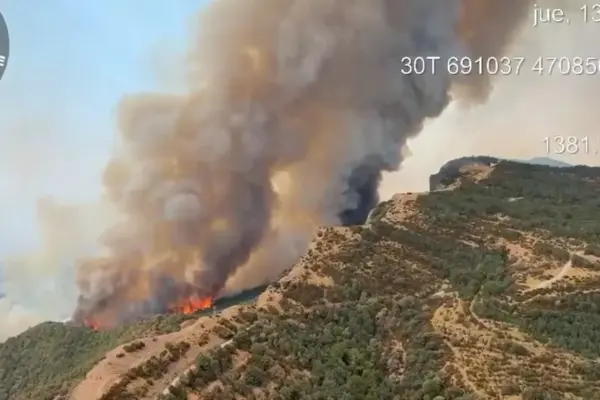
Technicians from the Government of Aragón and personnel from the Military Emergency Unit (UME) have extracted this Thursday from the Old Monastery of San Juan de la Peña the skeletal remains from the Royal Pavilion, as well as other items such as the clothing of the 10th Count of Aranda due to the advance of the fire declared this Monday in the Peñas de Riglos (Huesca) towards the east and the new monastery.

Read more Temperate forests that disappeared in the past over millennia are now vanishing with the same pattern, but in decades

The fire, which affects about 8,000 hectares, has forced the evacuation of nearly 900 people so far from 12 towns -Villalangua, Salinas de Jaca, Ena, Centenero, Arbués, Alastuey, Bailo, Larués, Botaya, Santa Cruz de la Serós, Binacua and Osia- and the Pirineos campsite, next to the N-240 road.

For the night of this Thursday, Defense plans to maintain two sections of the UME within the operation, alongside the brigades and ground resources of the Government of Aragón, MITECO, and the different fire departments. The reinforcement arrives at one of the most complicated moments since the fire began. The flames have advanced towards the surroundings of San Juan de la Peña, which has forced a change in the extinguishing strategy to defend the monasteries and Santa Cilia de Jaca. Additionally, it threatens both the New Monastery and the Old Monastery.

Sources from the Government of Aragón have told EFE that the items extracted preventively due to the advance of the flames, which so far “have not reached either of the two monasteries,” but have reached their surroundings and the protected natural area, have been transferred to the Museum of Huesca.

The intervention was carried out by UME personnel and a team from the Directorate General of Culture and Heritage in a second attempt, after they were unable to carry out a first attempt due to the danger of the situation and the proximity of the flames. The operation has allowed the transfer of remains of the kings to the Provincial Museum of Huesca, as well as some paintings and other heritage pieces.

The threat affects a space of enormous historical and cultural value where the two monasteries of San Juan de la Peña are located. While personnel work to protect the Old Monastery, attention is also focused on the New Monastery, located in the Llano de San Indalecio, due to the proximity of the fire front.

The operation worked this Thursday to defend both the two monasteries of San Juan de la Peña and the municipality of Santa Cilia, confined like Puente la Reina, and the rest of the evacuated towns in order to safeguard the villages and the natural and cultural heritage of the mentioned protected landscape and the two monasteries. The new monastery, located in the Meadow of San Indalecio, was created precisely after the fire in the old monastery, located under a rock, which burned in the 17th century.

Read more Sheinbaum assures that Colombia requests «another certification» from the Mexican Army rescuers who offer help

The UME reinforced this Thursday the operation against the fire in Las Peñas de Riglos with personnel from two new battalions, based in Torrejón de Ardoz, Madrid, and Bétera, Valencia. These units join those of the Fourth Emergency Intervention Battalion (BIEM IV), based in Zaragoza, which were activated at the start of the fire. The deployment thus brings together units from three Emergency Intervention Battalions of the UME. BIEM IV is based in Zaragoza; BIEM I, in Torrejón de Ardoz (Community of Madrid); and BIEM III, in Bétera (Valencian Community), according to the official structure of the Military Emergency Unit.

The new personnel from Torrejón de Ardoz and Bétera have joined the extinguishing efforts after the evolution of the fire forced the expansion of available resources, according to the Government Delegation in Aragón, which estimates that about 8,000 hectares have burned with a perimeter of 58 kilometers.

The Niebla fire affects more than 31,000 hectares

Wind gusts are a concern for the extinguishing efforts of the Niebla (Huelva) fire, which has covered more than 31,000 hectares. A total of 31 aerial resources have been working since noon on the forest fire declared last Thursday in Niebla, which threatens to become the greatest environmental tragedy in Andalusia after surpassing, with an estimated area of 27,800 hectares, the area burned by the Riotinto Mines fire (Huelva) in 2004. ç

The ground operation is composed of about 650 personnel: 305 from the Andalusian anti-fire device Infoca, 250 from the Military Emergency Unit (UME), 24 from the Army, 32 from the Brif La Iglesuela de Toledo and Pinofranqueado, 17 from the Provincial Firefighters Consortium of Huelva, and 20 from the Seville Provincial Council. After containing the active front in two-thirds of the northern sector, the extinguishing teams seek to focus the greatest amount of resources in the eastern zone, currently the most active.

It was expected that from 7:00 p.m. there would be a wind shift with gusts exceeding 35 kilometers per hour and relative humidity below 40%, as well as the possible recurrence of significant convective phenomena. Although the evacuation of more than 650 people remains, advances in the northern sector have allowed the return to their homes of the first 60 evacuated neighbors.

Read more Prichard Colón, the former Puerto Rican boxer who suffered severe injuries in a boxing match a decade ago, passes away

Translated from

Leave a Reply

Your email address will not be published. Required fields are marked *









