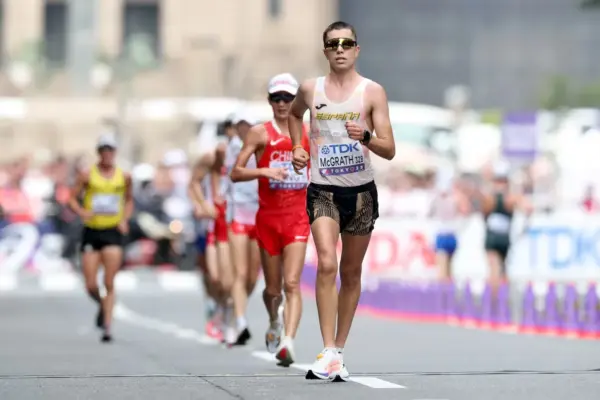
Paul McGrath and María Pérez lead the Spanish march: let ‘Gloria’ sound in Victoria Square

Paul McGrath and María Pérez lead the Spanish march: let ‘Gloria’ sound in Victoria Square

As a child, not so long ago, Paul McGrath remembers long car trips with his parents, a Scot in love with a Catalan woman who followed her to the Llobregat, and CDs, one after another of Van Morrison through the speakers. Despite everything, the Spanish racewalker did not end up repudiating the Lion of Belfast. On the contrary, he is so inspired by him that he would greatly enjoy if early this Saturday morning (from 8:30, Tdp) his exuberant voice resonated through the speakers of Victoria Square in Birmingham singing his Gloria at the top of his lungs, and several times, in praise of his victory in the half marathon event (21 kilometers and 97.5 meters), the distance that debuts alongside the marathon in a mild attempt to promote the specialty, and that of female and male companions who will share the route — a one-kilometer labyrinth with hills and stones through the center of the West Midlands capital, at the deserted hour when drunks stagger home, 7:30 British time, and 120 of the best athletes in Europe mixed, men, women, distances — and triumph in the chaotic Europeans.

Read more Finlay Tarling, 19-year-old Welsh cyclist, dies after being hit during the Tour of Portugal

“I would love to hear Gloria, already,” says McGrath, 24 years old and medalist at the 2024 European and 2025 World Championships. As a good Scot who has recharged his love for the land of his grandparents by spending the last days of his preparation in Glasgow, not far from Celtic Park, McGrath is not pleased to be made to compete in the square dedicated to Queen Victoria, but he happily prepares his revenge. He spent July in Font Romeu, went out on the road to applaud Pogacar when the Tour passed through there, that victorious stage of the Slovenian, who captured the yellow in the nearby Les Angles station, and has continued to feed his passion after morning training sessions enjoying swims on hot days in Lake Calbet and excited naps watching the Tour, Carapaz’s attacks in the Alps, Remco and Pogacar.

He leads the male sector of the Spanish racewalking team, a team rapidly renewing athletes and coaches. José Antonio Carrillo, immovable, remains, but Jacinto Garzón, José Antonio Quintana, and Alejandro Aragoneses are gaining more and more weight in the technical staff. And in the shadow of tireless figures, like Miguel Ángel López or Diego García, and wise veterans, like Manuel Bermúdez, grow the Madrid native Álvaro López, the Galician Daniel Chamosa, and the Granadian from Guadix José Manuel Pérez. Against them, the old Italy of Francesco Fortunato, in the half marathon, and the Tokyo Olympic champion Massimo Stano.

Read more The border czar justifies ICE using stun guns in the detention of migrants instead of lethal force

The romance blossoms between Antonella Palmisano and María Pérez, close friends who share training sessions in the same Font Romeu or in Livigno, and also share the podium in some competitions, like the Tokyo World Championships. Since the Italian, 35 years old, won gold at the Tokyo Games (fourth was the Granadian from Orce, five years younger), it has been the Spaniard who has dominated the competitions: four world titles (2023 and 2025) and one Olympic (2024) that the invincible pupil of Garzón added to the gold of the 2018 European Championships in Berlin, in her exuberant debut at 22 years old. And in her emulation, a very young generation has emerged, like the Lucense Aldara Meilán, 19 years old, cared for by Quintana in Madrid, the Catalan from Granollers Laura Monje (with Aragoneses, like McGrath and the veteran Raquel González), the Pontevedresa Antía Chamosa, or the Madrilenian Lucía Redondo.

The boost of racewalking in Spain, the passion of its athletes, clashes fatally with the sickly air of struggle for survival given by the certain indifference towards it from the international federations, the European and the International, and the International Olympic Committee (IOC), who, enamored like children of short, brief, fast specialties, despise long-lasting loves. No voice has risen against the madness of the organizing committee to do with the racewalking events what it would never do with other competitions in the program: a shameful hour and an unintelligible format. Rather, arguments have been lent to them: of course, if they want it in the city center, they will have to put up with it, repeat federation officials. And the athletes respond: of course we want to compete close to the fans, but at a time when there are fans, of course

Read more New details of Cristiano Ronaldo and Georgina Rodríguez’s wedding: prenuptial agreement with separation of assets and four witnesses

Translated from

Leave a Reply

Your email address will not be published. Required fields are marked *









