







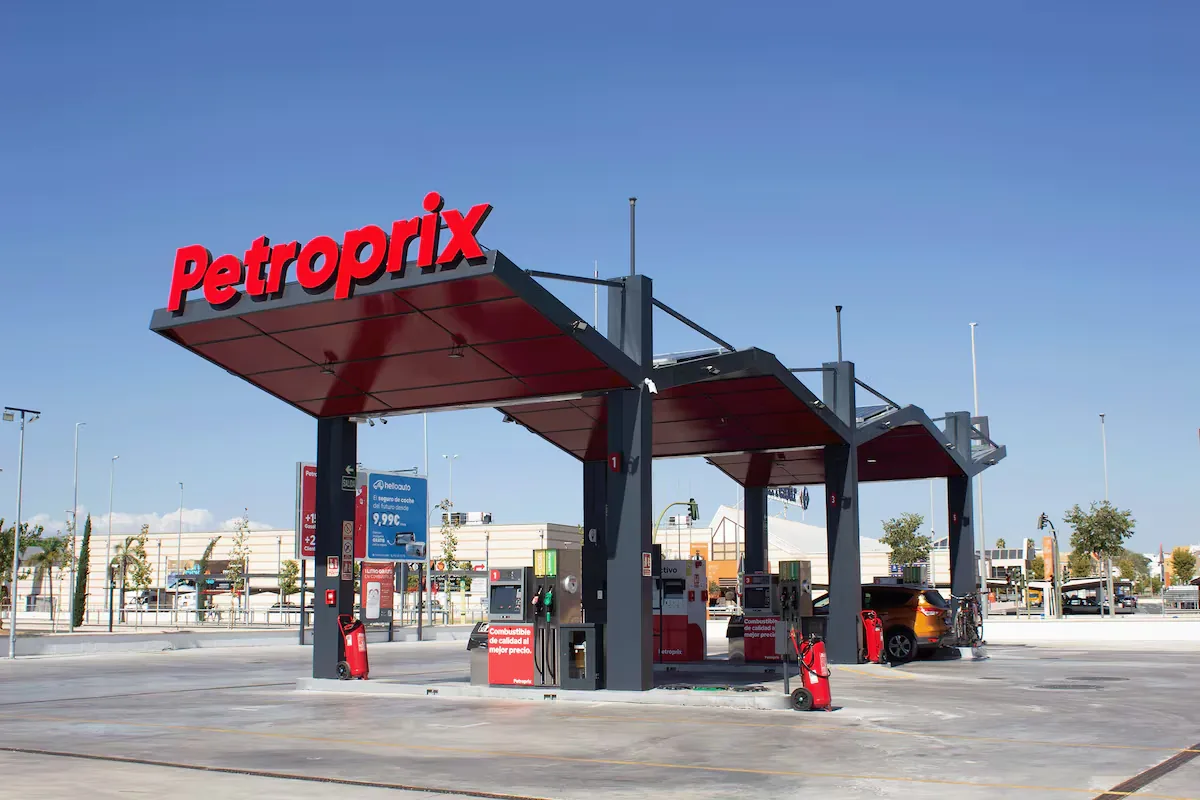
Petroprix has positioned itself at the center of the oil sector. The low cost gas station chain continues to grow both inside and outside Spain with its low-cost service stations, which are, according to the records of the National Commission on Markets and Competition (CNMC), among the companies with the most competitive fuel prices. In this context, several operators in the hydrocarbons sector dedicated to the buying and selling of petroleum-derived products point out that the latest diesel shipments that have entered Spain from Morocco – and which within the oil sector itself are said to originally come from Russia – have been purchased by Petroprix. The gas station chain has declined to comment.
Read more The Colombian shot dead by ICE in Maine was not the agents’ target
As this media outlet already reported, and is now confirmed by the records of the Strategic Petroleum Reserves Corporation (CORES), four ships carrying diesel have entered in two months from the ports of Tangier and a terminal near Casablanca. Now the sources consulted add that the fuel transported by the Aldebaran ship that arrived at the Exolum terminal in Bilbao on May 22 and was chartered by Futura Energy had Petroprix as the recipient. Previously, it had purchased the diesel that arrived at the same Basque port on the Sea Dragon cargo ship, chartered by Kimera Energy, add the operators consulted. The same sources also place Petroprix, which has preferred not to comment on these movements, as the recipient of the diesel that arrived at the Miladerto terminal in Barcelona on May 4 on the Kriti Episkopi ship, chartered by Futura Energy.
Alarms have gone off in the oil sector in recent months upon realizing that there has been a sudden surge in diesel imports from Morocco, as they suspect that it is actually Russian diesel arriving in Spain at a discount and through a third country to circumvent the sanctions imposed by the European Union on energy products from the country led by Vladimir Putin. The sanctions were decreed in 2023 as retaliation for Russia’s invasion of Ukraine. An offensive that continues four years later and has left more than half a million dead, injured, and missing.
As official import records show, it was three years ago, when those barriers were imposed on Russia, a regular diesel exporter to Europe, that imports began with third countries such as Morocco, Turkey, or Singapore, with which Russia maintains trade in energy products despite the war. In fact, the sum of imports from these three countries covers the gap left by Russia in Spain after the barriers raised by Brussels. The triangulation to smuggle diesel into Europe and bypass sanctions has also been documented in recent reports by the Centre for Research on Energy and Clean Air (CREA), a specialized analysis center based in Finland.
On the other hand, data from the international energy trading platform Kpler reveal that Morocco not only maintains diesel imports from Russia but that these have grown in recent years. The North African country bordering Europe to the south imported 645,000 tons of diesel from Russia in 2025. And so far in 2026, the figure continues to grow: Moroccan operators had purchased 489,000 tons of Russian diesel, which accounts for 45% of the total imports arriving in the country governed by Mohamed VI, according to data collected by Kpler.
Market operators consulted believe that importing from a country like Morocco, which in turn has to buy abroad since it has neither its own resources nor refineries, is not economically sustainable, as transportation costs do not allow the operation to be profitable. It is a different matter if this is done at a discount. Russia, despite recent problems with its energy infrastructure, sends more and more diesel to Morocco and, in a context of scarcity due to the closure of the Strait of Hormuz – derived from the Middle East war – it is one of the few countries with surplus capacity, as it is banned from selling to large markets such as Europe. The arrival of diesel from Morocco occurs amid a global diesel shortage, which is strongly increasing the price.
Apart from indirectly financing Russia from Europe, the arrival of diesel whose origin could be illicit also represents unfair competition for the local industry. Already in 2024, Josu Jon Imaz, the CEO of Repsol, the company with the greatest diesel production capacity in Spain, denounced before the European Union that Russian diesel was entering through third countries.
Now, sources from the Spanish Fuel Industry Association (AICE), composed of major brands, point out that “it is important to combat all types of fraud in the hydrocarbons sector, which seriously affects competition, including the import of fuels whose origin could be illicit.”
Read more Latest news on wildfires, live | Efforts continue to identify the victims of the Gallardos fire
For all the above, the sources consulted indicate that this suspicious diesel can only go to a buyer outside the refining industry, which puts independent chains in the spotlight as potential recipients.
Unfounded accusations
However, sources from the independent low cost sector reject the previous view and believe that these are unfounded accusations against Petroprix by competitors. These sources point out that the described operation is completely usual in the international trade of petroleum products. “Large ships usually unload at strategic storage terminals and, from there, the product is redistributed in smaller ships to different markets. It is purely a logistical and efficiency issue: many ports cannot receive large tankers and, moreover, it makes economic sense to concentrate the major routes and do regional distribution from storage parks.”
In addition, these same sources emphasize that “the Spanish petroleum products market remains very concentrated in a small number of large historical operators. It is logical that any increase in imports by new players generates competitive debate, but it is important to differentiate that commercial context from the normal functioning of international fuel logistics.”
Beyond the origin of the diesel, it is worth noting that the buyer in Spain of that product only sees that its origin is Morocco, so it does not incur any illegality in that transaction. Exolum, the hydrocarbon logistics operator in Spain, already warned that it was impossible to know the ultimate origin of the product that passes through several countries. For its part, the Ministry for the Ecological Transition opened an investigation into this matter but has not been able to prove any irregularity.
Petroprix expects to invoice 1.4 billion euros in 2027. The company has just purchased the 40 gas stations of the Eroski supermarket chain, reaching 245 service stations. The company founded by the siblings Manuel, Raquel, and Juan Carlos Santiago in Martos (Jaén) is internationalizing and is already present in Portugal, Chile, and Panama, with plans to expand to the United States.
The low cost gas station sector is attracting investors. Ballenoil was recently acquired by Moeve (formerly Cepsa) and Plenergy, another prominent chain, was bought by the private equity fund Portobello.
Read more The Mago Pop and Aitana announce the purchase of the Teatro Aquitània in Barcelona