









The population grows, therefore there are more households; pure and simple arithmetic. But the devil is in the details. Thirty-five years ago, Spain had 38.6 million inhabitants and about 11.8 million households, according to INE data. Today there are nearly 49.7 million spread across 19.8 million. One dimension has increased by almost 29% and the other by 68%. The second demographic transition, theorized in the eighties by sociologists Ron Lesthaeghe and Dirk van de Kaa, is drawing an increasingly numerous constellation of increasingly smaller households.
Read more ONCE Summer Extra 2026: draw of August 15
In the last three decades, households have lost almost one person on average, from 3.3 to just under 2.5. The large Spanish family has not survived the late Generation X nor the millennials. In 1991, 43% of households were made up of four members or more. Barely a decade later, they had been reduced to a third, and this year they do not reach one in four. The shift to the other end of the statistics is evident: single-person and two-person households now account for 57% of the total, compared to 36% 35 years ago. The number of people living alone has more than tripled since then, reaching 5.6 million.
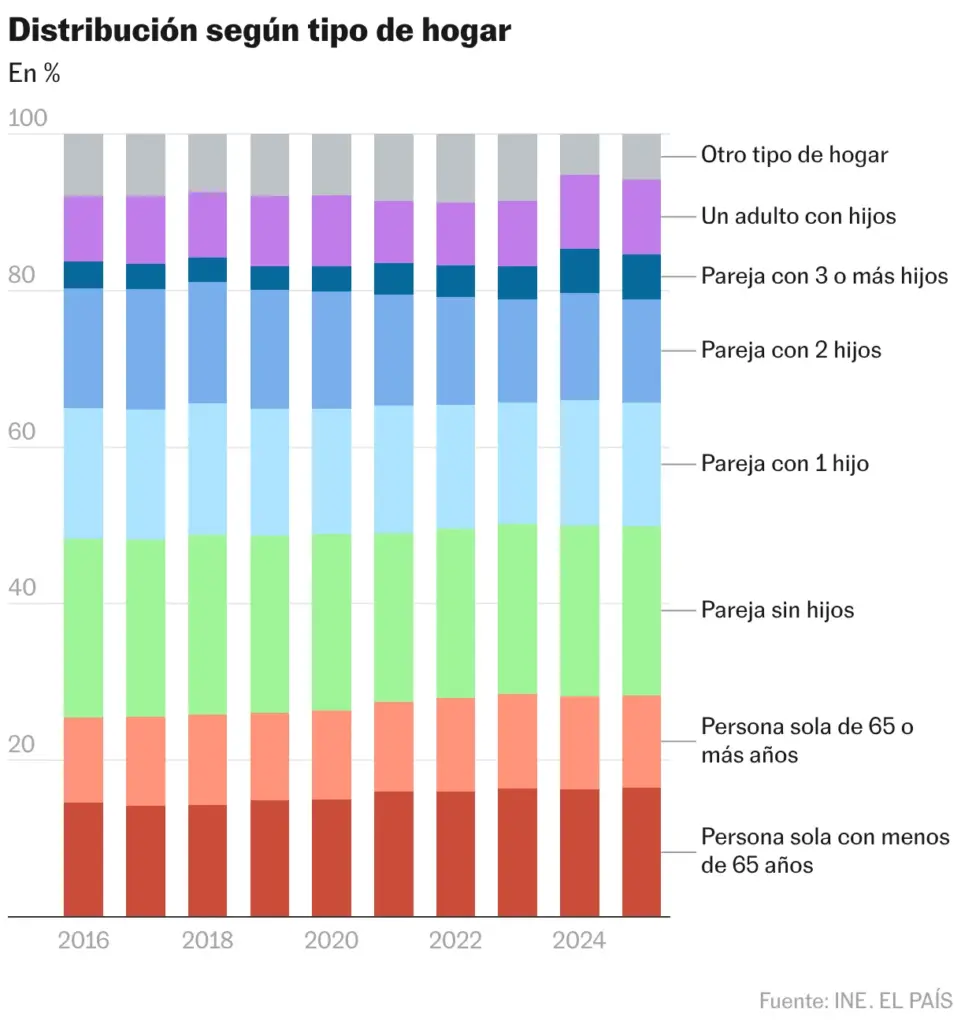
There are more and smaller households, first, because we live longer. The increase in longevity and the gap in life expectancy between sexes have sharpened atomization. The percentage of households composed of a single person over 65 has quintupled since the nineties, and in 2021, the latest data available from INE, those headed by women far exceeded those of men, even tripling them in some cases, across all age groups. It also has a lot to do with the dramatic decline in fertility since the mid-seventies. The predominant family model is two parents and one child, and those with three or more offspring are a species in extinction. There are more households where a couple lives without children than households with one child and households with two.
However, to tell the whole story of this revolution, demography falls short. Households transform because the way of planning them has also changed, because families are lived in, formed, and dissolved differently. People no longer leave the family home to marry and have children. It is also uncommon for grandparents, parents, and grandchildren to share a roof, even in southern Europe, where these structures had greater cultural roots.
Breakups accelerate
Couple dynamics no longer automatically — and fortunately — respond to the classic promise of “till death do us part.” When love or harmonious coexistence ends, you don’t have to wait for the grim reaper to put an end to it. “Breakups are increasingly common and lead to single-parent households when there are children or to single-person households much more frequently,” says Clara Cortina, demographer and professor in the Department of Political and Social Sciences at Pompeu Fabra University. “So we also live more alone or alone with children during our adult life.” Divorced or separated people today make up about 8% of the population over 16 years old, and single-parent households have risen to 9.5% of the total.
Economic factors filter through each of these cracks in varying degrees. Sometimes they favor atomization and other times they do not. An adverse economic situation, for example, can force a broken couple into forced cohabitation. “We do not know the exact extent of this phenomenon, but we know it exists,” Cortina points out. In lean times, it is not unusual to have to return to the parental home, usually linked to greater economic stability. “That happened en masse after the financial crisis,” says Paloma Taltavull, professor of Applied Economics at the University of Alicante and expert in the real estate sector.
Perhaps one of the clearest effects is seen in emancipation dynamics. On paper, young people prolong their stay in their parents’ home and become independent around age 30, four years later than in the early nineties. The main obstacle, notes the Youth Council of Spain, is access to housing at a time when the average rent is almost as high as their average salary. Since 2008, the youth emancipation rate has dropped from 26% to 14%. Fragmentation drives real estate demand over a scarce supply, with high prices, low wages, and more difficulty accessing mortgages, which in turn influences the creation and organization of households. “In 15 years, the population has grown, we have had more immigration, young people have grown up, left home, and not found housing. They have had to compete for homes because there has not been a sufficient supply of units to the market,” says Taltavull.
In the pages of this same newspaper, in a letter to the editor published in mid-July, a 26-year-old woman said that nothing had brought her closer to the possibility of having her own home like a family loss. Specifically, that of her grandmother. “There is something I find hard to accept without feeling a mix of shame and anger: that an entire generation has begun to link the possibility of emancipation, of having a place to live, not to their work or effort, but to the death of those they love,” she wrote. In the coming years, Taltavull says, a considerable number of houses and apartments, mainly from the baby boomers, a large and property-owning generation, will enter the housing circuit. “About 20% of all housing transactions are homes that come from inheritances,” the expert notes referring to the latest data she handles.

“Youth emancipation, I believe, has an economic aspect, but also a cultural one,” says Mariona Lozano, sociologist and researcher at the Center for Demographic Studies. “They have more precarious work trajectories, wages have not risen at the same pace as rent, so they have obvious economic difficulties to become independent. But it is also true that here it is not seen as unusual for a 25-year-old to live with their parents,” she adds. For Cortina, young people leaving the maternal home later is more related to the prolongation of educational stages than to not having anywhere to go. “Economic conditions have an undeniable weight, and whether they are adverse or favorable can intensify, accelerate, or moderate trends,” the expert says about the influence of economic conditions on household changes, “but I believe these are much deeper transformations.”
Spanish homes, for example, have fewer and fewer children. “Economic factors can affect fertility decisions more in the short term. Not so much in the total number of children per woman, but in the timing [when to have them],” explains Libertad González, PhD in Economics and professor at Pompeu Fabra University. Lidia Cruces, also PhD in Economics and researcher and lecturer at Goethe University Frankfurt, agrees: “The increase in the delay of the age at which you have the first child, not all but a large percentage, responds to the economy, which encourages you to have it later,” something that can end up affecting fertility even for biological reasons. Usually, women and their partners (or single mothers) wait to achieve a certain stability and security before making certain decisions. And it is not only the situation they are in that influences but also how they perceive it and with what degree of uncertainty they see the future.
Read more Atlético de Madrid signs Cuti Romero
But to explain a phenomenon like the decline in fertility, ongoing for decades, one must delve into deeper currents. One example is that the material conditions of women in general have improved compared to previous generations. Also, there is no rebound in motherhood when the economy recovers after periods of instability. “That fertility fell during the 2008 crisis made sense because women had fewer resources. And it was expected that once the economy recovered, fertility would too. And it hasn’t happened,” explains Clara Santamaría, professor of Economics at the Paris Institute of Political Studies, better known as Science Po.
The current fertility rate, 1.1 children per woman, is one of the lowest in Europe. In the mid-sixties, 2.88 children per mother were reached, a figure that dropped by about a tenth in the following ten years. Between 1975 and 1995, however, the indicators plummeted. It went from 2.77 to 1.16. It would be impossible to dissociate this change from female liberation, from the possibility — material and social — and the will to choose their procreative destiny. Without this reduction in fertility, moreover, professional, public, and influence and power spaces could not have been conquered. “The incorporation of women into the productive sphere and their exit from the reproductive sphere in terms of exclusivity explains to me that we have gone from five or six to two children, but not that we have gone to one,” says Cortina.

Motherhood and fatherhood today are a more ambitious project than decades ago. The absolute, relative, and opportunity cost of bringing offspring into the world has grown considerably in developed countries; parents have become more involved in the process and women have intensified their participation. “The interest of families or the priority to do a perhaps more intensive type of upbringing, in terms of resources and time, means that smaller families are prioritized,” says Virginia Sánchez Marcos, professor of Fundamentals of Economic Analysis at the University of Cantabria. Women pay a higher professional and labor toll. In the long term, they lose, according to a 2020 Bank of Spain report, 28% of their income. “Usually, what is seen in the data is that if the man improves his work or salary situation, the number of children increases. But when it happens with the woman, it decreases,” notes Santamaría. Women with high incomes, according to the latest INE fertility survey of 2018, have a slightly higher average number of children than those at the lower end of the scale. However, large families are somewhat more common among the latter.
The role of women in society changed and with it their expectations about the involvement of fathers. “Women entered the labor market massively, but men did not enter massively into the care sphere. There is no equitable distribution of productive and reproductive tasks; women still mostly carry out the double shift,” says Lozano. The main reason women aged 40 to 44 have not had children is the lack of a partner or a suitable partner, as one in five declared to INE, followed by not wanting motherhood, health issues (including fertility), and work-life balance. “Women are more educated and have more economic independence. That means many divorces that did not happen before now happen. Pairing is also different; women look for men with whom to share life equally, and if they do not find them, they remain single,” adds the expert.
Households are the first to feel the shocks of atomization. “At first, you lose economies of scale in consumption,” explains Guadalupe Souto, lecturer in the Department of Applied Economics at the Autonomous University of Barcelona. “Two people living in two houses spend much more than two people living in one,” she adds. According to OECD equivalence scales, each could reach the same standard of living with 25% fewer resources by sharing a roof. As household members increase, spending per person falls. A household of two adults and one child would need the income of 2.7 adults, while one with three adults and two children would require that of 2.6. Fixed expenses are shared and purchases are more efficient. “Relatively speaking, if you compare two households with the same characteristics except for the number of members, clearly living in a small household is more expensive.”
Households headed by a single adult are also more vulnerable to economic disruptions or shocks. “If you only have one person bringing in resources to maintain family life, that means more risk,” says Olga Cantó, professor of Economic Analysis at the University of Alcalá. Single-parent households, which keep growing and are overwhelmingly headed by women, can be an example of the relationship between size and increased vulnerability. Families with a mother and children are more exposed to poverty or social exclusion, with a rate of 50.8% compared to 27% of households with two parents.
At the macroeconomic level, this phenomenon is opening cracks that threaten to fracture the welfare state. It is very likely that the first thing that came to mind when reading these lines was the pension system. You are not wrong. So far, migratory flows have helped soften the impact of declining fertility on the active population. “For now, we are doing well, but there are political proposals that aim for the opposite,” says Cantó. “Also, we must keep in mind that fertility is falling in all countries, including those from which immigrants come,” says Sánchez.
A more expensive old age
The debate around pensions is heated, and some of the most mentioned measures are also those that find the most opposition in society. Eight out of ten people, according to a Funcas report from late last year, for example, reject delaying retirement age to 70. “The system will probably need targeted reforms to remain sustainable, but I think we must clearly differentiate those related to capital accumulation interests,” warns Cantó about proposals pointing to privatization. “It may well be that we have to reform it, even deeply, but the big expense will not be in the pension system. The big expense will be in the health and dependency system,” she concludes.
The need for informal care — those that fall on the environment, mainly women — grows due to an older population, while family support networks become smaller and physically dispersed. This trend does not seem likely to reverse, and the state will have to intervene more and more directly in this area. “The practical effectiveness of dependency laws, to date, is very slow and in some autonomous communities never arrives. That will be an urgent need in the next 10 or 15 years,” says Cantó. “That people live longer and have fewer children is not a problem; it is a new characteristic of our society. And what we have to do is adapt our social structures to the new characteristics,” says Souto. Probably, the trickiest part will be, once again, how to pay for it.