The complexity of the economy, the thousands of variables on which the European Central Bank (ECB) bases its adjustment of the price of money a few degrees to the right or left, hide a truth of extreme simplicity: it depends on the Iran war. The rise in the price of oil and gas has led the ECB to raise rates this Thursday for the second time in three months, taking the price of money from 2.25% to 2.5%, the highest since March last year. In June, when the ECB raised rates for the first time in three years, uncertainty persisted about a possible agreement between Iran and the United States that would allow the Strait of Hormuz to reopen. Three months later, ships crossing the strait are exposed to being attacked, brent is at 100 dollars, and European natural gas at 80 euros.
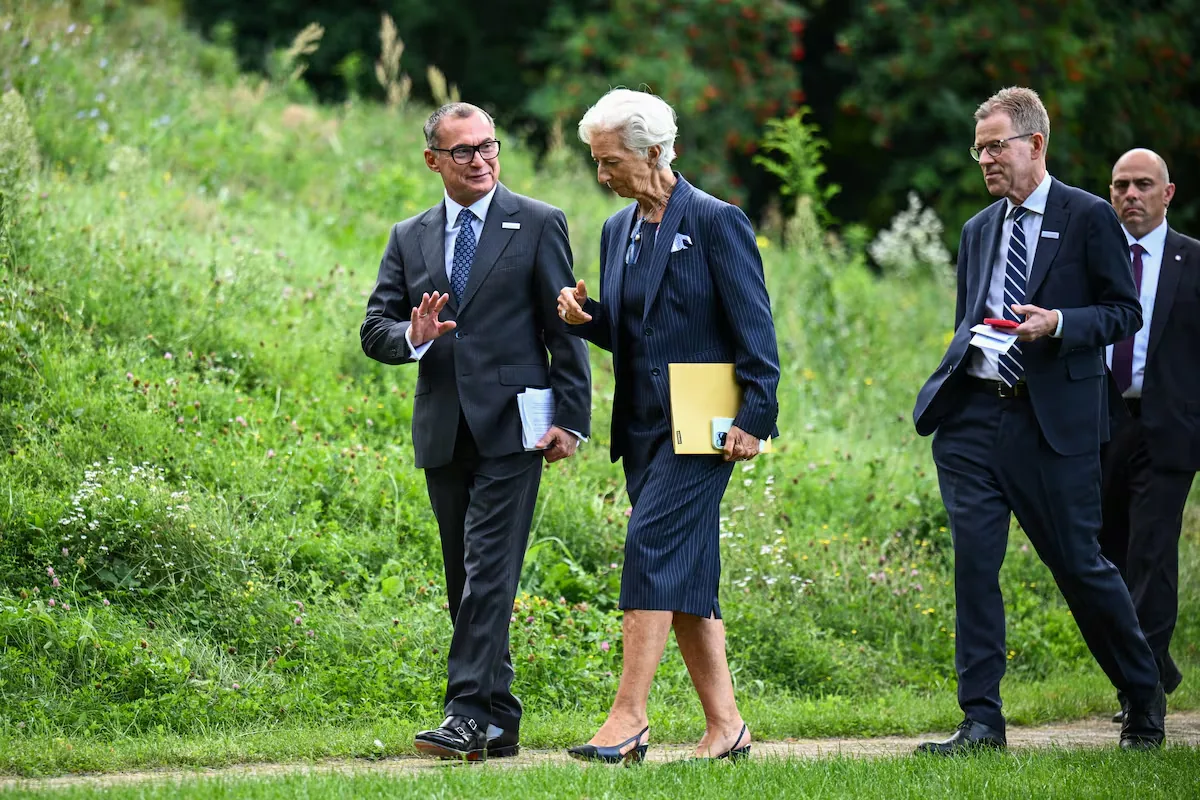
The ECB had no doubts and voted unanimously to raise the deposit rate (reference interest), a decision that the president, Christine Lagarde, called “obvious” and the market was 99% sure of. The bank expects prices to deviate from the 2% target for “a prolonged period,” a phrase not included in previous statements and interpreted as a sign of future rate hikes. But it prefers to keep room for maneuver: “If we do not commit in advance, it is not to annoy anyone, but because we operate in environments of uncertainty that change overnight,” Lagarde explained in response to persistent questions about her next move.
The good news is the resilience of the European economy in recent months, an adjustment capacity to the shock of energy that has surprised the bank. Thus, the entity has improved the GDP projection for this year to 0.9% (one tenth more than in June) and for 2027 to 1.4% (compared to 1.2%). On the inflation side, Lagarde stated: “We have seen it lower than anticipated,” but now the ECB expects it to remain elevated for longer. It estimates a 3% CPI for the eurozone this year, the same forecast as in June despite the rise in oil prices. However, at the cost of raising the 2027 forecast by two tenths. All this, under the assumption that brent will moderate by December to 86 dollars and gas to 60 euros.
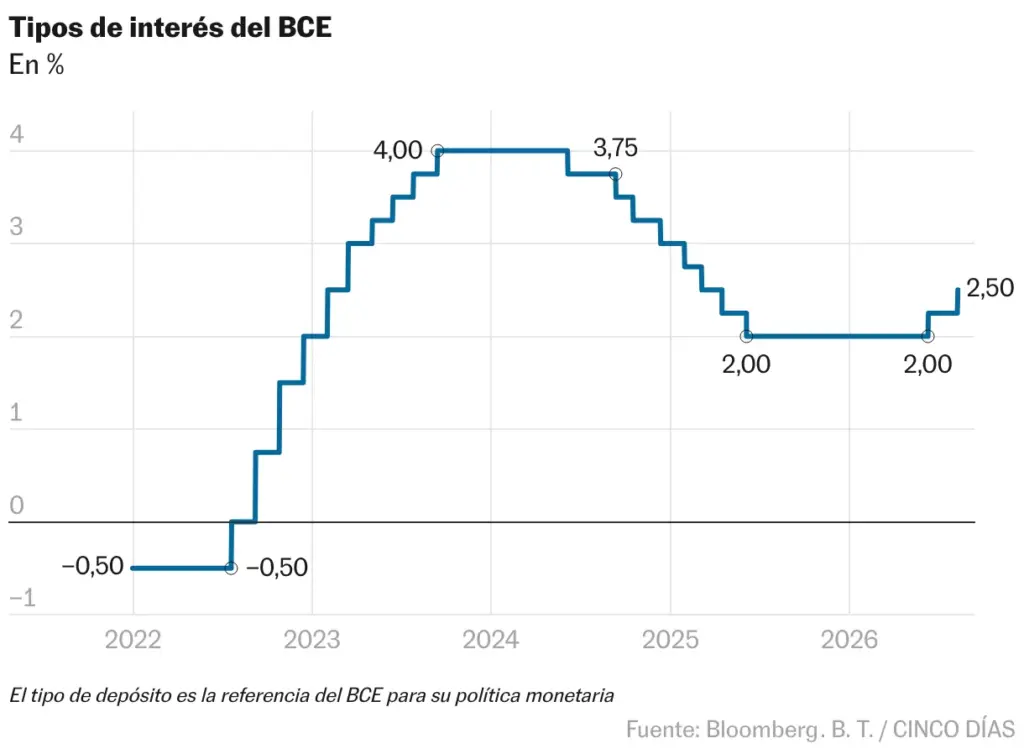
Lagarde, therefore, sees the European economy as somewhat stronger than before summer, but in a more complicated energy environment. In any case, more than fighting current prices or past inflation, the ECB has set itself the mission of preventing the rise in fuel prices from spreading to the entire economy. “At this stage, wages do not show a significant reaction to the shock energy,” Lagarde indicated. But she later qualified, “it is expected that the increase in energy prices will gradually be reflected in core inflation and food prices.” That is, the ECB fears that some of these so-called second-round effects will eventually arrive. Partly for this reason, the market has clearly raised its rate hike forecasts: yesterday it did not expect a rate hike in October but did in December; now it even considers two consecutive increases.
Economists, as has happened in recent months, have many more doubts. “Given the exceptionally high level of uncertainty, it is likely that the central bank will maintain its restrictive bias,” explains Ulrike Kastens, senior economist at DWS, Deutsche Bank’s fund manager. “We believe the risks are skewed towards fewer hikes,” indicates Pimco, the world’s largest fixed income manager. According to the firm, the ECB will wait to have more elements of judgment (in prices, wages, and expectations) to avoid exposing the council to division.
Everything depends on the Middle East conflict. A better economic response or a resolution of conflicts (Lagarde also includes the invasion of Ukraine) can improve growth and inflation prospects, and vice versa. The ECB has done its math: in the worst scenario (oil at 130 dollars in December and gas at 130 euros) the economy would brush recession this winter, CPI would soar to 5.8% in spring, and inflation would not moderate until well into 2028. If, on the contrary, oil falls a little faster than expected, CPI will be below 2% in June and the economy would not lose momentum.
Between Lagarde’s future and populisms
The ECB president has dodged several times the questions about her possible early departure from the bank: indicating that she will dedicate herself to promoting her book, scheduled for January and February, on weekends or days off, and pointing out that when she has something to say, journalists will be the first to know (only after her grandchildren), she has refused to answer. Nor to assure that she will fulfill her mandate. But the bank has wanted to speak out on questions about the growing populist approaches in Europe. Faced with the proposal of the leader of France Insoumise, Jean-Luc Mélenchon, to cancel French debt held by the ECB, Lagarde said: “An idea without legal, technical, or economic basis does not gain it by being repeated many times. […] It is a violation of the treaty and it is not a good idea.”
For his part, Joachim Nagel, president of the Bundesbank and present at the press conference as host (the meeting was held in Berlin), responded to questions about the rise of the far right in Germany. “I am concerned about what this can do to our values, to our country. Economically, it is an own goal, money will be reluctant to come.”
On the economic front, the most recent figures have allowed the ECB to buy time, shake off market pressure, and keep ranks tight in an explosive environment. The discrepancies between hawks (supporters of higher rates) and doves (the opposite) have remained under wraps, a balance that is increasingly difficult. The Berlin meeting does leave a bias of German orthodoxy: the bank has flexed muscle against inflation and seems closer to extending rate hikes than to hitting the brakes. But, despite the forcefulness with which futures express themselves, the only certainty is that the Iran war will continue to mark the path not only of what is paid when filling the gas tank but also of what is paid for the mortgage.