









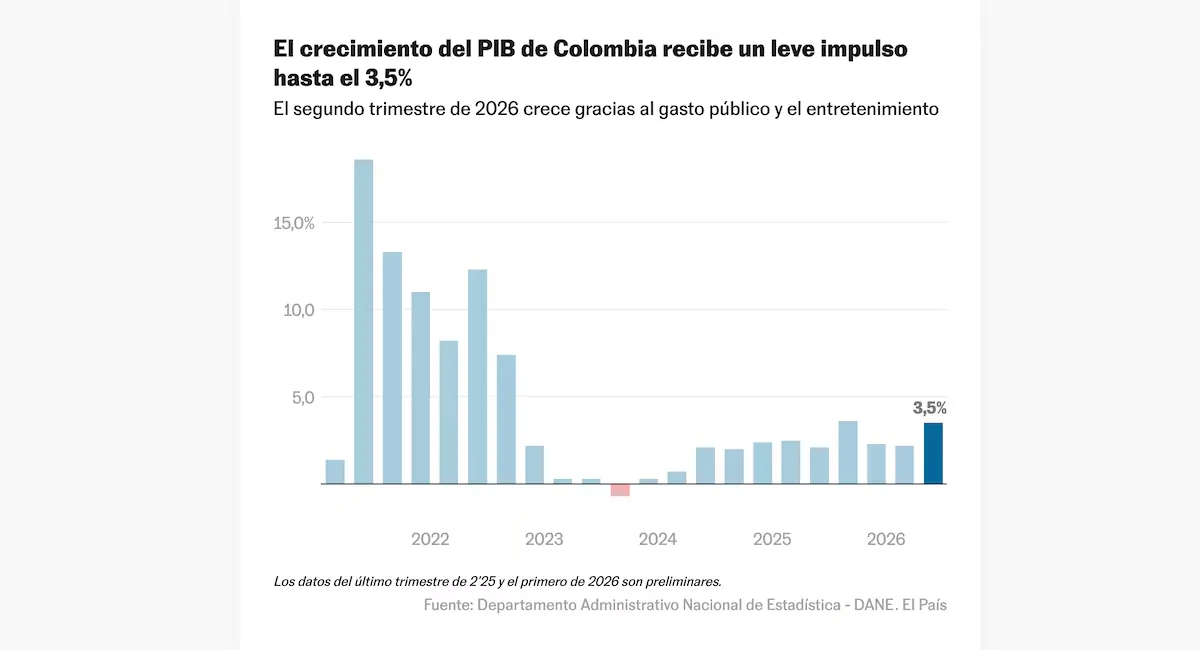
The Colombian economy grew 3.5% in the second quarter of the year, measured against the same period in 2025. The result was better than what the market consensus expected, which pointed to growth close to 3.2%, according to a survey of analysts cited by La República. There are two engines driving the movement: State spending and entertainment.
The result sets the outlook for the first half of the year. Between January and June, the Colombian economy accumulated growth of 2.9%, a result of a more modest first quarter, of 2.2%. In those six months, the main engine has been the State. Public administration, defense, education, and health grew 7.9% and contributed 1.3 of the 2.9 percentage points of growth for the semester, almost half. Commerce, transportation, and accommodation services added another 0.5 points, with a joint increase of 2.6%, and artistic and entertainment activities contributed 0.3 more points, with growth of 6.3%.
Household consumption and Government consumption move at different rates. While Colombian families increased their spending by 2.7% during the semester, Government spending grew 12.6%, almost five times faster. Economist Remi Stellian, professor at the Faculty of Economic and Administrative Sciences of the Pontifical Javeriana University, agrees with this reading: “Public spending, especially public spending for consumption, has been one of the main engines behind the growth figure. Private household consumption has also recorded growth, but much more moderate,” he highlights in an exchange of messages.
Read more Disney sues the FCC for “a campaign of retaliation” due to ABC network’s criticism of Trump
Investment closed a weak semester: gross capital formation barely grew 0.8%, well below the 7.1% it showed only between April and June. This fragility worries analysts, who repeat that today’s investment in buildings, machinery, or infrastructure is the basis for tomorrow’s growth. Something similar happened with construction. Although the sector is in negative territory for the full semester (a drop of 1.5%), it shows signs of recovery in the seasonally adjusted series: between the first and second quarters it advanced 6.4%, driven by public infrastructure works.
“Recovering investment requires the implementation of costly projects and financing through debt, difficult at this moment with high interest rates,” adds Stellian. During the semester, exports grew barely 0.3%, while imports rose 5.6%.
Read more Barcelona announces the signing of Rodri until 2030