The new flexible retirement is now a reality in Spain. The Government approved the reform of this option, as well as deferred retirement, at the end of May, but it is only now that both have come into effect. From this Friday, retirees who want to return to work as self-employed and at the same time keep part of their pension will be able to do so, a formula that until now was only possible for returning to salaried work. And those who have delayed their retirement for several years will see increased economic benefits from this decision. With these changes, the Executive completes a series of transformations aimed at encouraging workers to extend their working life and delay the moment of retirement.
Read more Harald V, King of Norway, dies at 89 years old
All the changes in Social Security regulations, approved in several phases, have had two main objectives: on the one hand, to increase the system’s income by raising contributions; and on the other, to encourage workers to remain active after reaching retirement age. Both issues ultimately seek to strengthen the sustainability of pensions in the face of the massive arrival, from this decade onwards, of retirees from the baby boom generation, something that will test the financial seams of the system.
The first phases of the reform mainly adjusted the modalities of early, partial, and active retirement. While the new measures coming into effect now mainly affect flexible retirement, which is when a person already retired decides to return to work and keep part of the pension; as well as deferred retirement, which occurs when someone reaches retirement age but decides to remain active and delay pension collection.
The new flexible retirement
The most significant change in flexible retirement is that, until now, only those returning to part-time salaried employment could enjoy it, combining it with part of the pension. From this Friday, those already retired who want to engage in an activity as self-employed will also be able to combine work income with a pension. However, they must not have been registered in the Self-Employed Regime (RETA) in the three years prior to their retirement. The percentage of the pension that those who choose to combine it with self-employment will receive will be 25% of the amount of the retirement benefit they were receiving.
The percentages of working hours and pension that those who, once retired, decide to return to work part-time but as salaried employees will receive will also change. In this modality, the pension is reduced inversely proportional to the working hours (as before), but the novelty is that the working hours compatible with the pension are expanded and must be between 33% and 80% of the ordinary working day (previously it was between 25% and 75%).
Additionally, incentives are established in the form of pension improvements if the retiree decides to rejoin the labor market as an employee and combine pension and salary after six or more months since retirement. In that case, the compatible pension increase will be 25% if the part-time work is between 55% and 80% of the ordinary working day; and 15% if the working hours are between 33% and 54%.
Changes in deferred retirement
Regarding deferred retirement, the latest reform focuses on improving the so-called deferment supplement, which is the economic incentive received by those who continue working once they have reached retirement age without combining it with the pension. Until now, people who chose this modality to extend their working life could choose between increasing the pension percentage (4% more for each full year of deferment); receiving a lump sum payment; or a mixed formula combining the two previous options. In this last mixed modality of the deferment supplement (which can be accessed if two years have passed since reaching retirement age and effective retirement), full semesters will be counted from this Friday. Since it will no longer be by full years as before, the incentive improves.
Furthermore, in very long deferred careers, which are those extended nine or more years after reaching retirement age, those who opt for the mixed formula have a fixed scheme: five years are compensated by a lump sum payment and the rest by a percentage increase in the pension (4% more pension per year, 2% per six months).
More compatibility in Europe
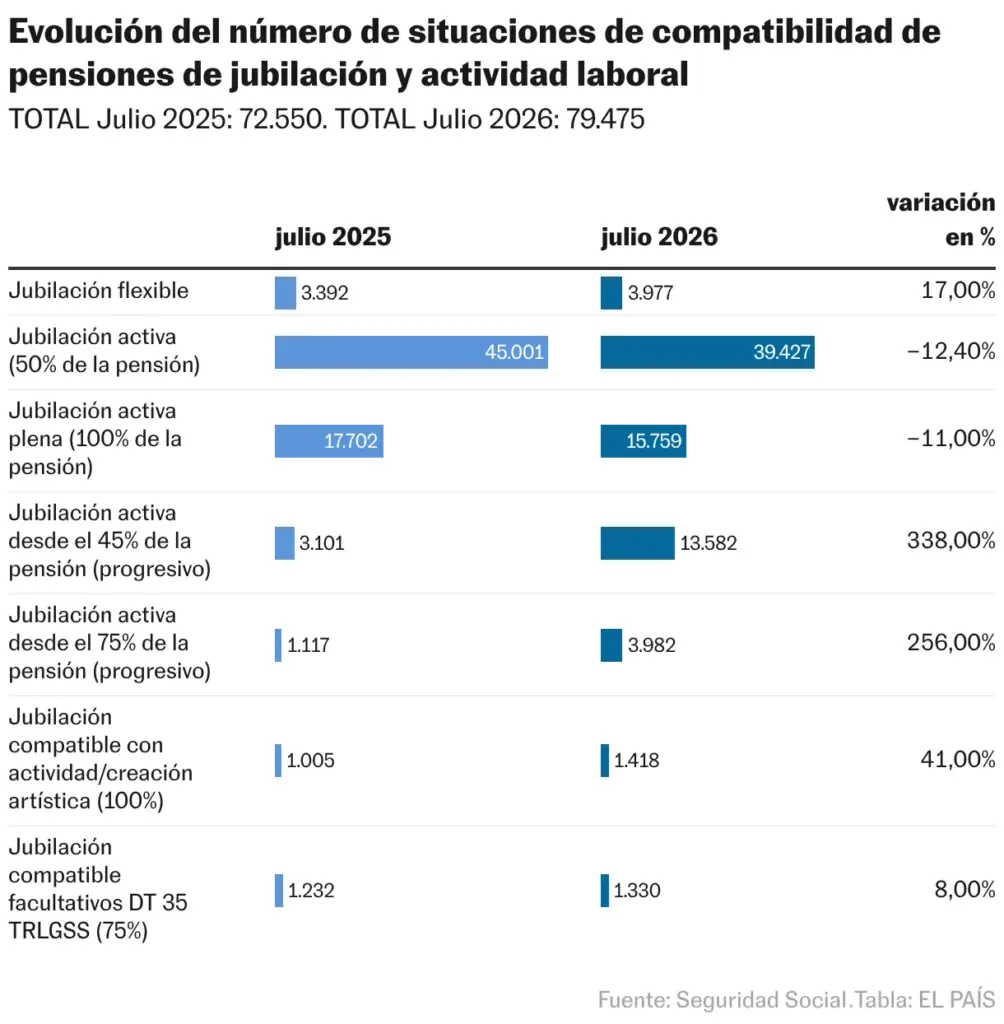
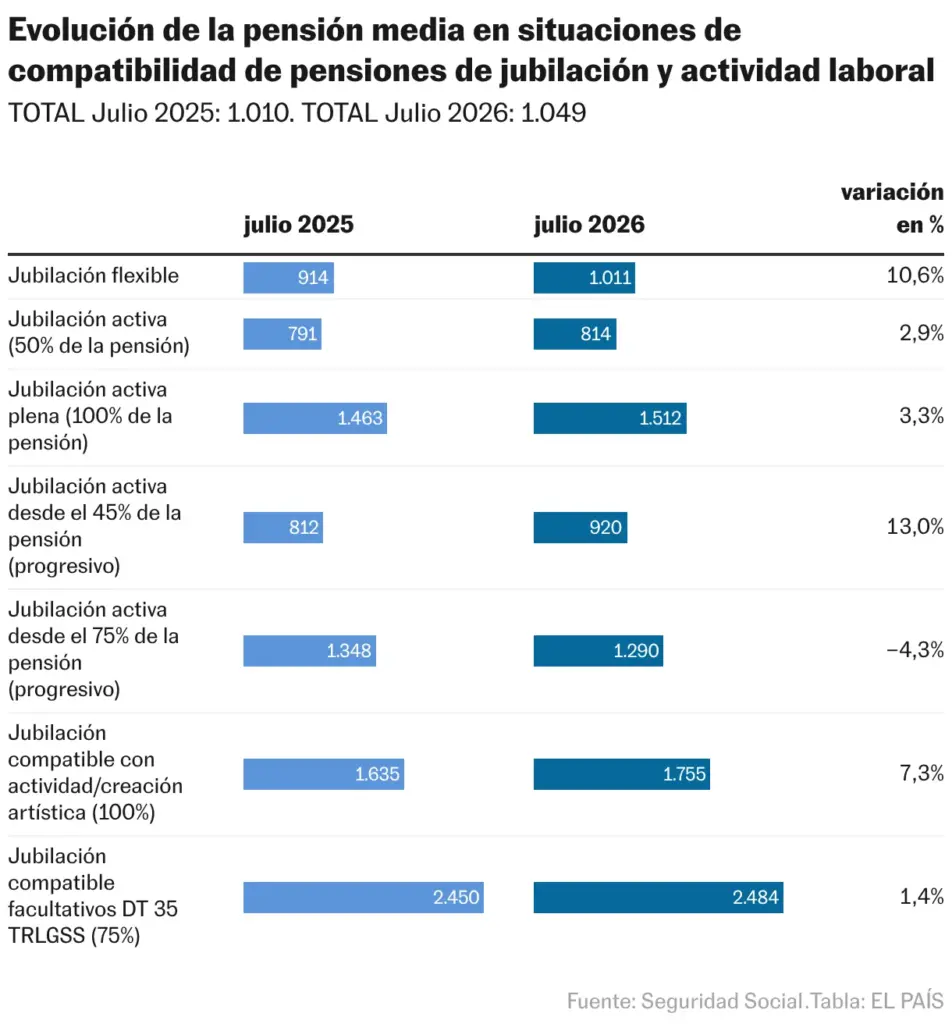
With all these changes, the Government aims for more and more workers to decide to delay the moment of their full retirement, as the figures of those who choose this are still residual in Spain, although they have been rising in recent years. In the payroll of pensions paid by Social Security last July, it was reflected that 79,475 people combined salary and pension mainly through the different existing active and flexible retirement routes. This means that cases have increased by 9.5% compared to a year earlier. But it represents a small weight on the system, not reaching 1% of the ten million people receiving a pension in Spain.
Despite this growth, the Spanish economy remains well below the European average in these parameters. According to the latest comparable figures from Eurostat, 4.9% of people who started receiving a retirement pension in Spain continued working afterwards, compared to 13% average in the Twenty-Seven.
Progress and persistent obstacles
With the transformations now completed, it is expected that in the coming years the situations of compatibility between work and pension, as well as total retirement delays, will increase. The Organisation for Economic Co-operation and Development (OECD) indicated at the end of last year in its Economic Study of Spain 2025 that “all pension system reforms carried out by Spain have been steps towards greater flexibility in retirement.” But it added that “obstacles still persist that limit the capacity and willingness of older workers to remain employed.”
Additionally, the organization’s economists evaluated the latest changes on compatibility of active and partial retirement and warned that “despite them, administrative complexity and limited knowledge of existing rights may limit the effectiveness of system changes.” The body also warned that “inertia in worker behavior and lack of information could continue to prevent many older employees from taking advantage of the new available options.”
A very similar analysis was just made by economists Nacho Conde-Ruiz and Jesús Lahera for the Santalucía Institute. In a document where they assess all legal reforms aimed at receiving retirement benefits and salary simultaneously, they warn that numerous flaws persist. “The coexistence of three schemes — active, partial, and flexible — with different logics regarding contributions, amount, and eligibility, generates horizontal inequity and institutional confusion,” they point out.
Without a common framework establishing uniform principles, both economists argue, “the entire system risks fragmenting into overlapping regimes with little real use.” Consequently, Conde-Ruiz and Lahera propose creating a comprehensive model that unifies access, calculation, and contribution criteria “under common principles of proportionality, contributory neutrality, and legal certainty.”
For Octavio Granado, who held the position of Secretary of State for Social Security under four different ministers (all from the PSOE), the reforms carried out by the current Government “seem to be heading in the right direction.” But when determining if they are sufficient, the expert considers that new adaptations will always be necessary. “Although it is evident that in many occupations a culture of delaying retirement has been established that did not exist a few years ago, in others it has not yet,” he concludes. He adds the idea that a “sociological assessment” would be advisable to determine in which occupations it would be necessary to consolidate a more deferred retirement, but with gradual reductions in working hours.
Read more Marlaska goes to Congress after the clash with Robles ready to defend his version