









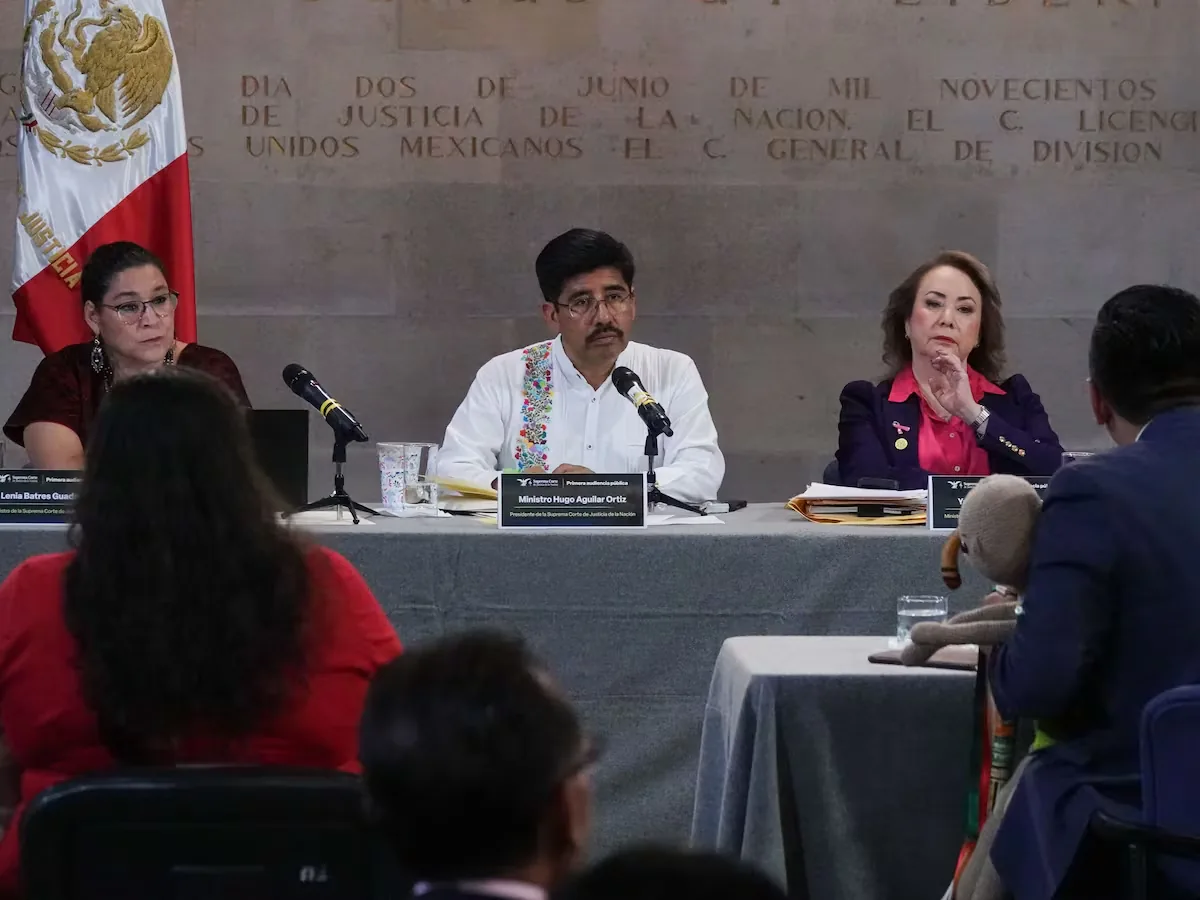
There is little spirit of celebration within the new Supreme Court, which reaches its first anniversary with the Plenary turned into a powder keg. No one talks about the end of corruption or privileges, nor about the speed in the administration of justice, the promises with which the ministers elected from the polls landed in the High Court. Just 12 months since their arrival, and still with another 12 ahead until the succession, in principle, takes place, the struggle for the presidency has eclipsed any attempt to steer the conversation in other directions. Political statements, legal blunders, or the desire for protagonism of some judges do little to help the Supreme Court’s image, contrasting with the backlog of an overwhelmed plenary, even when operating at full capacity. The delay in resolving major pending issues, such as double taxation, mandatory preventive detention, or dignified death, completes the picture. After 365 days, the Court has not managed to shake off the stigma of being an unproductive tribunal focused on defending the interests of Morena, the ruling party. Criticism surrounds it from the legal community and with special alarm also from business sectors.
The crown jewel of Mexican justice has a position most dream of: the presidency of the Court. Who will be the next to occupy the post has now become the biggest point of friction, in a crisis that has erupted much earlier than expected, according to internal sources. The original judicial reform proposed a rotating method every two years based on votes obtained at the polls. That model coexists with the previous one, which was never removed from the Constitution, and which establishes that the plenary must elect its president every four years. Deliberately, none of the current official reform proposals resolve the issue, which has become a time bomb within the court.
The dispute has intensified due to the profile of who should, according to the first mechanism, take the reins of the Supreme Court next September: Lenia Batres, who calls herself “the minister of the people,” a replica of Morena’s expressions. The judge, who appeared in the official voting guides, has increased hostility towards her colleagues, whom she has publicly accused of having an “unhealthy animosity” towards her, and she is now more isolated than ever. “She only has the support of Sara Irene Herrerías,” say a source from a panel. Other sources point out that she has also lost her backing: “Before they let it pass. Now they are all very angry.”
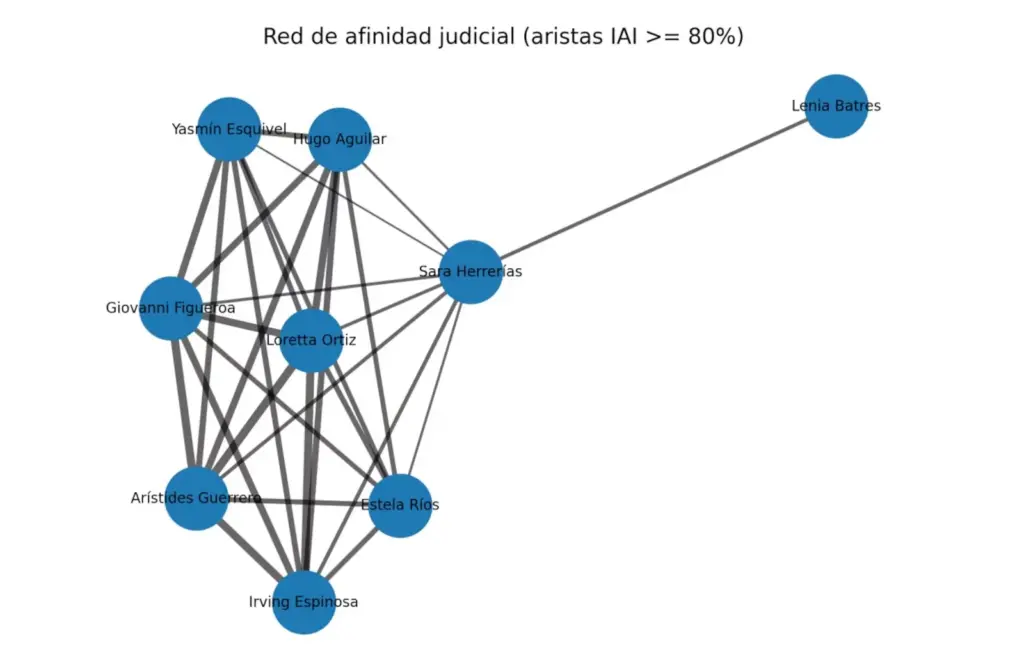
The consulted sources agree in pointing out that the main problem is the minister’s lack of collegiality, who tries to impose herself on the majorities or turns differences of opinion into personal quarrels. A study conducted by the organization México Igualitario confirms the polarized scenario: “The network is highly cohesive, with a core of eight strongly interconnected members, a bridge figure (Sara Herrerías), and a peripheral actor (Lenia Batres).” By studying the resolutions of more than 120 cases, this report () quantifies the general feeling: the figures who most disagree within the Court are Yasmín Esquivel and Lenita Batres (in 30% of cases), and those who least do, Arístides Guerrero and Loretta Ortiz (who vote the same 98% of the time).
That fight with Batres, which initially happened behind closed doors and with shouting, has moved to public sessions, where the tension is more than palpable. “The Court is a very old institution. The INE or the former IFAI had fallen due to internal differences, but the very protocolary customs of the court meant that, even with deep enmities, members did not disrespect each other in the Court. Now they go without rules,” points out a source close to Sheinbaum’s Cabinet: “And that terrible atmosphere is also damaging the perception of justice: they are giving reason to those who criticized the reform.”
The president, Hugo Aguilar, has tried, at least publicly, to contain the differences, but his lack of firmness has not worked to ease the tension. Yasmín Esquivel — who went from being accused of plagiarism in her theses to defending order in the Court — has adopted a more combative profile and is shaping up as the strongest alternative. Thus, while the potential next president fiercely defends the mechanism that would give her the leadership, her unwillingness to reach consensus and her public affronts are rapidly distancing that possibility: within the Court few are betting their cards on Batres today.
The minister is also the one who arouses the most mistrust in the business sector, which was already nervous since the judicial reform was approved. To smooth tensions and soften relations, the High Court is preparing a series of forums and meetings with representatives from some prominent sectors, such as pharmaceuticals or banking. The success of the new Judiciary will be measured, in part, by its ability to convince these groups of the technical soundness of its judicial decisions.
Some of the pending issues directly affect them, such as the multimillion-dollar lawsuit by a lawyer against Google or the potential double taxation of maquiladoras, which has dragged on from the previous composition and has exceeded the six-month margin set by tax regulations. This delay, awaiting the High Court to resolve a contradiction of criteria that has no deadline and would unblock everything, keeps at least 30 key lawsuits against the SAT on edge, which attributes losses of 44 billion pesos in revenue within the indicated period, according to the court itself.
None of these issues have been brought to the plenary, despite at least one having a deadline. The situation repeats in sensitive but socially crucial issues, such as mandatory preventive detention or the possibility of invalidating disability regulations for not having previously consulted the affected people. This last case, for example, was brought to session and later withdrawn due to the controversy it was generating outside. This August some files related to the issue have been resolved, but never the central one. Hugo Aguilar’s extreme inclination towards consensus and the fear that controversy will overflow on networks that scrutinize the court’s actions minutely is leaving the most important files out of discussion, which are systematically withdrawn or simply not listed, all consulted sources agree.
The main promise of the reform was “to bring justice closer to the people,” so ministers, magistrates, and judges were to be elected by popular vote. This mechanism has fostered the individualistic profile of the judges, who now share a need to appear in the media. “They act like politicians,” says a source, who considers that the new ministers have not had “the maturity” to understand “the role the Court plays and what they have to do there.” “There is no improvement this year, no learning curve, because the ministers believe they are doing well,” says a person close to the Cabinet.
Being a Court made up exactly of the names Morena chose in the voting guides, the president, Claudia Sheinbaum, has barely intervened in its functioning. The leader did give a warning to the ministers regarding the purchase of armored vehicles, also when Batres and Aguilar tried to reopen already judged cases, or, the last time, due to a misunderstanding about medical expense insurance. Beyond that, the new Court has ceased to be, as it was with López Obrador, the piñata of the executive power.
The new Court, in numbers
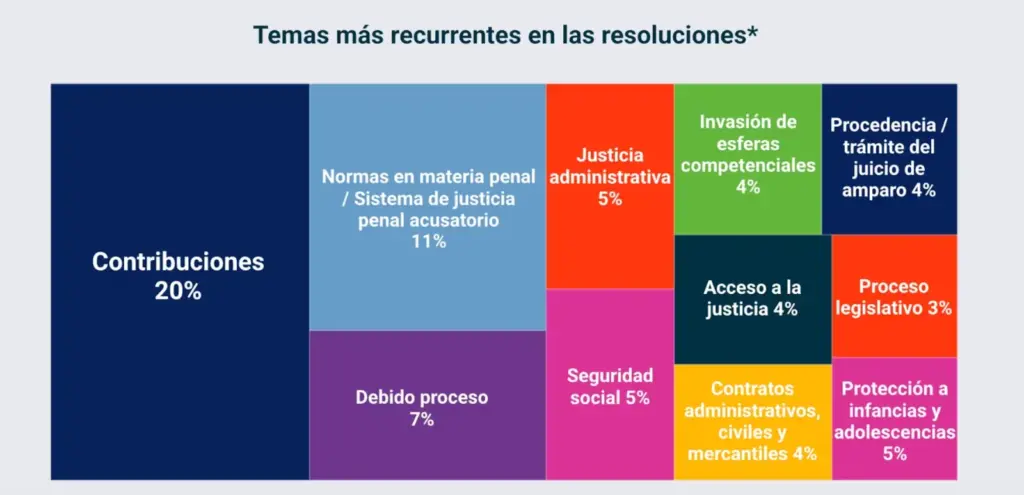
From last September to this July, the new Supreme Court has resolved 2,371 cases in Plenary sessions, according to the court’s own public information. Its initial month was, as expected, the slowest, with only 98 cases resolved, reaching a maximum of 290 this January. The ministers resolve more or less equally, from 8% by Hugo Aguilar (who as president of the Court combines cases with coordination) to 11% by Lenia Batres or 13% by Yasmín Esquivel. What they resolve most are direct amparos under review, and a fifth of the cases relate to contributions, that is, taxes.
The elimination of the two chambers in the judicial reform has overloaded judges who cannot keep up. Although this plenary — which meets more days and hours — resolves many more cases than the previous one, it does not manage, however, to match the speed guaranteed by having the chambers resolving simultaneously, each in its specialization. Thus, for example, the previous composition of the Court, in the same period (from September to July), resolved 3,534 cases in session when it was complete between 2023 and 2024, and 2,860 without one of the ministers and in the process of dismantling between 2024 and 2025. That is, one year had 1,200 more cases and another, 500 more.
The positions, again, are divided. Minister Esquivel has publicly spoken in favor of the return of the chambers, as contemplated, under the name of “sections,” in the new reform proposal. In contrast, President Aguilar continues to lean towards the legitimacy given by collegial decisions debated by all, even at the cost of losing speed.
Besides the number of cases, the organizations Disentir and Ojo en la Justicia Observatorio Ciudadano, , point out as “worrying” that “the Plenary directs its efforts to resolving litigations whose problems have already been overcome through solid precedents, or worse, that transcendental projects — such as AI 182/2024 [related to the rights of people with disabilities] — are pending resolution while they dedicate themselves to duplicating identical debates.” In contrast, the organizations highlight the willingness to provide qualitative information and to explain resolutions to the public in “simple language,” which they say must be completed with the missing statistical data.
The new Court has been, they finally point out, “focused on resolving procedural issues, without yet seeing major shifts in substantive decisions on human rights.” That may change now. Besides the major tax case against businessman Ricardo Salinas Pliego, the Court has taken a fundamental step by taking on the issue of the constitutionality of dignified death. The discussion of this topic is a historic opportunity, civil organizations point out, to truly advance social rights. Cases like this will ultimately define the impact of the new Constitutional Court, beyond its internal tensions or political struggles.
Read more Goodbye to neck tension and snoring: the ergonomic butterfly pillow to sleep through the night again