






The Government of the Canary Islands (formed by Coalición Canaria, Partido Popular and Agrupación Herreña Independiente) announced this Monday that it will support the new regional financing model this Wednesday in the Fiscal and Financial Policy Council, after seeing its singularities recognized with “reasonable approaches that do not harm other communities” and that will bring 1,300 million more per year to the essential services of the archipelago.
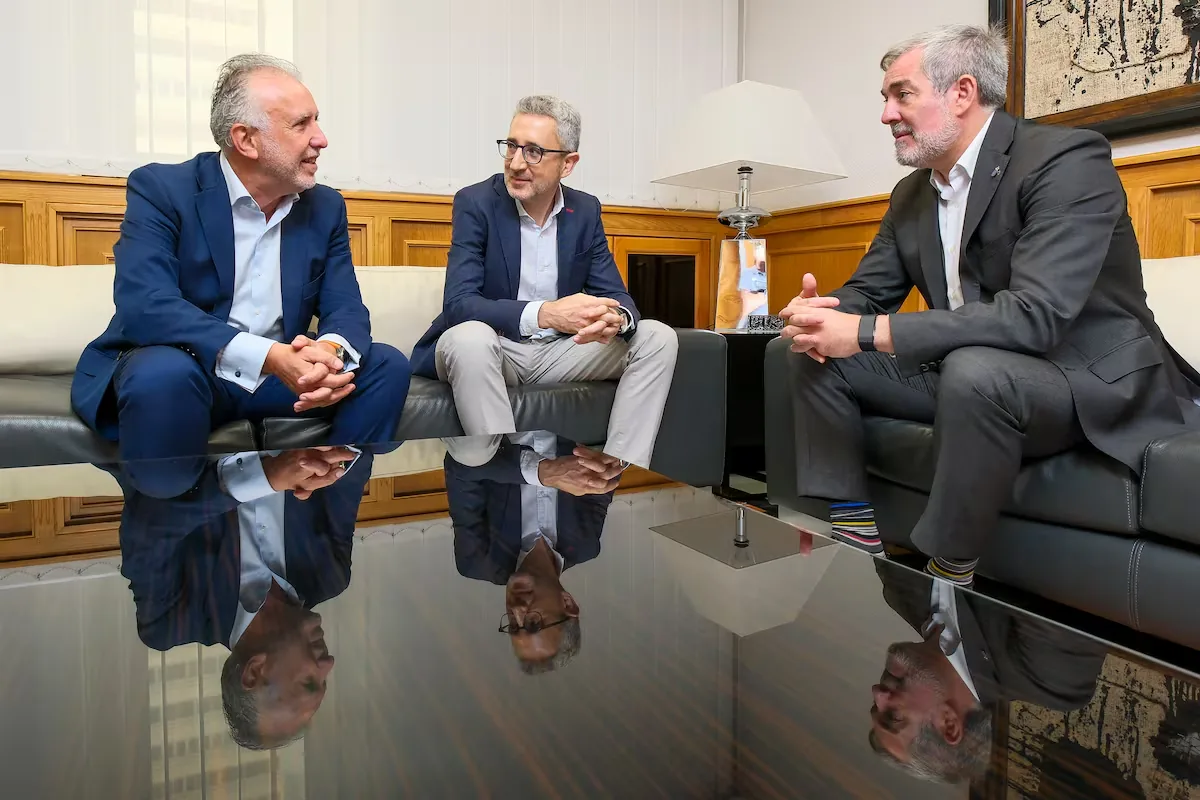
This was announced by the Canarian president, Fernando Clavijo, after meeting in Las Palmas de Gran Canaria with the Minister of Finance, Arcadi España, and the Minister of Territorial Policy, Ángel Víctor Torres. With both, he also agreed to advance budget items linked to the so-called Canarian Agenda, to which CC conditioned its support for the investiture of Pedro Sánchez. The Canary Islands thus become the second community to explicitly support the financing model after Catalonia, the only one that had defended it until now.
Clavijo explained that the agreement puts an end to “several months of intense negotiations” between the technical teams of both governments, structured around four axes: regional financing, compliance with the Canarian Agenda, the possibility for the archipelago —being the community with the lowest per capita debt in Spain— to use its surplus, and the so-called Canarian Decree. According to the Canarian president, the new model guarantees in writing that the resources of the Economic and Fiscal Regime (REF) remain outside the financing system, and considers the pending compensation of 50% of the General Tax on Business Traffic (IGTE), which the Canary Islands claimed from the State, settled. The additional fund that will compensate for the variables of insularity and adjusted population, he specified, will be freely available, of indefinite duration and with monthly settlements. Clavijo has estimated the combined amount of both mechanisms for essential public services at more than 1,300 million euros annually and has defended that “this new financing system agreement is positive and does justice to the Canary Islands.” The president also announced that the Canarian decree —scheduled for late August or early September— will include the extension of the 60% IRPF for La Palma to the 2026 and 2027 fiscal years, in addition to the legal study of 100 million euros to complete the compensations to farmers affected by the volcano.
The Minister of Finance, Arcadi España, for his part, opened his speech with a message of support for the communities affected by the fires that are still active. Regarding the agreement, he defended that “dialogue works, dialogue bears fruit and dialogue is the agreement,” and stressed that the commitment to exclude the REF from the model and to eliminate the IGTE will be recorded in writing. He placed the figure of additional resources outside the financing model, linked to the reform of the convergence funds that the Government plans to present in the coming months, at 611 million euros. He also announced that the Canary Islands will be able to dispose, for three years, of 687 million euros in surplus and financing excesses pending application for investment projects, and recalled that the regional debt remains below 12.4%.
Read more Barça signs Tosan Evbuomwan, an athletic power forward to strengthen the paint
Ángel Víctor Torres closed the appearance with a review of the Canarian agenda calendar. The former Canarian president announced that this Tuesday’s Council of Ministers will include a subsidy of 45 million euros for the comprehensive employment plan in the Canary Islands, a budget modification of 23.1 million as compensation for the consequences of the war in the Middle East. In turn, agreements on energy and agriculture, and port construction contracts for almost 100 million, will be included, in addition to a plan against poverty endowed with 30 million.
Asked about the fires that were then affecting the Peninsula, the minister insisted that “we must work on the emergency, then there will be time for political debates.” For the next Council of Ministers, scheduled for August 25 or September 1, he confirmed that the Canarian Royal Decree-Law with 60% of the IRPF for La Palma and measures for the primary sector will be presented, as well as a hydraulic infrastructure plan of about 23 million euros.
Read more Vodafone, MasOrange and Telefónica restore networks and enable backup technologies due to fires