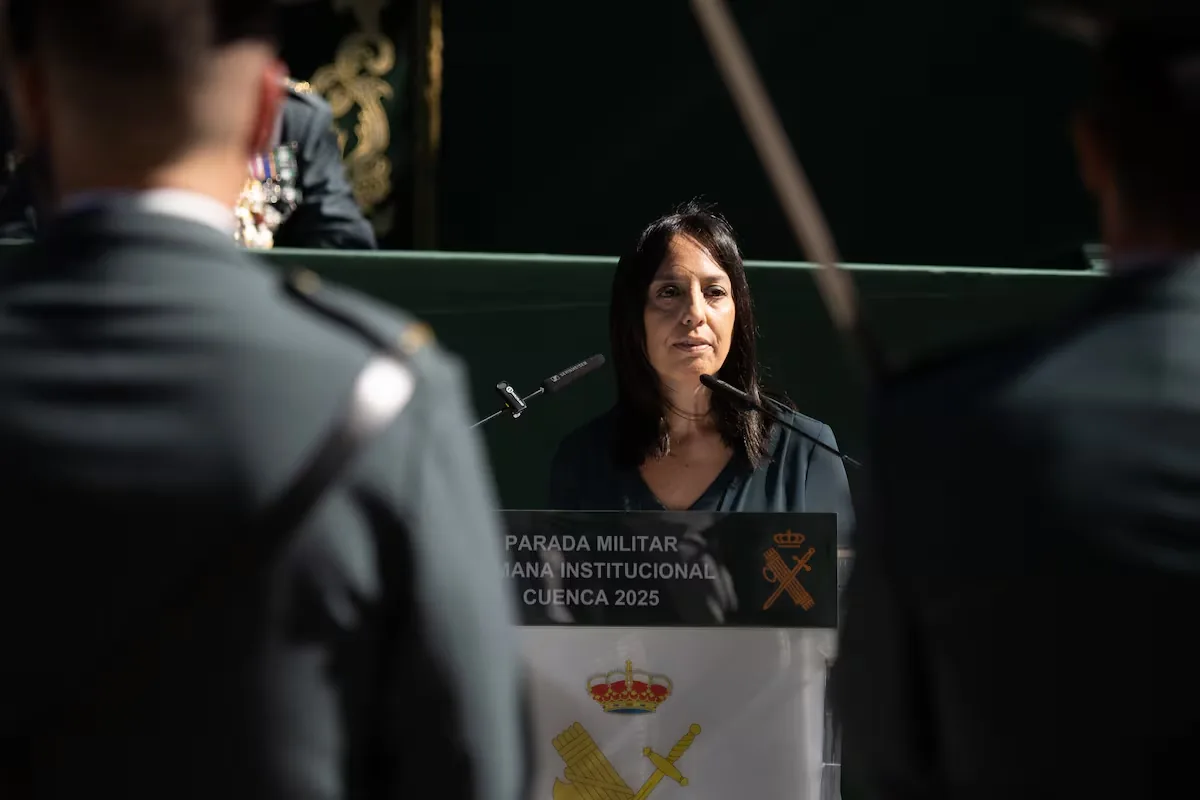
It was May 29 last year, three days after a video came to light in which former socialist militant Leire Díez and businessman Javier Pérez Dolset tried to convince a person investigated by the Civil Guard to provide them with compromising information about Lieutenant Colonel Antonio Balas, the head of the Central Operative Unit (UCO) in charge of the main anti-corruption operations affecting the Government. That day, the director general of the armed institute, Mercedes González, met with him in her spacious official office on Guzmán el Bueno street, in Madrid. They were not alone. Also present at the meeting were Balas’ then hierarchical superior in the unit, at that time Colonel Rafael Yuste; the Civil Guard’s Deputy Operational Director (DAO), Lieutenant General Manuel Llamas, and the head of the Civil Guard’s Judicial Police groups, General Alfonso López Malo, who had previously been the head of the UCO.
Read more Visit of Pope Leo XIV, live | The Pope leaves the Nunciature to officiate mass in Cibeles
At the meeting, which lasted just under half an hour, the director general encouraged Balas and Yuste to continue working as they had until then. The two commanders thanked her words and stressed that the threat emanating from Díez’s words – “if Balas is dead, even better” – would not affect their investigative activity. The meeting, apparently cordial, was in reality fraught with tension, according to sources familiar with its development. By then, the UCO itself and the Civil Guard’s Information Service (the unit responsible for counter-terrorism) had already warned about Mercedes González’s alleged relationship with Leire Díaz. All of this had been recorded in separate “office notes” ― an internal Civil Guard document in which agents communicate facts they consider relevant to their superiors ― dated April 29 and May 6 of that year. The director herself was informed of the “very similar” content of both weeks before the meeting.
That’s why, when on May 27, UCO agents, led by Lieutenant Colonel Balas, arrived at the main headquarters of the armed institute, it was raining on already soaked ground. It was an unprecedented event: Civil Guard agents requesting documentation from the Civil Guard and taking statements from high-ranking Civil Guard officers in an investigation where the shadow of suspicion extended over the Civil Guard’s own director. In short, the Civil Guard looking inward. The scene also had a striking detail: the five participants of the meeting in González’s office a year earlier were once again prominent protagonists, although their roles were very different from back then.
Balas had taken charge of a delegation in which Generals Yuste and López Malo —who had been his direct superiors when they commanded the UCO— were to be questioned as witnesses, in addition to a third member of the general staff, Antonio Cortés, current head of Armament and Explosives. For their part, the director and her number two, who initially seemed to be out of focus, were actually at the epicenter of the suspicions. By then, investigators had confirmed that González had met on at least three occasions with the so-called fixer of the PSOE. General Llamas – who had also been with the UCO, though not as head of the unit, but during his time as lieutenant colonel – was attributed with having tried to pressure investigators to “keep a low profile” in those investigations affecting the Government.
The testimonies of Yuste and López Malo ― with great prestige within the Civil Guard ― and to a lesser extent that of Cortés, only served to heighten suspicions about the director and her number two. The three generals detailed to the agents how the opening of three reserved investigations (internal investigations, which can lead to the opening of disciplinary proceedings) concerning the UCO was orchestrated, with which it was allegedly attempted to influence the unit’s investigations. All three had the same objective: to investigate alleged leaks to the press. The first, from November 2024, was related to the case of the Prime Minister’s brother; another in May 2025, about the leak of WhatsApp messages from the cases involving former minister José Luis Ábalos and his former advisor Koldo García; and the last, in September of that same year, after a news item published in El Mundo about alleged tensions in the UCO “due to the constant interference of Marlaska’s pawn” in reference to Llamas.
One of the high-ranking officials alluded to a fourth, this one from November 2024, linked to the leak of Begoña Gómez’s email address, although it was closed shortly after verifying that the court had erroneously notified the document that included that data, which was later disseminated by a media outlet. No less than four reserved investigations in just nine months, a fact on which General Cortés commented when questioned by the agents. In his “44 years of service,” he said, he had known of the opening of reserved investigations, but always in an “infinitesimal” number, he added. When the UCO requested the files of these internal investigations on May 27, they found a new surprise: they were deposited in Lieutenant General Llamas’ office, where they went to seize them.
Regarding the investigation opened to ascertain whether data from the Ábalos and Koldo García summary had been leaked from within, General Yuste stated that the DAO was receiving “political pressure” over those reserved investigations. The former head of the UCO explained this by recounting that he advised the internal investigation’s instructor to report the opening of these inquiries to the Supreme Court and the National High Court, where the cases against the former minister and his former advisor were being processed. “Given this proposal made by the witness, the instructor tells him that he had already contacted them, as the DAO was receiving a lot of political pressure,” states the record of his declaration drawn up by the agents.
However, this was not the only mention by this general of the Deputy Operational Director. Yuste again explicitly pointed to Lieutenant General Llamas when noting a meeting with the DAO on July 16, 2024, attended by himself, López Malo, and Balas. According to the record of his statement, Llamas told them that “in those police procedures that had political implications, one should not be proactive […] under the instruction to ‘keep a low profile,’ with the judicial authority, in this specific case, being the one to take the initiative”. Yuste again requested to testify before his former subordinates two days later to add that the DAO “was aware” that the alleged leak of Ábalos’s WhatsApp messages with Pedro Sánchez was “impossible” to have been the work of the UCO because they corresponded to messages dated after the most recent ones intercepted by that unit. Despite this, it was investigated.
The relationship between Leire Díez and the director of the Civil Guard was also mentioned by two of the three high-ranking officials who testified on May 27 as witnesses before the UCO. The agents mentioned the “office note” of May 6, 2025, drafted by Lieutenant Colonel Antonio Balas himself, which reported that Díez boasted of “having control over the director of the Civil Guard and that a discredit campaign was being carried out against the Central Operative Unit”. Asked about the “veracity” he gave to that note, General Yuste assured that he gave it “total veracity” and even ordered “counter-surveillance with operational teams and technical means by Central Operative Unit personnel on the two main investigators who had been referred to in the note”.
The general added that Lieutenant Colonel Balas recommended in the note that, in addition to informing the top officials of the Civil Guard about his suspicions and “given the seriousness of the facts and that they could affect the Unit and its investigators,” all information that other units had about these facts should be gathered and all of it reported to the court or the Prosecutor’s Office “for the opening of the consequent investigation if they deemed it appropriate”. The agents then asked Yuste if he had any record that this information had finally been forwarded to justice. His answer was no.
In the other internal note, this one from the Information Service and with the heading “Possible defense strategy against UCO investigations,” a fairly detailed reference was made ― and consistent with what the investigation has subsequently uncovered ― to the alleged plot designed to torpedo the activity of that unit. Even then, more than a year ago, Díez appeared as the visible face of a network that boasted of contacts, invoked Ferraz, and tried to instill in society through the media the idea that there is a “patriotic UCO” (which recalls the group of police officers who, during Mariano Rajoy’s government, spied on PP rivals and whose members are currently in the dock of the National High Court) to call into question the credibility of the agents and their inquiries.
The then Secretary of Organization of the PSOE, Santos Cerdán, who at that time was not yet charged in any of the judicial cases he now features in, was also mentioned. This group of people led by Leire Díez, the note warned, “was orchestrating a disinformation campaign that sought to discredit the investigations carried out by the UCO”. According to the note, Leire “would make it seem that behind this strategy would be” Santos Cerdán with the knowledge of the director general of the Civil Guard.
The allusions to González and her relationship with the so-called fixer of the PSOE in the reports known in recent days have caused an earthquake in politics and, above all, within the Civil Guard, which is far from subsiding. In fact, the latest steps taken by the director to minimize the consequences of her meetings with Díez have only increased the discomfort among Civil Guard officers. First, by denying through people close to her the holding of meetings “inside” the general directorate, but ignoring the at least three that took place in cafes near the Civil Guard headquarters and had been discovered by the UCO. And then with a note released at 10:00 PM last Wednesday in which, while admitting the meetings, she disassociated their content from any attempt to torpedo ongoing investigations.
The very content of that press note ― which has been interpreted within the Civil Guard as an attempt to downplay the UCO investigation ― and, above all, its format ― with official letterhead, giving the appearance that it reflects the institution’s version and not González’s own ― has added fuel to the fire. “That note should have included her resignation,” says an indignant officer who requests anonymity. Another commander insists that what happened has not caused an internal war in the Civil Guard, “as the director’s entourage insists on spreading,” but rather a rift between the leadership and the rest of the institution. This same agent also points to Lieutenant General Llamas as responsible for the situation. “They should all resign,” he concludes. The role of the Minister of Interior, Fernando Grande-Marlaska, has also not left Civil Guard officers indifferent. His defense of the director general ― joined by Pedro Sánchez himself ― despite the evidence gathered and her initial lack of explanations, has only widened the rift that already existed between him and the Civil Guard almost since he took office in 2018.