




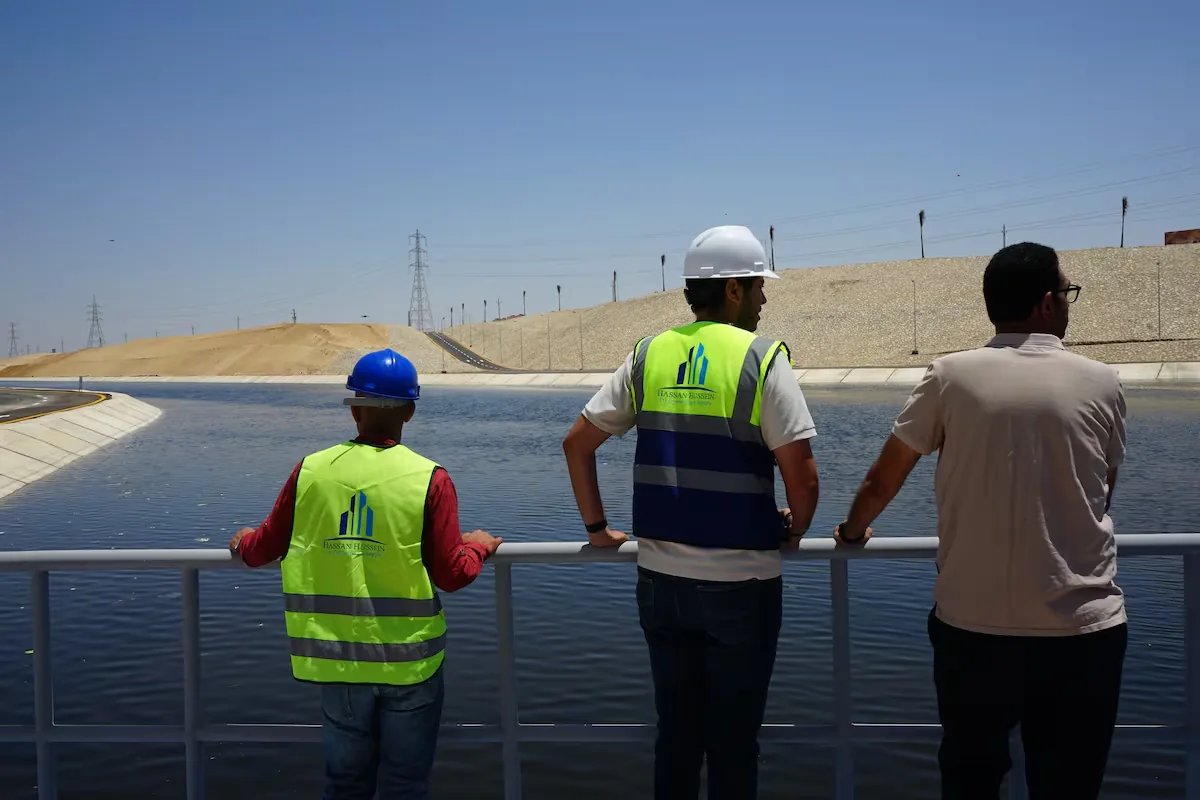
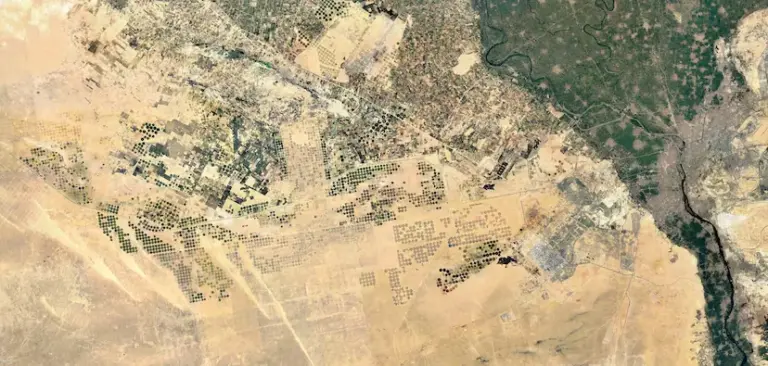
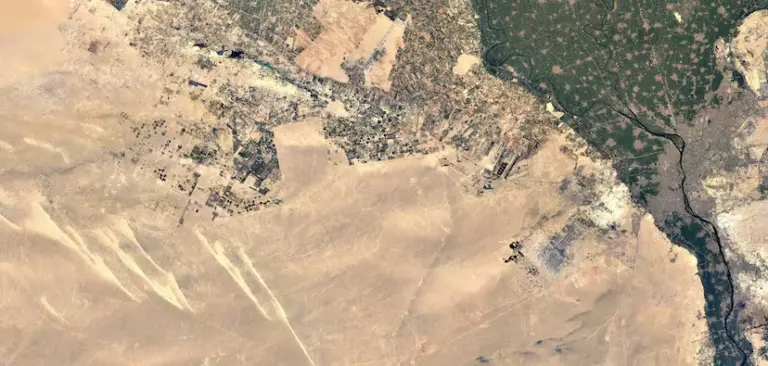
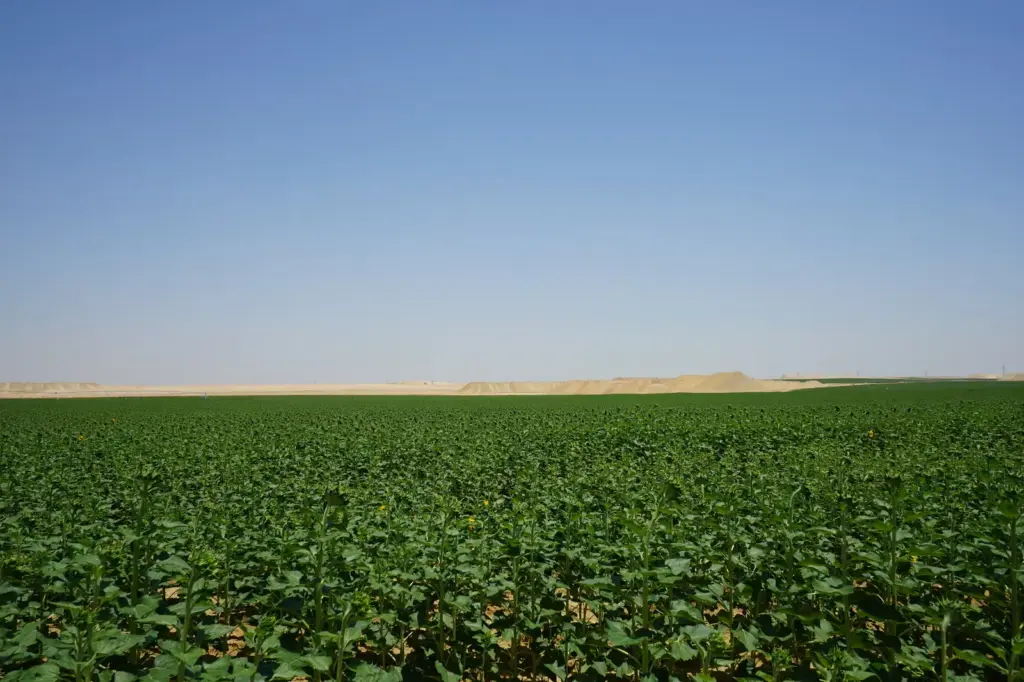
On the outskirts of west Cairo, next to the Dabaa highway, an extensive network of roads unfolds across a landscape where the desert wasteland is interrupted every few kilometers by wide irrigation canals, cultivated fields, and industrial plants. These are not mirages, nor an oasis, but a massive land reclamation project.
Read more Europe drags its feet again on sanctions against Israel for the massacre in Gaza and the West Bank
In this inhospitable place, under a scorching sun, a critical battle is being fought to renegotiate the borders between the limited fertile land of the Nile Valley, Egypt’s only source of fresh water for its more than 110 million inhabitants, and its eastern desert, the gateway to the Sahara. It is also the setting where the country’s authorities are testing a new agricultural model, centered around an alliance between the military and agro-industrial giants.
Named the New Delta, it covers about 924,000 hectares and is the largest agricultural infrastructure project in modern Egyptian history. Its main goal is to expand the country’s agricultural lands, meet a significant part of the local demand for strategic crops, reduce imports, and maximize their added value with a view to exporting.
“It is one of the most important development and agricultural projects, not only in Egypt but perhaps also in the Middle East,” says the president of the State Information Service, Alaa Youssef, during a recent visit with journalists in which EL PAÍS participated. “It will contribute greatly to Egypt’s food security while projects like land reclamation are underway,” he predicts.
The New Delta began as one part of a national agricultural project announced in 2015. But in just a few years, when others failed, the agency in charge of its development, Future of Egypt, successfully cultivated the land assigned to it, quickly becoming the new backbone of the country’s food security strategy.
Future of Egypt claims to have adopted a smart agriculture model that allows it to achieve higher efficiency levels while rationalizing the use of water and energy and focusing on crops such as wheat, of which Egypt is still the world’s largest importer. In total, the agency states it has invested about 14 billion euros in the New Delta.
Since the cultivated land has been reclaimed from the desert, a sophisticated irrigation system had to be designed to supply around 10 million cubic meters of water daily through aquifers, treated water, and the Nile. Nearly 700 kilometers of open canals, a pipeline network of about 9,200 kilometers, and 28 pumping stations have been built.
“Water is an extremely valuable resource for us Egyptians,” says the director of the engineering department of Future of Egypt, General Essam Wally, in response to a question from EL PAÍS. “The plan is to take advantage of and reuse wastewater that ends up in the Mediterranean, and for that, we are diverting Nile flow that was previously wasted into the sea,” he explains.
Behind Future of Egypt’s achievements lies what observers describe as an agile agency, with little bureaucracy and meticulous planning. Also a military discipline, but with participation from civilian experts, close ties to the private sector, and political support at the highest level. In contrast, previous projects led by other economic arms of the military had shown poor management that generated great frustration.
Following its initial success, Future of Egypt attracted the attention of President Abdel Fattah al-Sisi and was elevated, by presidential decree, to a sovereign state entity: the Future of Egypt Authority for Sustainable Development. However, its legal and administrative structure is not entirely clear because the resolution was never published, according to the Egyptian media Mada Masr.
Al-Sisi has made the landlord and rentier capitalism model represented by Future of Egypt and other military agencies active in the urban real estate sector the backbone of his economic approach to generate revenueYezid Sayigh, senior analyst at the Carnegie Middle East Center think tank.
Since then, Future of Egypt has experienced meteoric expansion, not only in its agricultural activities, with the ambition to cultivate about half of the country’s lands by 2027, but also into other sectors such as livestock, aquaculture, wheat importation, logistics, and even urban and real estate development, tourism, and mining.
“Al-Sisi has made the landlord and rentier capitalism model represented by Future of Egypt and other military agencies in the urban real estate sector the backbone of his economic approach to generate revenue,” considers Yezid Sayigh, senior analyst at the think tank Carnegie Middle East Center. “However,” he argues, “this model cannot be replicated in sectors such as manufacturing and services, including tourism.”
The rise of Future of Egypt has also gone hand in hand with the meteoric rise of its general manager, Air Force Lieutenant Colonel Bahaa El Ghannam. In an article published in the Egyptian media Al Manassa, rural sociology PhD Saker El Nour described him as “a new archetype” that “fuses hierarchical discipline with the language of markets.”
“He seems to have a more commercial mindset, as well as some prior experience and contacts in the agricultural sector through family businesses,” explains food security and agriculture journalist Nada Arafat. Ghannam, she says, has risen to the point of holding regular meetings with al-Sisi and “having received the kind of administrative facilities that ministries, and even other military entities, often do not receive.”
Sowing doubts
The bet on Future of Egypt and the New Delta came at a critical moment for Egypt, following the disruption in the grain market caused by the Russian invasion of Ukraine in 2022, which triggered a local crisis. In this context, Ghannam’s agency boasted of having helped reduce imports by several billion dollars.
According to Arafat, “it is true that Future of Egypt has been more successful, or at least more visible and has projected a more polished image, than many previous agricultural initiatives linked to the military.” But the director of the verification unit of the Egyptian Initiative for Personal Rights (EIPR) emphasizes that “up close, the picture is more complex.”
For experts like El Nour, the agricultural model promoted by Future of Egypt in the New Delta represents a fundamental shift from previous regimes that combined large crops and state farms, but with more strictly public ownership, with the effort to redistribute fertile agricultural lands expropriated near the Nile among small farmers.
Arafat notes that, over time, these plots were divided through inheritance, and it is now common for a few hectares to be divided among many owners with different crops. “The government considers it economically inefficient” and that “it has generated a very fragmented agricultural landscape with poor coordination,” she points out.
“Projects [like the New Delta] were not designed for small farmers, and Prime Minister Mostafa Madbouly has stated this quite explicitly,” Arafat continues. “The argument is that they do not want to repeat what happened in the Nile Delta and Upper Egypt, where agricultural lands have become increasingly fragmented over generations.”
The growing centrality of Future of Egypt in the national food security portfolio has also raised doubts because, as a sovereign entity, it operates outside the official institutional framework of the state. And although in practice it has shown more agility than the Ministry of Agriculture and Land Reclamation, it represents a parallel administration.
Moreover, its management is concentrated in very closed circles, and it is almost impossible to oversee not only its performance and efficiency but also its budget, contracts, and profits, as well as its tax contribution and the destination of its earnings. The lack of transparency about environmental impact studies has also raised questions about its long-term sustainability.
In general terms, there is no clear public framework through which the agency can be overseen. We do not know what oversight mechanisms exist, who audits its activities, or how it is supposed to be held accountableNada Arafat, food security and agriculture journalist
“It is very difficult to assess whether it is a successful management model because there is very little transparency or oversight,” Arafat notes. “In general terms, there is no clear public framework through which the agency can be overseen. We do not know what oversight mechanisms exist, who audits its activities, or how it is supposed to be held accountable,” she adds.
All the same, one of the biggest concerns remains the impact that the bet on this new agricultural model would have on small farmers. Arafat notes that they face chronic problems receiving subsidized fertilizers, increasing losses linked to the climate crisis, water pollution, unstable markets, and lack of reliable information. In addition, they have very limited capacity to organize independently.
In this context, Arafat points out, the New Delta project does not directly displace most of these small farmers. But “it reflects a broader agricultural strategy that prioritizes large-scale, capital-intensive production, while many of the structural problems affecting small farmers remain unresolved,” she concludes.
Read more “In summer we make more friends as social barriers fall”: why do adults socialize more on vacation?