









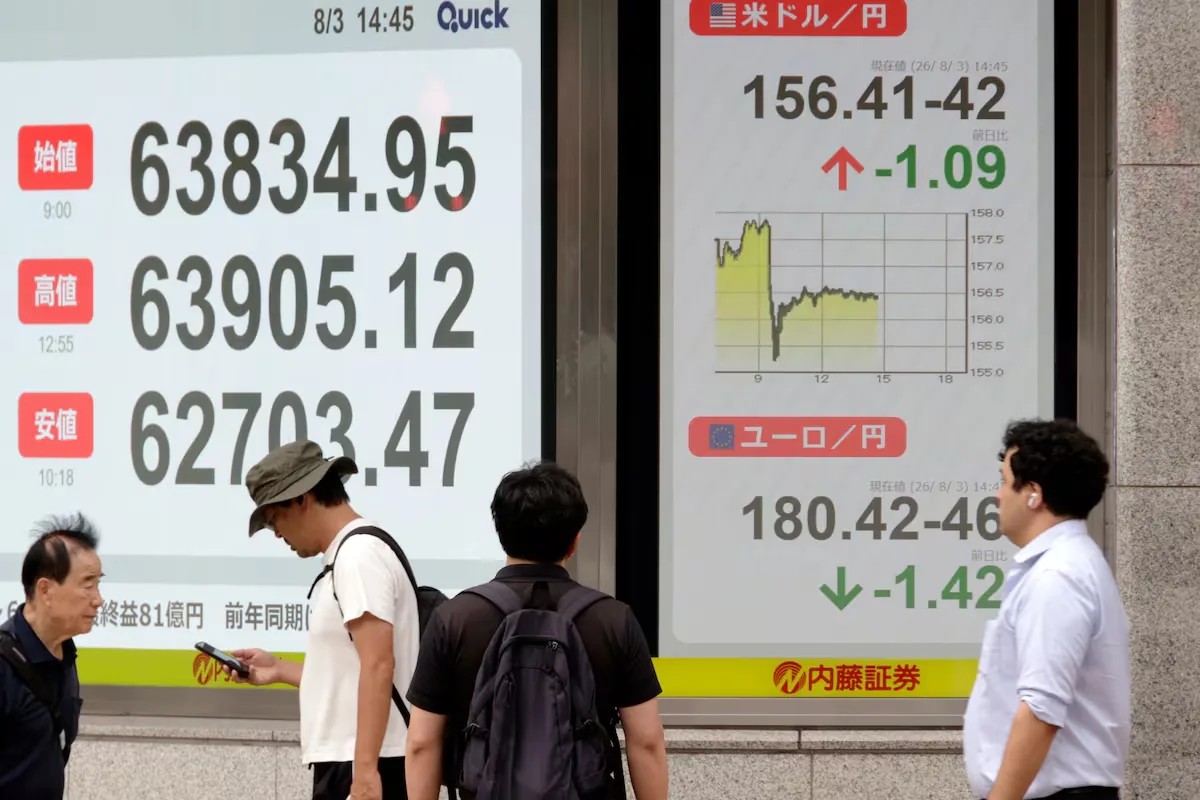
A few days ago we witnessed an unusual operation in the international financial markets: the United States government, in coordination with Japan, intervened in the markets to try to stabilize and prevent a further depreciation of the yen, the Japanese currency. The peculiarity of this intervention was that, to achieve its purpose, the United States did not sell dollars to buy yen, as would have been natural, but sold euros to buy yen. The economic authorities of the Eurozone, who were unaware of the operation, expressed surprise at what happened.
The complexity of the operation reveals that global financial stability is at stake. There are several issues involved here that need to be kept in mind to better understand what happened. On one hand, there is the issue of Japan’s complex economic situation; on the other, there is the matter of the relative financial fragility of the United States, which led it to intervene in a sui generis way to avoid higher domestic financial costs. Let us look at each of these issues separately.
On Japan’s side, the problem is partly structural and partly cyclical. Japan has carried a huge public debt for several years (more than 200% of its Gross Domestic Product), in addition to facing severe demographic and productive problems associated with the aging of its population. This country, which also has a significant volume of domestic savings, got used to living for years with an almost zero interest rate (it was even negative for some time). Now, however, it is facing significant inflationary pressures coming from the international economic environment. Japan, in particular, is directly impacted by the rise in energy prices due to its high external dependence on these products. These inflationary pressures can only be contained if Japan raises its domestic interest rate.
Japan’s structural situation, combined with very high interest rates in the United States, has caused a large differential in interest rates between the two countries, which in turn has caused a continuous depreciation of the yen. In fact, the Japanese currency has continuously depreciated since 2020, as it has gone from a parity of 110 yen per dollar in 2020 to about 164 at the end of July 2026, that is, an accumulated depreciation of more than 30% so far this decade. This depreciation, along with the recent volatility of energy prices, has pressured domestic inflation in Japan. The natural response would be to raise the interest rate, which has in fact occurred gradually in recent months, but at too slow a pace. At this moment the Bank of Japan’s target interest rate is barely 1%. At the end of July, the Japanese central bank decided to keep its interest rate constant, which again pressured the exchange rate parity.
Now, Japan could try to stabilize its currency by itself. However, to do so it would have to get rid of part of its dollar assets to be able to buy its own currency. It should be remembered that Japan is the world’s largest holder of United States Treasury Bonds, so it could perfectly sell some of these bonds and use those dollars to strengthen its own currency. This would imply offering those bonds on the market, which would imply a drop in their price and, consequently, an increase in the interest rates that the United States Treasury would have to pay. And here is where the issue of the United States’ own financial fragility comes in. Why would the United States not want this? Because it would imply a rise in its own interest rates, especially long-term ones, which would increase the fiscal cost of its debt. This is precisely the same reason why the United States preferred to support the Japanese yen by selling euros and not dollars. In this way it avoids pressuring the market for its own Treasury bonds and a possible increase in its financial costs.
In summary, the enormous public debts of Japan and the United States are at the heart of these complex international financial decisions. It is very likely that, in the short term, the Bank of Japan will have to give in and will have to raise domestic interest rates, otherwise the pressures on the yen will continue. This should happen as soon as September of this year. On the other hand, in the medium and long term, it is possible that we will have to redesign the international financial architecture and reduce global dependence on the dollar. The current balance is extremely fragile and unstable as it crucially depends on the currency of an economy as indebted as the United States.
Read more The power for what?