So far, the United States has been key to keeping Javier Milei’s government in Argentina standing. Not only has it used its influence at the International Monetary Fund to approve a new $20 billion bailout for the country in April 2025, but the U.S. Treasury itself has directly intervened in the local foreign exchange market to support the peso’s exchange rate and has made another $20 billion available via swap to contain the financial volatility surrounding last year’s midterm elections. Now, as Argentine politics begins to gear up for the 2027 presidential race, the libertarian seeks to ensure that his main ally remains behind him, covering his back.
Read more Milei’s wealth grows by 43% in one year and his sister Karina’s triples
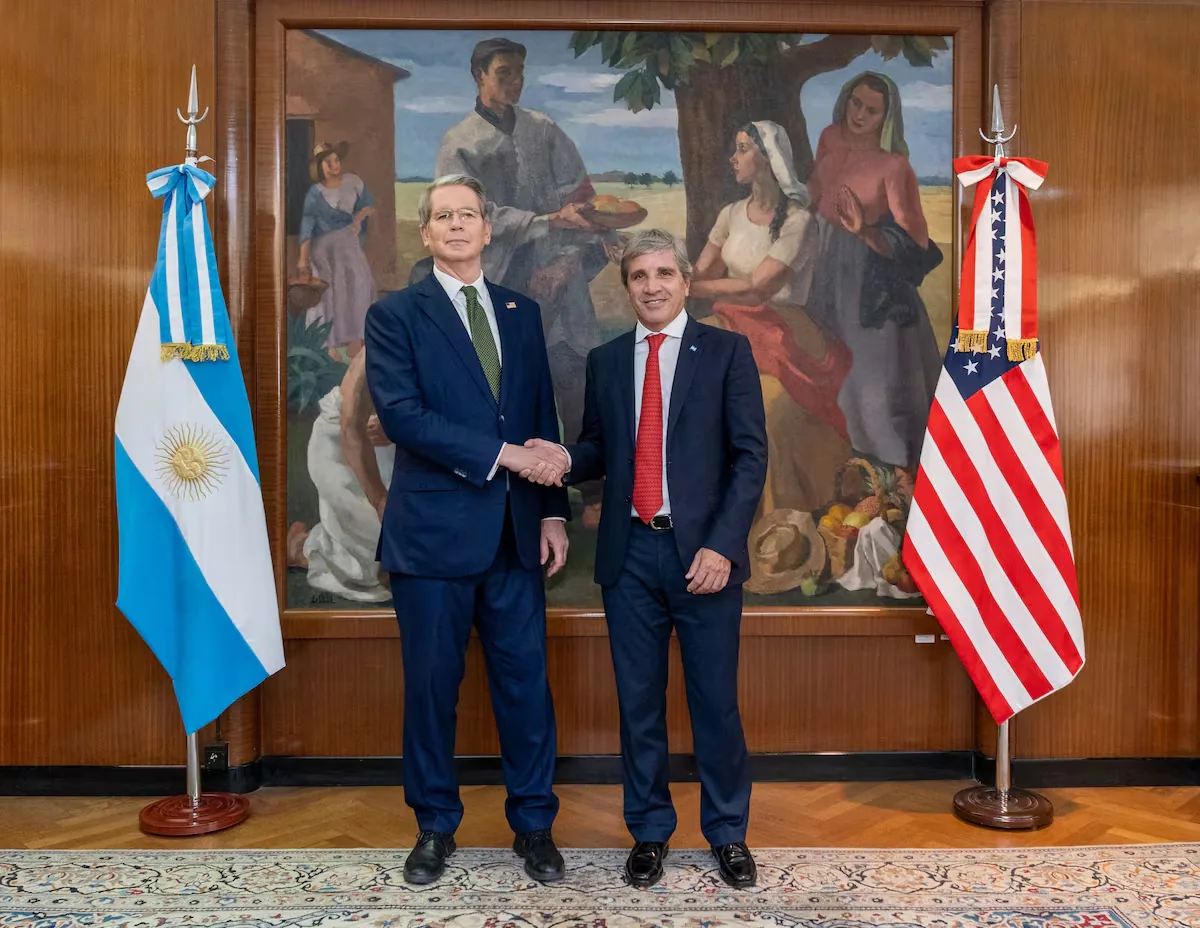
The Minister of Economy, Luis Caputo, participated this week in the G20 finance ministers and central bank governors meeting in Asheville, North Carolina, where he held two key meetings. On Monday, he met with Kristalina Georgieva, Managing Director of the IMF, and on Tuesday with Scott Bessent, U.S. Treasury Secretary and central coordinator of Washington’s support for the Argentine government during the 2025 currency crisis.
Bessent not only received him privately at the Omni Grove Park Inn hotel but publicly showed his support for a model that faces rejection within the South American country. “We have a historic opportunity in the Western Hemisphere led by Argentina and the reforms they implemented there,” he said in a conversation with conservative presenter and analyst Larry Kudlow, former director of the U.S. National Economic Council. “Everyone said it couldn’t be done, and now we are seeing inflation go down and a change in economic conditions,” he added.
NEIGHBORHOOD PHENOMENON.
BAD DAY FOR THE MICROPHONE CORRUPTS. DATA HITMEN. https://t.co/gqAtewYivq— Javier Milei (@JMilei) September 1, 2026
The details of these ties are central to the market which, in the words of former Argentine Economy Minister Martín Guzmán, perceives the “significant dependence” that the Argentine economy has on the northern country. “The U.S. government’s commitment was very clear with the measures it took last year, and now the market is watching whether that commitment can be sustained over time, depending on the evolution of the political situation,” points out Guzmán, who currently serves as a professor at Columbia University. In that sense, what happens on November 3 with the U.S. midterm elections will be decisive for its financial maneuvering capacity, beyond the political affinity Donald Trump may have with Milei.
“Today Argentina needs to guarantee Bessent’s presence as the last-resort rescuer ahead of the 2027 election,” summarizes economist Emmanuel Alvarez Agis, founding partner of PxQ Consultora and former Deputy Minister of Economy of the Nation between 2013 and 2015. If election years are more turbulent in any country in the world, in Argentina — like so many other things — that turbulence can become extreme. Both investors and small savers seek to protect themselves with safe assets; they shed pesos and migrate to the dollar, which raises its exchange rate. If the Central Bank is not able to maintain exchange rate stability with its market intervention, the effects are quickly seen in rising inflation and the loss of purchasing power of the population. Something that, if it happens, would not only expose the failures of Milei’s economic scheme but would also complicate his project of being re-elected president for another four years.
Read more Those interested in buying the controversial penthouse of the Community of Madrid cannot visit it
In recent weeks, these protective movements have begun to accelerate. The demand for dollars by Argentines reached its highest level since the 2025 elections in July, with purchases of nearly $3.15 billion during that month, 52% more than in June and the highest monthly record since October last year, amid electoral tension. It is a figure that, for example, exceeds Argentina’s trade surplus and more than doubles crude oil exports, one of the country’s main sources of foreign currency.
To anticipate this scenario, the government’s economic team has changed its strategy this year and purchased around $14 billion in reserves throughout 2026, an unprecedented amount and more than the annual target set by the IMF, of $10 billion. That is why analysts like Gabriel Caamaño, director of the consulting firm Outlier, consider that the Argentine economy is in a stronger position than in 2025 to withstand shocks. “Today Argentina is less dependent on external aid, but the weight of the United States can still be decisive, as it was last year,” he nuances.
For Guido Zack, director of Economics at the NGO Fundar, if the demand for dollars continues to deepen toward the elections, scheduled for October 2027, there is a possibility that all the safeguards taken by the Central Bank will be insufficient. He considers that the margins for support from the IMF are already exhausted — Argentina is by far the organization’s largest debtor — but he does believe that the U.S. Treasury could intervene again directly or by activating the swap already signed between the monetary authorities of the two countries. “The mechanism to eventually implement a bailout by the United States is already in place. Whether it is used or not depends as much on Argentina as on whether the United States is willing to do so. One could say that next year’s elections in Argentina start to be played out in this year’s U.S. elections,” he warns.
Aware of this situation, the Argentine government activates alternatives such as the swap with China — which was renewed for five years earlier this month — and the possibility of expanding the Central Bank’s external financing tools, something included in the reform of the entity’s Organic Charter sent by the ruling party to Congress.
Minister Caputo, who defended the libertarian government’s results before his counterparts from other countries at the G20 meeting, anticipates that the elections will not bring turbulence and that it will even be an opportunity to demonstrate the model’s strength. “It will be an absolutely atypical election year because the economy will, for the first time, take politics along with it,” he has assured in past interventions. In any case, he works hard to keep relations with his allies smooth.
Read more Leagues Cup 2026 semifinals: dates, times, venues, and where to watch the matches